The artist known as Banksy is arguably the most famous anonymous man in the world. Not knowing who he is – is akin to believing in Santa Claus. The appeal is not knowing for sure – or at least making ourselves believe that we don’t know for sure.
That’s why the recent “exhaustive investigation” by the Reuters news agency pissed off so many people. [Ed: Read the room, Reuters.] More on that below.
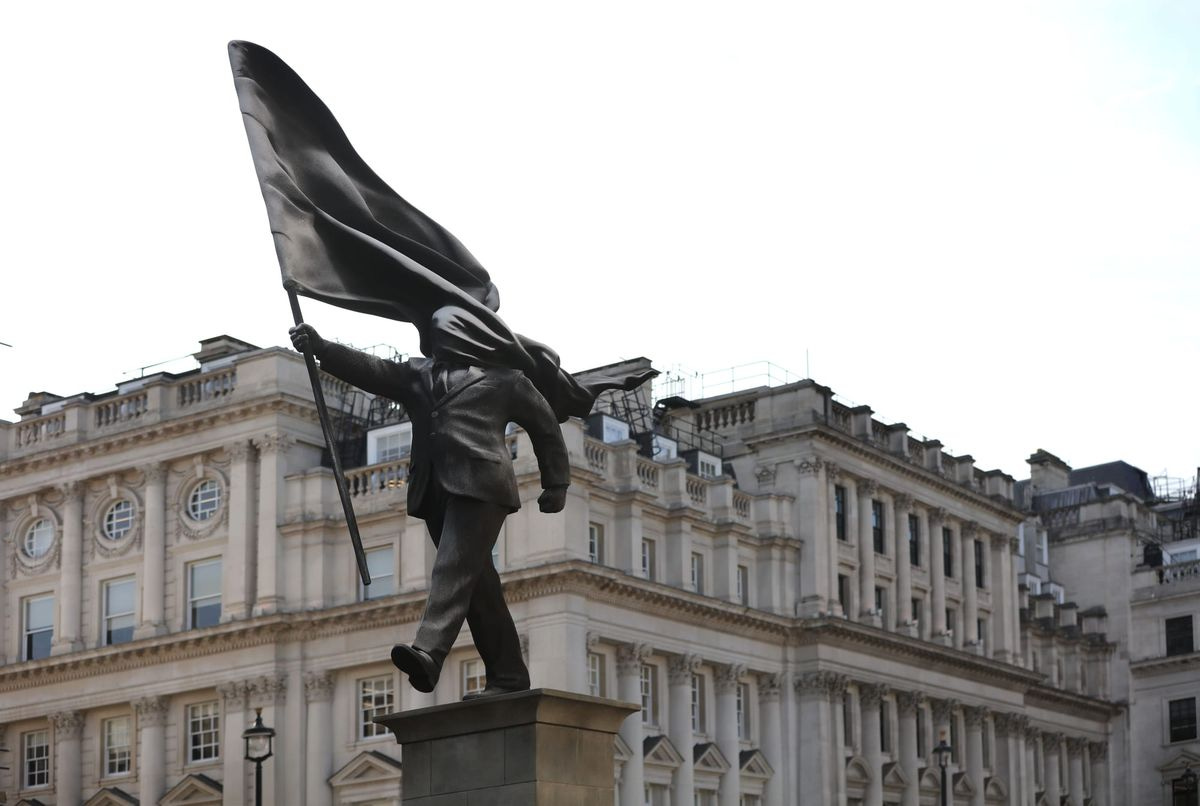
Banksy emerged from the underground graffiti scene of Bristol in the 1990s, developing a style that fused quick-execution stencilling with sharp political commentary. His early work, often created illegally under cover of darkness – the latest sculpture is a great example of that – drew on influences such as French stencil pioneer Blek le Rat, but rapidly evolved into something more immediate and culturally resonant. By using stencils, Banksy could work quickly, reducing the risk of arrest while maintaining a distinctive visual clarity.
Banksy’s art is defined by its accessibility and subversive wit. His images – rats, policemen, children, soldiers – are often paired with ironic or disarming juxtapositions that critique authority, capitalism, war and social inequality.
Over time, his work has appeared across the globe, from London and New York to conflict zones such as Ukraine and the West Bank, reinforcing his role as both artist and political commentator.


What transformed Banksy from street artist into global phenomenon was not just the imagery, but the mythology. His anonymity – carefully maintained for decades – became inseparable from the work itself, fuelling intrigue and media fascination.
A recent and exhaustive investigation by Reuters argues that this anonymity is not incidental but central to the “Banksy” brand, enhancing both cultural impact and market value. The same investigation marshalled extensive evidence – travel records, company filings, police reports, eyewitness accounts – to support the long-held belief that Banksy is Robin Gunningham, an artist from Bristol, born in 1973, who may now operate under another name, having initially changed his name to the intentionally very common “David Jones”.
Reuters also revealed the scale and complexity of Banksy’s commercial ecosystem. Despite his anti-establishment stance, his works have generated hundreds of millions of dollars in secondary-market sales, supported by a tightly controlled authentication system run through his organisation, Pest Control. This paradox – anti-capitalist art thriving within elite markets – has become a defining tension of his career.


Banksy has repeatedly turned this contradiction into part of the artwork itself. The most famous example is Girl with Balloon, which self-destructed via a hidden shredder immediately after being sold at auction in 2018 for US$1.4m, transforming into a new work, Love Is in the Bin, that subsequently resold for US$25m. Such acts blur the boundaries between creation, performance and critique – reinforcing his reputation as both prankster and provocateur.


Beyond spectacle, Banksy’s influence extends into philanthropy and activism. He has funded refugee rescue missions, donated artworks to raise money for hospitals and used his platform to draw attention to humanitarian crises.
Ultimately, Banksy is less a single artist than a cultural phenomenon: a figure whose anonymity amplifies his message, whose work bridges street and gallery, and whose very existence challenges the structures within which art operates.
Postscript
As alluded to above, some critics have questioned whether or not the Reuters [Ed: party poopers] exposé and claimed unmasking serves or benefits the public, comparing the cultural value of preserving Banksy’s mystique to that associated with the traditional belief in Santa Claus.
Videos
REMORANDOM Subscription
Banksy, along with 89 other topics, will feature in REMORANDOM 7, coming in October 2026. Meanwhile, new subscribers will also receive REMORANDOM 6. Are you subscribed to the printed book series? If not you can do so HERE on the REMO website, or by upgrading your FREE Substack subscription to PAID.

See also: BUGA UP