


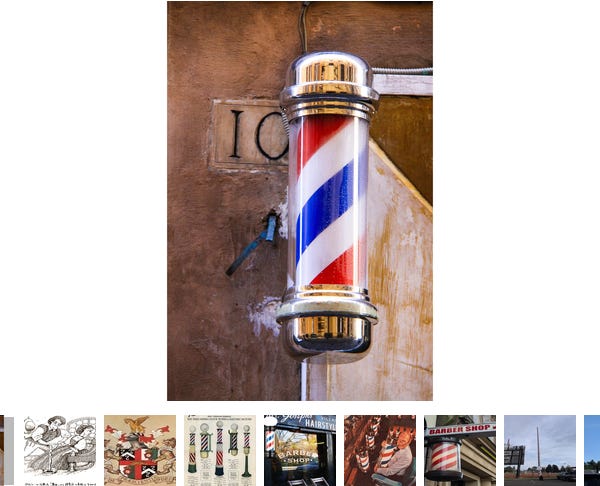
Barbering is one of the world’s oldest professions, with evidence of barbers and their trade dating back thousands of years to ancient civilisations: Egyptians, Greeks and Romans.
In these early societies, barbers not only cut hair, but also performed various other medical procedures. They were all good with a blade, and considered to be skilled practitioners; so they would often get to perform surgeries such as leeching, bloodletting, tooth extractions and even amputations. [Ed: Don’t get any ideas Frankie. See below.]
In medieval Europe, the practice of barbering was even more closely tied to medicine and surgery. The most common health remedy provided by (so-called) “barber surgeons” at the time was bloodletting. During this common (and now known to be somewhat pointless) procedure, barber surgeons would have patients squeeze a pole, which served both to expose veins for cutting and increase the blood flow once they were cut. The bowl at the top of the pole would contain leeches, and the bowl at the base would collect the blood.
To advertise this service barber surgeons began to hang the blood-soaked bandages and the bloodstained pole outside their establishments, and this practice would ultimately morph into the development of the symbolic red-and-white barber pole: red representing the blood and white for the bandages.
In 1540, barbers, who had organised themselves as the Worshipful Company of Barbers (with a nice coat of arms, it has to be said), joined together with the Fellowship of Surgeons to form what would be called the Company of Barbers and Surgeons. The Company of Barbers and Surgeons decided to give each trade a distinct pole with which to advertise their services. Barbers would henceforth be represented by a white pole with blue stripes.
Surgeons would be marked by a white pole with red stripes. This setup lasted until 1745 when the surgeons broke away from the barbers to form the Royal College of Surgeons and abandoned the pole identification system altogether.
In the years that followed, barbers would eventually combine the blue and red stripes into the modern barber pole that we most commonly see today. [Ed: Red and white with no blue involved is medieval old school we suppose.]
The pole may be stationary or may rotate, often with the aid of an electric motor.
The William Marvy Company of Saint Paul, Minnesota is now the sole manufacturer of barber poles in North America, selling only 500 per year (compared to 5,100 in the 1960s). Marvy’s poles have been shipped to barbers throughout the world. Even The White House barber shop boasts a Marvy pole.
The rustproof version developed by the founder in 1950, which Marvy called “Six Ways Better”, is made of stainless steel, aluminium and glass.
Finally, and in case you were wondering, the world’s tallest barber pole is 22m (72ft) high and sits in what looks like a car park in Forest Grove, Oregon.
Story Idea: Frankie Nasso (Remo’s barber in North Bondi)
Barber Pole was discussed in Episode 1 of the REMORANDOM video podcast