The Turing test was introduced in 1950 by British mathematician and computer science pioneer Alan Turing in his landmark paper “Computing Machinery and Intelligence”. Rather than asking “Can machines think?”, Turing proposed a more practical question: “Can a machine imitate a human well enough to be indistinguishable in conversation?”
CAPTCHA, short for “Completely Automated Public Turing test to tell Computers and Humans Apart”, began in the late 1990s as a solution to a growing problem: bots exploiting online services. Early implementations, like those used by the AltaVista search engine, relied on distorted text images to block automated URL submissions. The term CAPTCHA itself was coined in 2000 by researchers at Carnegie Mellon University – Luis von Ahn, Manuel Blum, Nicholas Hopper and John Langford – who developed a system that could distinguish humans from machines by exploiting tasks humans found easy but computers found difficult.


The earliest CAPTCHAs used warped letters and numbers, which humans could decipher but basic algorithms could not. As bots evolved, so did CAPTCHA. Image-based systems asked users to identify pictures of objects like traffic lights or buses, while audio CAPTCHAs provided alternatives for visually impaired users. In 2007, von Ahn (who, as it happens, was also the subsequent co-founder of language-learning company Duolingo) introduced reCAPTCHA, a novel version that not only kept bots at bay, but also harnessed human effort to digitise old books and newspapers. Google acquired reCAPTCHA in 2009.


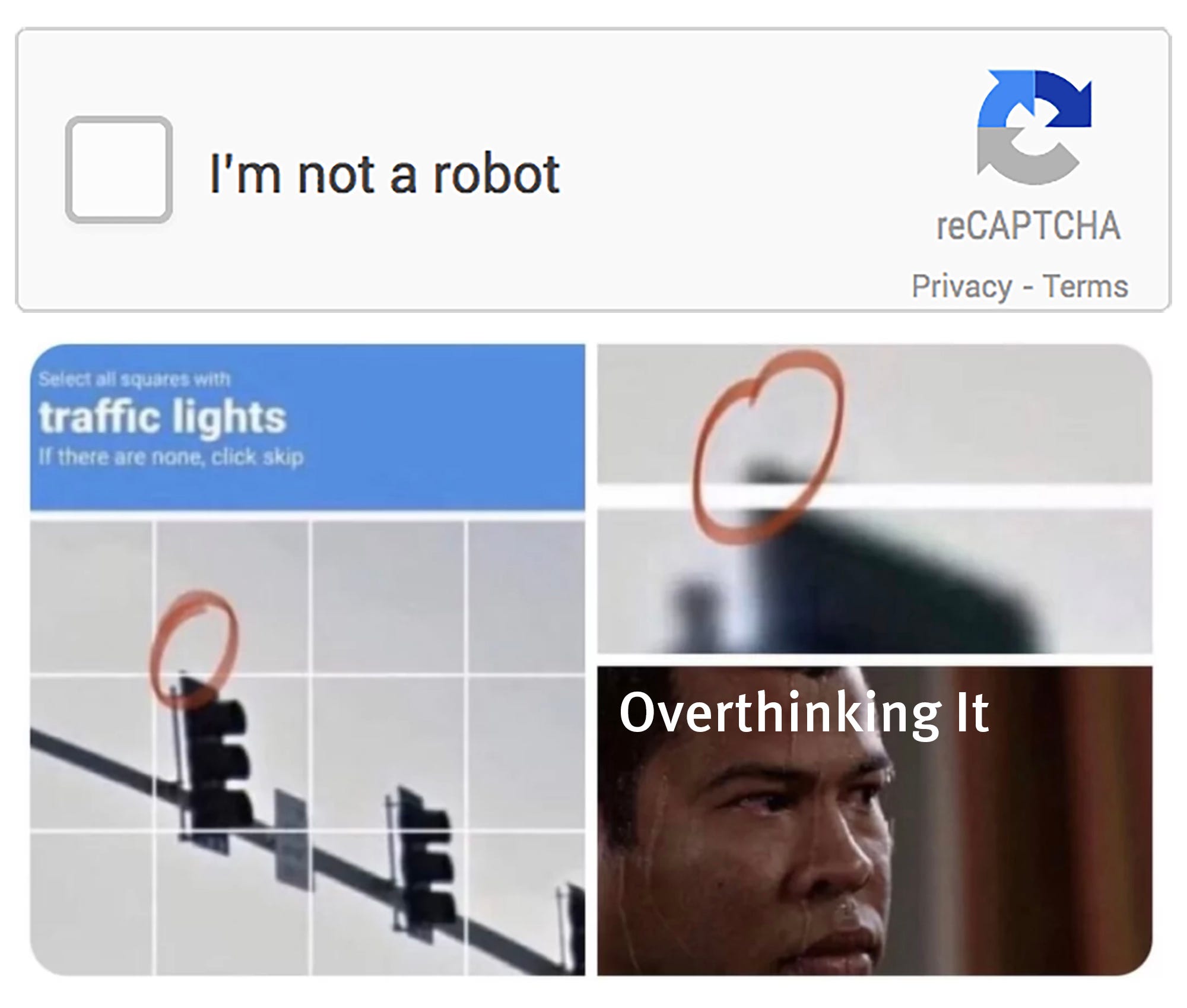
As artificial intelligence advanced, so too did CAPTCHA systems. In 2014, reCAPTCHA v2 introduced the familiar “I’m not a robot” checkbox, often verifying users without any challenge at all, relying on subtle behavioural cues like cursor movement. CAPTCHA’s growing complexity reflects a deeper cultural and technological shift. What began as a simple barrier to bots has become a key frontline defence against a vast ecosystem of automated abuse: fake accounts, spam, ticket scalping and credential stuffing – to name a few. At the same time, CAPTCHA has become a source of public frustration – tedious, time-consuming and sometimes inaccessible. For users with disabilities, especially visual or motor impairments, many CAPTCHA systems remain a significant barrier.
Culturally, CAPTCHA has become a symbol of our uneasy coexistence with machines – a moment when the digital world asks us to prove our humanity. It has inspired memes, artworks, and even academic discussions about identity and surveillance.


New technologies are replacing traditional CAPTCHAs with more seamless and intelligent systems that assess user authenticity without interrupting the experience. These include invisible CAPTCHAs like reCAPTCHA v3, which analyse behaviour in the background; behavioural biometrics that track how users move, scroll or type; and device fingerprinting, which uses unique device configurations to detect bots. Biometric logins (like Face ID or fingerprint) and passkeys are gaining ground as secure, user-friendly alternatives, while tools like Cloudflare Turnstile and Google’s Trust Tokens aim to verify humanity without invasive data tracking. These shifts reflect a broader trend toward passive, privacy-aware verification that balances security with user convenience.
Story Idea: Melanie Giuffré
PS: If you’re a CAPTCHA fan, you might enjoy playing the I’m Not a Robot online game at Neal.fun. Do that HERE.
Video
REMORANDOM Book Chapter