


The reason why cars (and indeed people) in most countries keep to the right, but in some countries keep to the left, relates to the passage of horses and horse-drawn carriages, and a general desire to have a rider’s greeting/sword-carrying hand (right for a horse rider, but left for a carriage driver using his/her right hand to control the team) near the centre of the road. But this could vary by custom and country, and different places had different norms.
It’s a country’s prerogative to change its mind. A case in point is “Dagen H”.
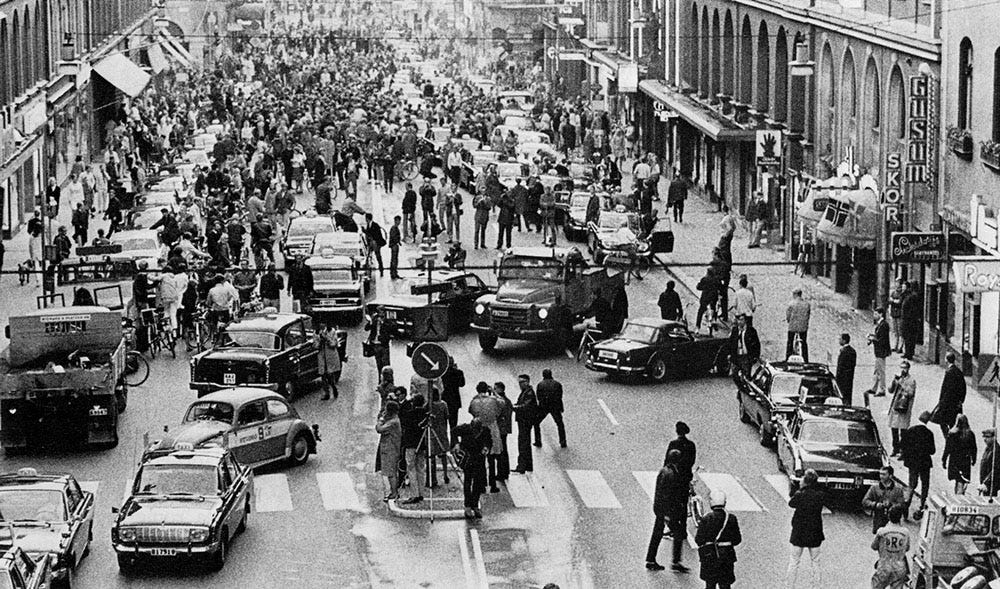
Dagen H (H Day) happened on 3 September 1967, the day that Sweden switched from driving on the left hand side of the road to the right. The “H” stands for Högertrafik, the Swedish word for right hand traffic. It was by far the largest logistical event in Sweden’s history, and the most massive overhaul in driving infrastructure that the world had ever seen.


So, why the change?
Well, all of Sweden’s neighbouring countries were driving on the right. So when Swedes visited those places, lots of them were having accidents; and when the residents of those countries visited Sweden, they were also having accidents.
The change was unpopular. In a 1955 referendum, 83 percent voted to keep driving on the left. Nevertheless, the Swedish Parliament decided to go ahead, and approved Prime Minister Tage Erlander’s proposal on 10 May 1963 for right hand traffic to begin in 1967.
A four-year education programme ensued. The campaign included the display of a cool and very literal Dagen H logo on various commemorative items, including milk cartons and underwear! (Naturally, you can order the design from REMO HERE.)


And, typically for Sweden, pop music came to the rescue. Swedish television held a contest for songs about the change, and the winning entry was “Håll dig till höger, Svensson” (“Keep to the right, Svensson”) written by Expressen journalist Peter Himmelstrand and performed by The Telstars. The song involved a nice dash of double entendre. In Swedish, “keeping to the right” is shorthand for staying faithful to your spouse, while “going left” means having an affair.
Everything had to happen within a single day, and there was much to do in preparation. Workers hit the streets early in the morning on Dagen H to make the changes. Throughout Sweden approximately 350,000 signs had to be removed or replaced, including some 20,000 in Stockholm alone.
On Dagen H, Sunday 3 September 1967, all vehicles had to come to a complete stop at 4:50 am, then carefully change to the right-hand side of the road and stop again before being allowed to proceed at 5:00 am.
Remarkably, H Day went very smoothly, thanks in part to drivers displaying excessive caution in the face of what was presumably a terrifying shift. The changeover saw a temporary reduction in the number of accidents, but these initial improvements did not last. The number of motor insurance claims returned to “normal” over the next six weeks and, by 1969, the accident rates were back to the levels seen before the change. Damn!
Story Idea: Michiel van der Hoeven
Hard to believe it actually worked, but then the Swedes know how to make shit happen :)
herregud! det var som fan! puss och kram fån laurie