


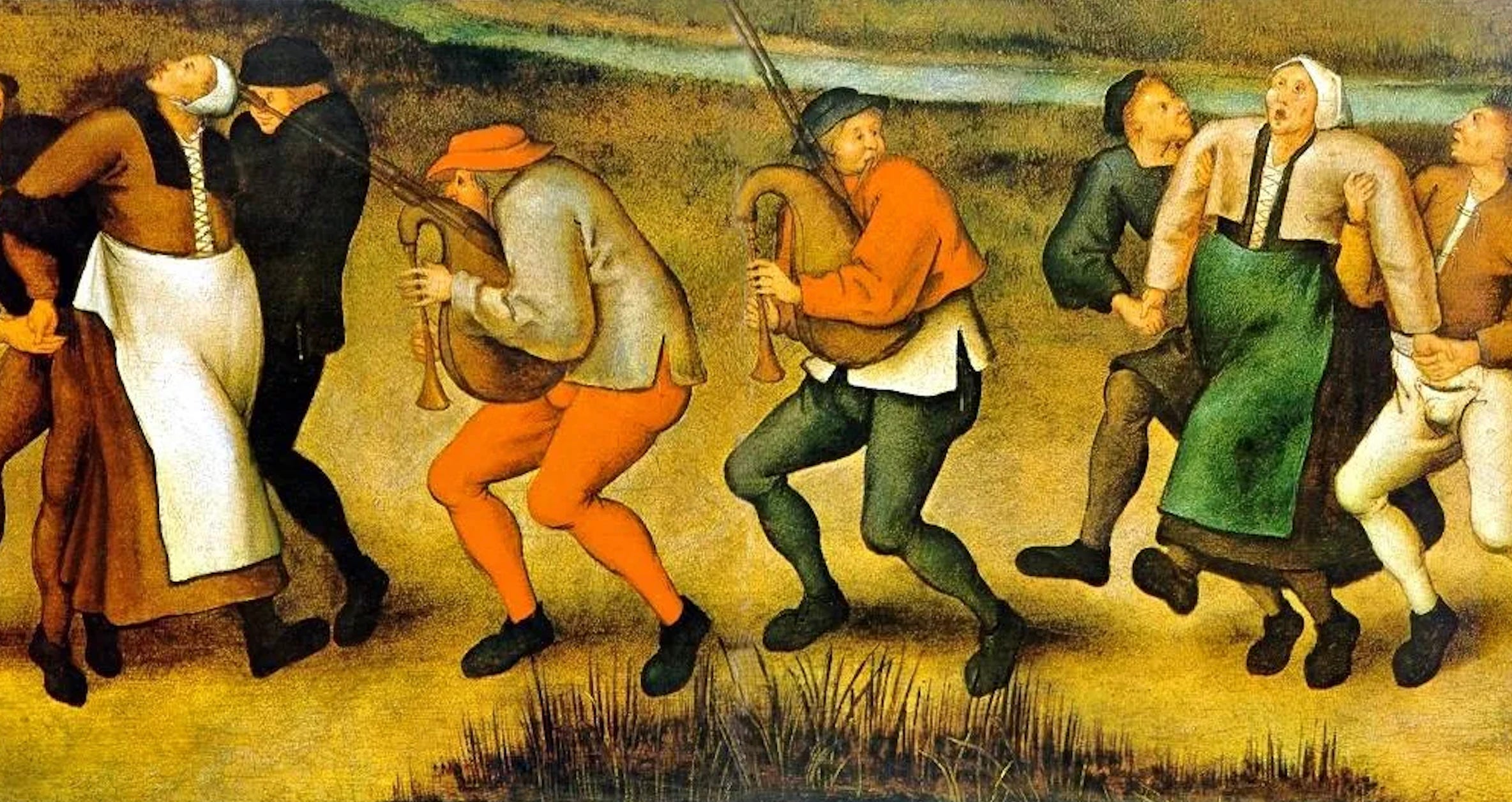
Dancing mania, also known as choreomania, St Vitus’ Dance or St John’s Dance, was a social phenomenon that occurred primarily in Europe from as early as the 7th century but mostly between the 14th and 17th centuries. It involved groups of people dancing erratically, sometimes thousands at a time, for hours, days or even weeks.
The most notable outbreaks happened in the years 1374 (Aachen, Germany) and 1518 (Strasbourg, France). Similar events were reported in other parts of Europe.
Men, women and children participated in these frenzied dance sessions. The dancers often seemed to be in a trance-like state, unable to stop dancing until they collapsed from exhaustion or, in some cases, died.


Participants would experience a sudden urge to dance uncontrollably. Other symptoms included hallucinations, hyperactivity and, sometimes, speaking in tongues. Many of the dancers would scream, laugh or cry during their episodes. The continuous dancing led to physical injuries, dehydration and, as already mentioned, even death.
For whatever reason, participants were reported to demonstrate extremely adverse reactions to both the colour red and (wait for it) pointed shoes. Curiouser and curiouser.
WTAF – we hear you cry. So, what was the cause?
Numerous hypotheses have been proposed for the causes of dancing mania, and it remains unclear whether it was a real illness or a social phenomenon.
One theory suggests that the mania was caused by ergot poisoning, a condition resulting from consuming rye bread contaminated with ergot fungus. Ergot contains chemicals similar to LSD, which can induce hallucinations and convulsions. However, the ergot fungus was not always present in the places where the dancing mania occurred.
Instead, most agree that dancing mania was one of the earliest-recorded forms of mass hysteria, and it has been suggested that the outbreaks may have been due to cultural contagion triggered, in times of particular hardship, by deeply rooted popular beliefs in the region regarding angry spirits capable of inflicting a “dancing curse” to punish their victims.
Thankfully, the phenomenon gradually disappeared by the 17th century, likely due to changes in social conditions and improved understanding of diseases and psychological disorders. Phew!
Story Idea: Melanie Giuffré
REMORANDOM Chapter

Mushroom season.