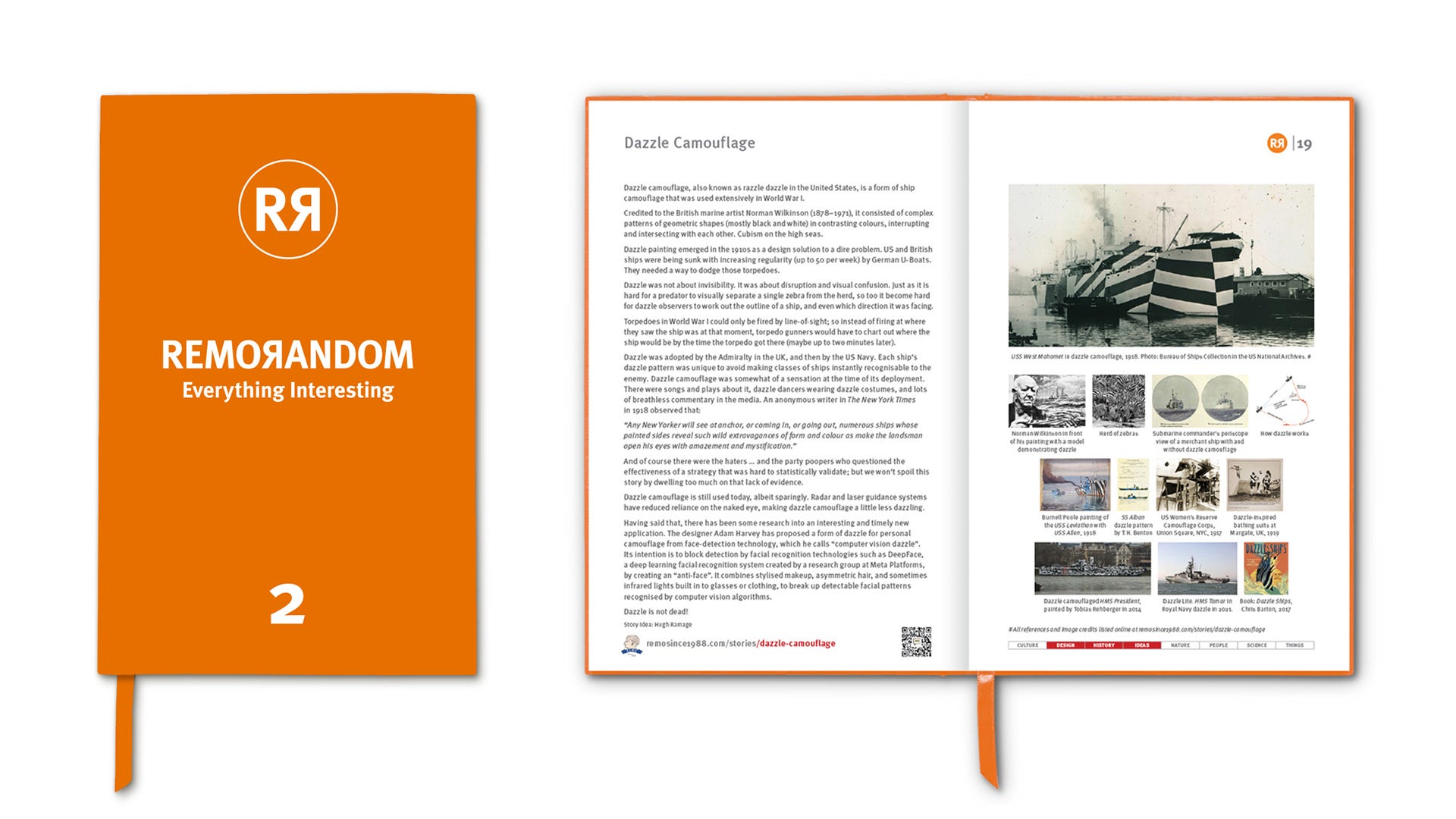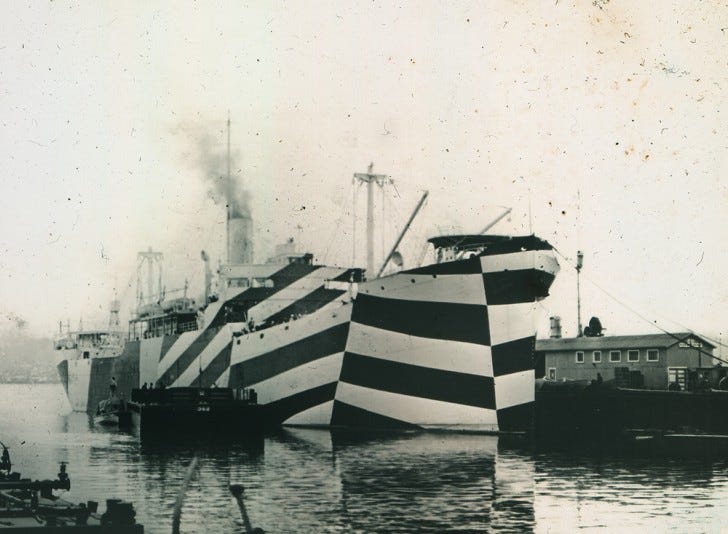
Dazzle camouflage, also known as razzle dazzle in the United States, is a form of ship camouflage that was used extensively in World War I.
Credited to the British marine artist Norman Wilkinson (1878–1971), it consisted of complex patterns of geometric shapes (mostly black and white) in contrasting colours, interrupting and intersecting with each other. Cubism on the high seas.
Dazzle painting emerged in the 1910s as a design solution to a dire problem. US and British ships were being sunk with increasing regularity (up to 50 per week) by German U-Boats. They needed a way to dodge those torpedoes.


Dazzle was not about invisibility. It was about disruption and visual confusion. Just as it is hard for a predator to visually separate a single zebra from the herd, so too it become hard for dazzle observers to work out the outline of a ship, and even which direction it was facing.
Torpedoes in World War I could only be fired by line-of-sight; so instead of firing at where they saw the ship was at that moment, torpedo gunners would have to chart out where the ship would be by the time the torpedo got there (maybe up to two minutes later). [Ed: Wayne Gretsky vibes]
Dazzle was adopted by the Admiralty in the UK, and then by the US Navy. Each ship’s dazzle pattern was unique to avoid making classes of ships instantly recognisable to the enemy. Dazzle camouflage was somewhat of a sensation at the time of its deployment.


There were songs and plays about it, dazzle dancers wearing dazzle costumes, and lots of breathless commentary in the media. An anonymous writer in The New York Times in 1918 observed that:
“Any New Yorker will see at anchor, or coming in, or going out, numerous ships whose painted sides reveal such wild extravagances of form and colour as make the landsman open his eyes with amazement and mystification.”
And of course there were the haters … and the party poopers who questioned the effectiveness of a strategy that was hard to statistically validate; but we won’t spoil this story by dwelling too much on that lack of evidence.
Dazzle camouflage is still used today, albeit sparingly. Radar and laser guidance systems have reduced reliance on the naked eye, making dazzle camouflage a little less dazzling.
Having said that, there has been some research into an interesting and timely new application. The designer Adam Harvey has proposed a form of dazzle for personal camouflage from face-detection technology, which he calls “computer vision dazzle”. Its intention is to block detection by facial recognition technologies such as DeepFace, a deep learning facial recognition system created by a research group at Meta Platforms, by creating an “anti-face”. It combines stylised makeup, asymmetric hair, and sometimes infrared lights built in to glasses or clothing, to break up detectable facial patterns recognised by computer vision algorithms.
Dazzle is not dead!
Story Idea: Hugh Ramage