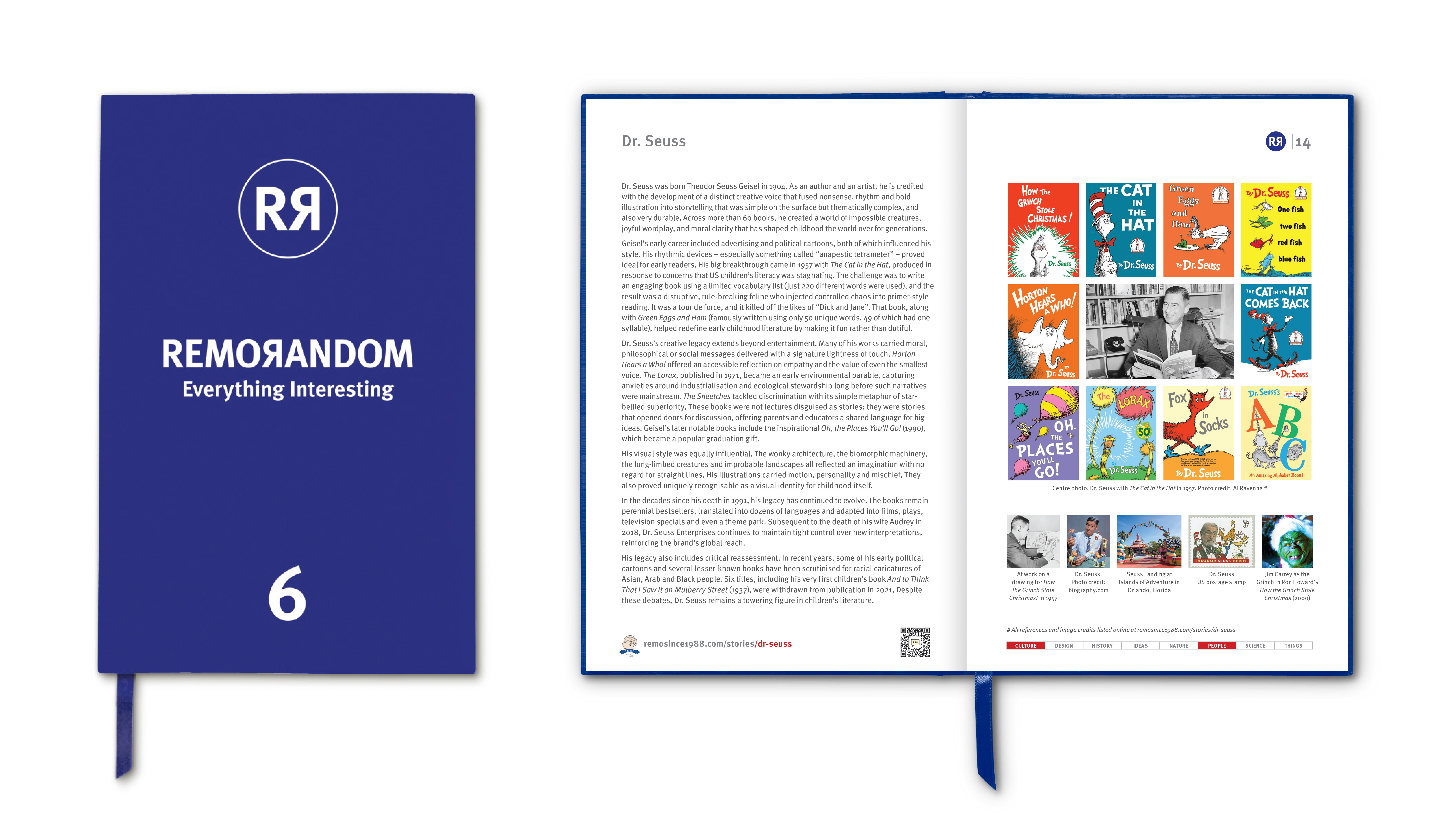
Dr. Seuss was born Theodor Seuss Geisel in 1904. As an author and an artist, he is credited with the development of a distinct creative voice that fused nonsense, rhythm and bold illustration into storytelling that was simple on the surface but thematically complex, and also very durable. Across more than 60 books, he created a world of impossible creatures, joyful wordplay and moral clarity that has shaped childhood the world over for generations.
Geisel’s early career included advertising and political cartoons, both of which influenced his style. His rhythmic devices – especially something called “anapestic tetrameter” – proved ideal for early readers.
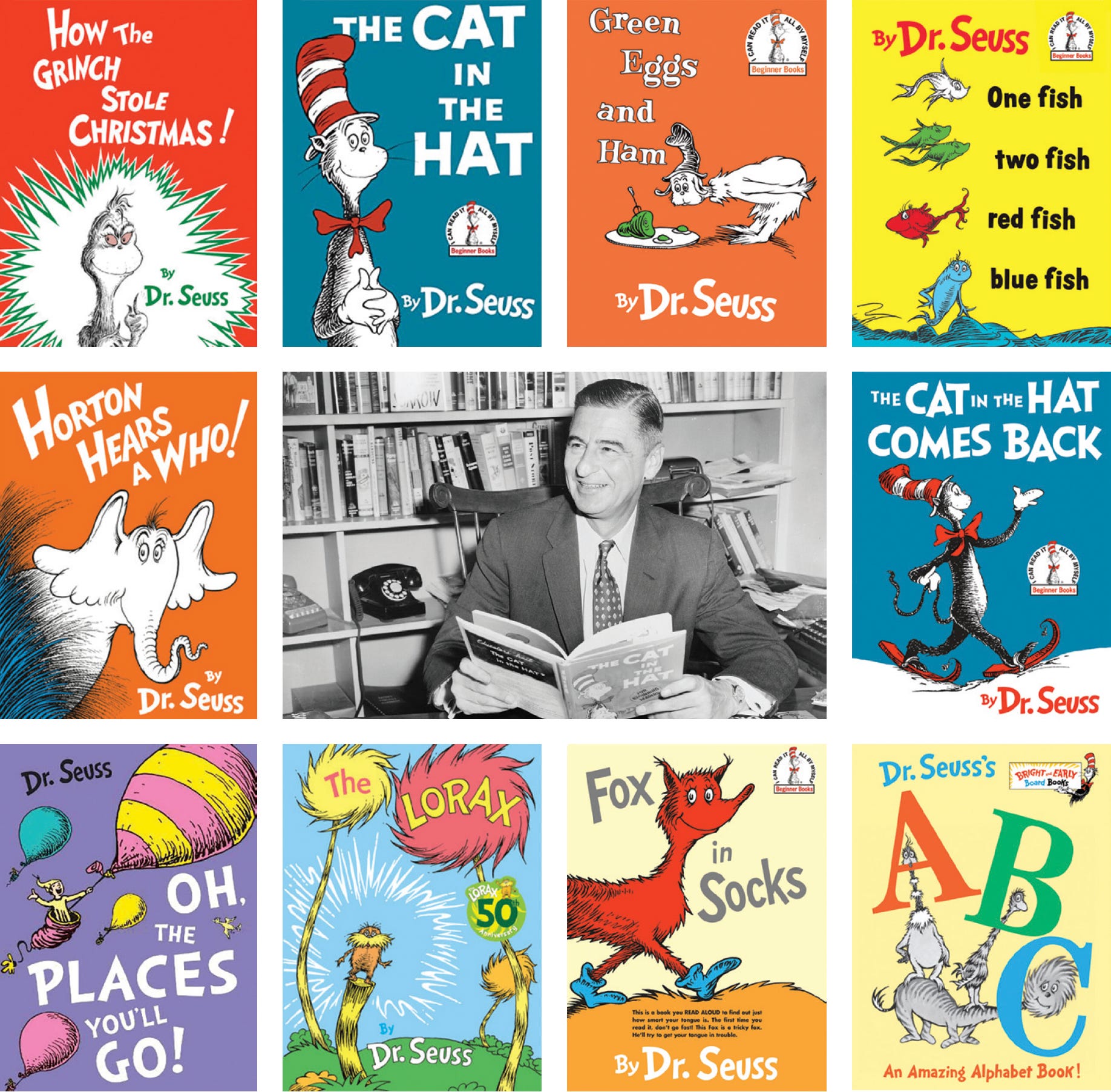
His big breakthrough came in 1957 with The Cat in the Hat, produced in response to concerns that US children’s literacy was stagnating. The challenge was to write an engaging book using a limited vocabulary list (just 220 different words were used), and the result was a disruptive, rule-breaking feline who injected controlled chaos into primer-style reading. It was a tour de force, and it killed off the likes of “Dick and Jane”. That book, along with Green Eggs and Ham (famously written using only 50 unique words, 49 of which had one syllable), helped redefine early childhood literature by making it fun rather than dutiful.


Dr. Seuss’s creative legacy extends beyond entertainment. Many of his works carried moral, philosophical or social messages delivered with a signature lightness of touch. Horton Hears a Who! offered an accessible reflection on empathy and the value of even the smallest voice. The Lorax, published in 1971, became an early environmental parable, capturing anxieties around industrialisation and ecological stewardship long before such narratives were mainstream. The Sneetches tackled discrimination with its simple metaphor of starbellied superiority.
These books were not lectures disguised as stories; they were stories that opened doors for discussion, offering parents and educators a shared language for big ideas. Geisel’s later notable books include the inspirational Oh, the Places You’ll Go! (1990), which became a popular graduation gift.
His visual style was equally influential. The wonky architecture, biomorphic machinery, long-limbed creatures and improbable landscapes all reflected an imagination with no regard for straight lines. His illustrations carried motion, personality and mischief. They also proved uniquely recognisable as a visual identity for childhood itself.


In the decades since his death in 1991, his legacy has continued to evolve. The books remain perennial bestsellers, translated into dozens of languages and adapted into films, plays, television specials and even a theme park. Subsequent to the death of his wife Audrey in 2018, Dr. Seuss Enterprises continues to maintain tight control over new interpretations, reinforcing the brand’s global reach.
His legacy also includes critical reassessment. In recent years, some of his early political cartoons and several lesser-known books have been scrutinised for racial caricatures of Asian, Arab and Black people. Six titles, including his very first children’s book And to Think That I Saw It on Mulberry Street (1937), were withdrawn from publication in 2021. Despite these debates, Dr. Seuss remains a towering figure in children’s literature.
REMORANDOM Chapter