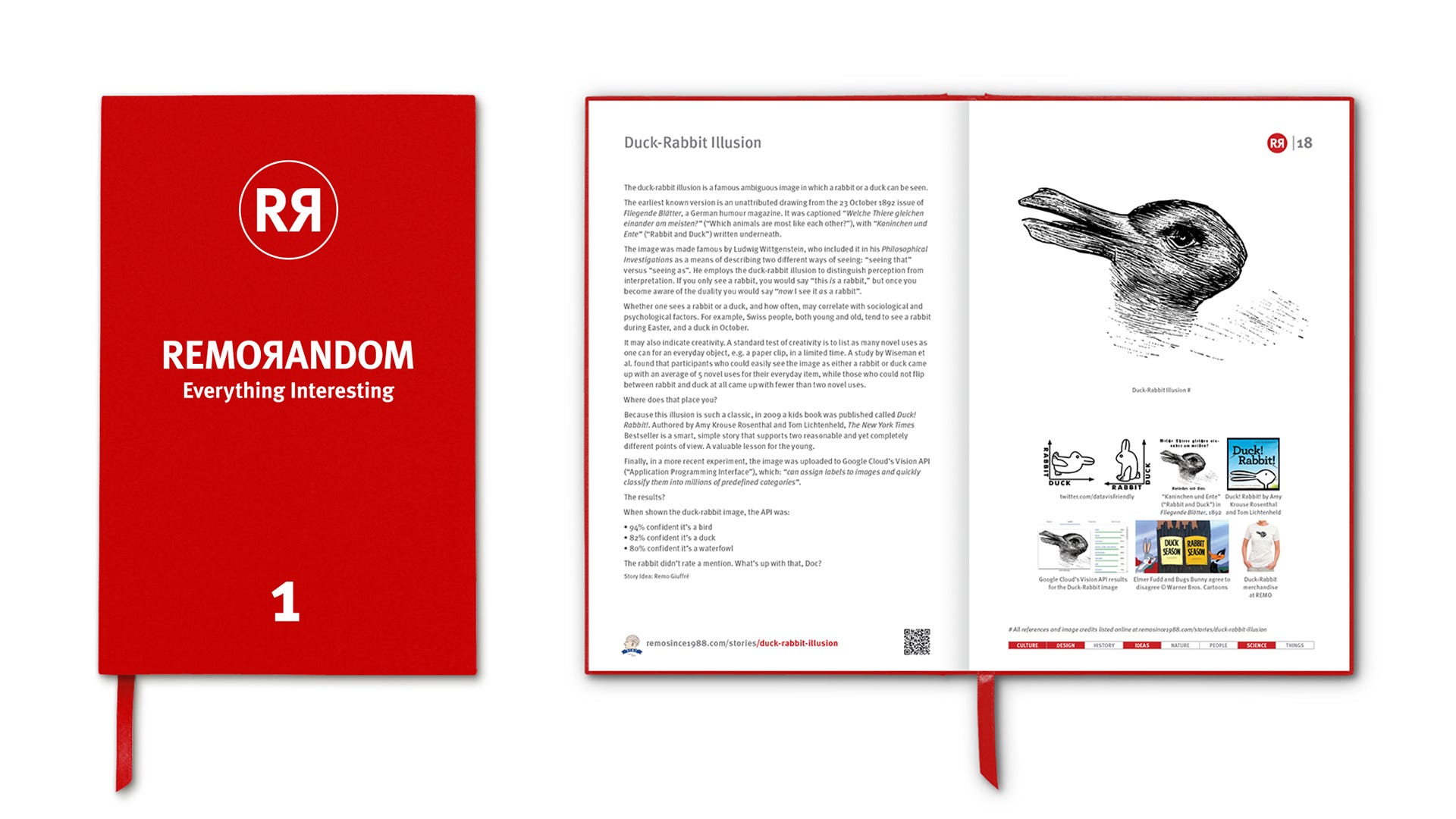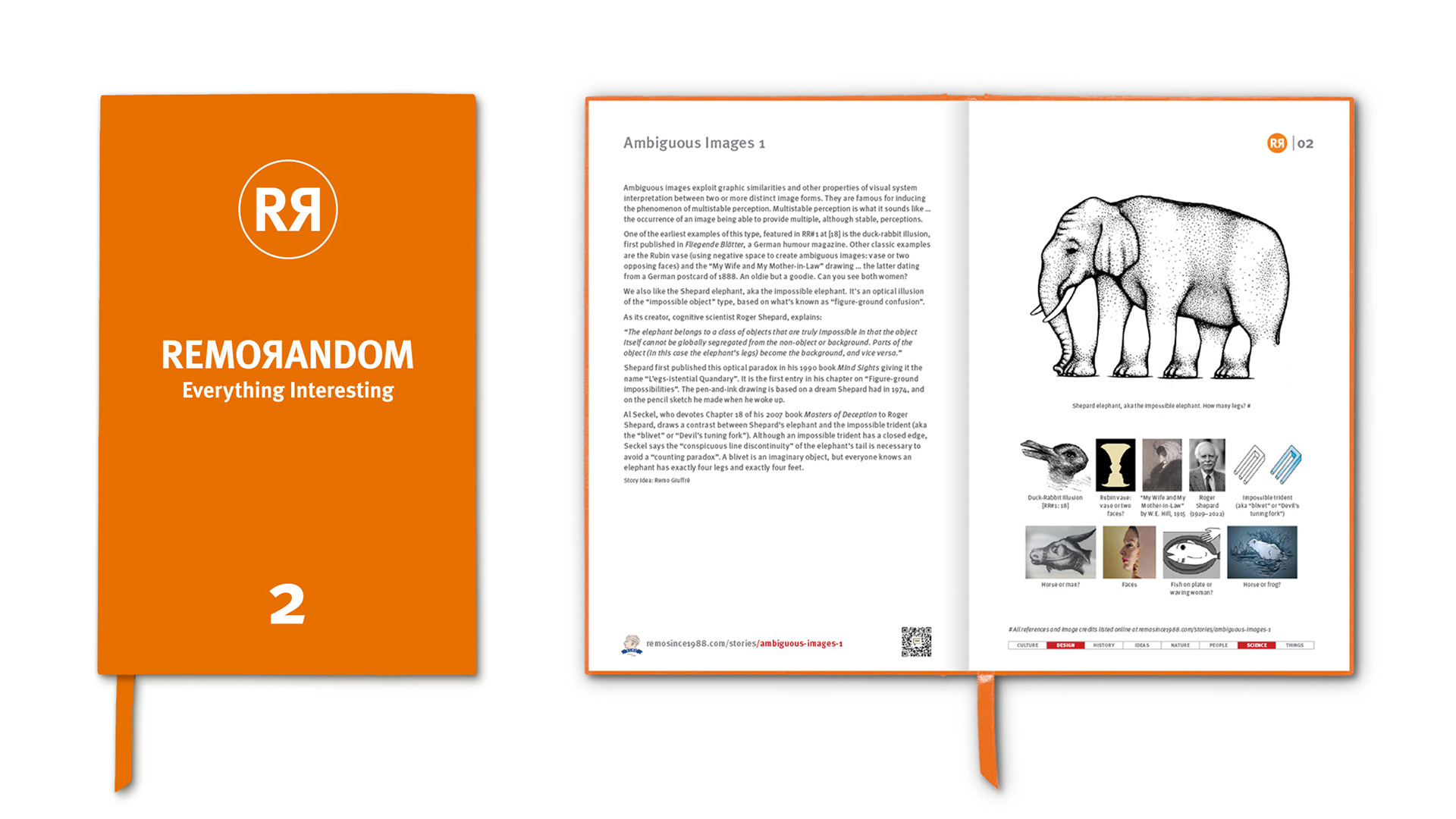
Ambiguous images exploit graphic similarities and other properties of visual system interpretation between two or more distinct image forms. They are famous for inducing the phenomenon of multistable perception. Multistable perception is what it sounds like – the occurrence of an image being able to provide multiple, although stable, perceptions.


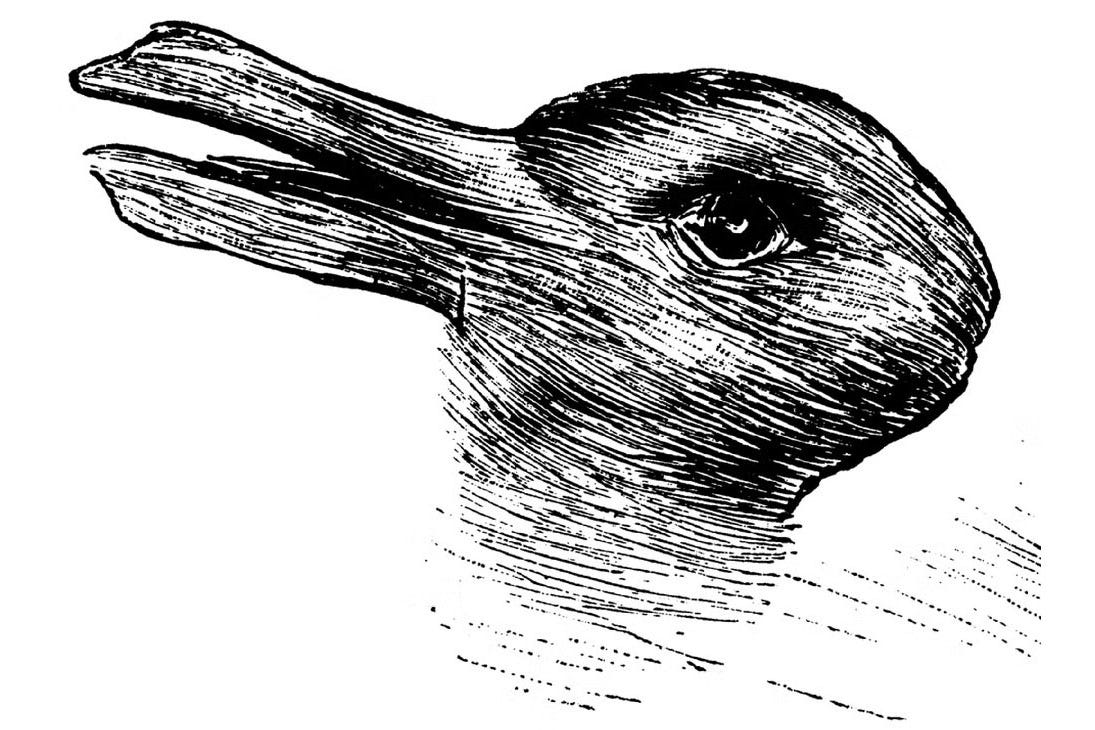
One of the earliest examples of this type is the duck-rabbit illusion, a famous ambiguous image in which a rabbit or a duck can be seen.
The earliest known version is an unattributed drawing from the 23 October 1892 issue of Fliegende Blätter, a German humour magazine. [Ed: Yes, that’s right: German humour. Insert racially stereotyping joke here.] It was captioned Welche Thiere gleichen einander am meisten? (“Which animals are most like each other?”), with Kaninchen und Ente (“Rabbit and Duck”) written underneath.


The image was made famous by Ludwig Wittgenstein, who included it in his Philosophical Investigations as a means of describing two different ways of seeing: “seeing that” versus “seeing as”. He employs the duck-rabbit illusion to distinguish perception from interpretation. If you only see a rabbit, you would say “this is a rabbit,” but once you become aware of the duality you would say “now I see it as a rabbit”.
Whether one sees a rabbit or a duck, and how often, may correlate with sociological and psychological factors. For example, Swiss people, both young and old, tend to see a rabbit during Easter, and a duck in October.
It may also indicate creativity. A standard test of creativity is to list as many novel uses as one can for an everyday object, e.g. a paper clip [RR3:59], in a limited time. A study by Wiseman et al. found that participants who could easily see the image as either a rabbit or duck came up with an average of 5 novel uses for their everyday item, while those who could not flip between rabbit and duck at all came up with fewer than two novel uses.
So, where does that place you?
Because this illusion is such a classic, in 2009 a kids book was published called Duck! Rabbit!. Authored by Amy Krouse Rosenthal and Tom Lichtenheld, The New York Times Bestseller is a smart, simple story that supports two reasonable and yet completely different points of view. A valuable lesson for the young.


Finally, in a more recent experiment, the image was uploaded to Google Cloud’s Vision API (“Application Programming Interface”), which: “can assign labels to images and quickly classify them into millions of predefined categories”.
The results?
When shown the duck-rabbit image, the API was:
94% confident it’s a bird
82% confident it’s a duck
80% confident it’s a waterfowl
The rabbit didn’t rate a mention. What’s up with that, Doc?
Postscript
Shout out to Hugh Ramage and Katerina Penko who for many years ran the duckrabbit gallery on Little Eveleigh Street in Redfern. Not only have both of them played key roles in the REMO story, my artist son Roman had a successful solo show at that gallery in November 2022, shortly before it closed.


REMORANDOM Book Chapters