



If you don’t know something, you also don’t have the ability to recognise that you don’t know it. Illusory superiority. Conversely, those with high ability often underestimate their competence.
The effect was first identified in a 1999 study by psychologists David Dunning and Justin Kruger. They found that people who performed poorly on various tests often rated their performance much higher than it actually was. Meanwhile, those who performed well were more accurate in their self-assessments, but often underestimated their relative competence compared to others.


The Dunning–Kruger effect highlights the importance of self-awareness and the role of feedback in helping individuals accurately assess their abilities. It also underscores the idea that confidence doesn’t always correlate with competence.
In popular culture, the Dunning–Kruger effect is often misunderstood as a claim about general overconfidence of people with low intelligence, instead of specific overconfidence of people unskilled at a particular task.
A notable example of the Dunning–Kruger effect was the Fyre Festival. That infamous event was touted to be the trendiest, celebrity-infused festival of 2017. The organiser recruited influencers, investors and ticket buyers for what turned out to be a catastrophic event that experienced problems with security, food, accommodation and medical services. The organiser believed he had the skills and knowledge to pull it off in a short time, resulting in people losing money, employees going unpaid, and an eventual prison sentence for fraud. Ouch.


Another high-profile example of the Dunning–Kruger effect was Theranos. Founded by Elizabeth Holmes, a college dropout with no business or medical experience, she sold investors on ideas that were based on flawed medical research. She hired executives with no experience to run the company, including her boyfriend, brother and others, and continued to grow the company. Because Holmes lacked the experience she claimed she had, the company later collapsed, with many of the executives fined or jailed.
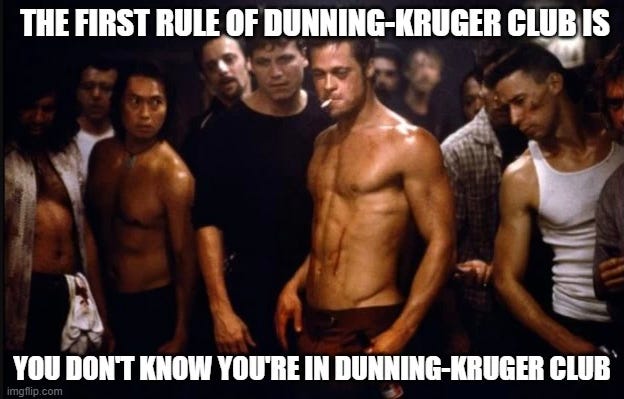
How to avoid the Dunning–Kruger effect? The short answer is to be self-aware. You must first accept it can affect anyone. We all have pockets of incompetence that we don’t recognise. We think we’re better drivers, or money managers, or chess players than we actually are. It does not mean you lack intelligence, but simply that you lack the expertise you believe you have.
Story Idea: Andrew Westcombe
Video
REMORANDOM Chapter

Alternatively, it may just be an effect of the data ...
https://www.mcgill.ca/oss/article/critical-thinking/dunning-kruger-effect-probably-not-real