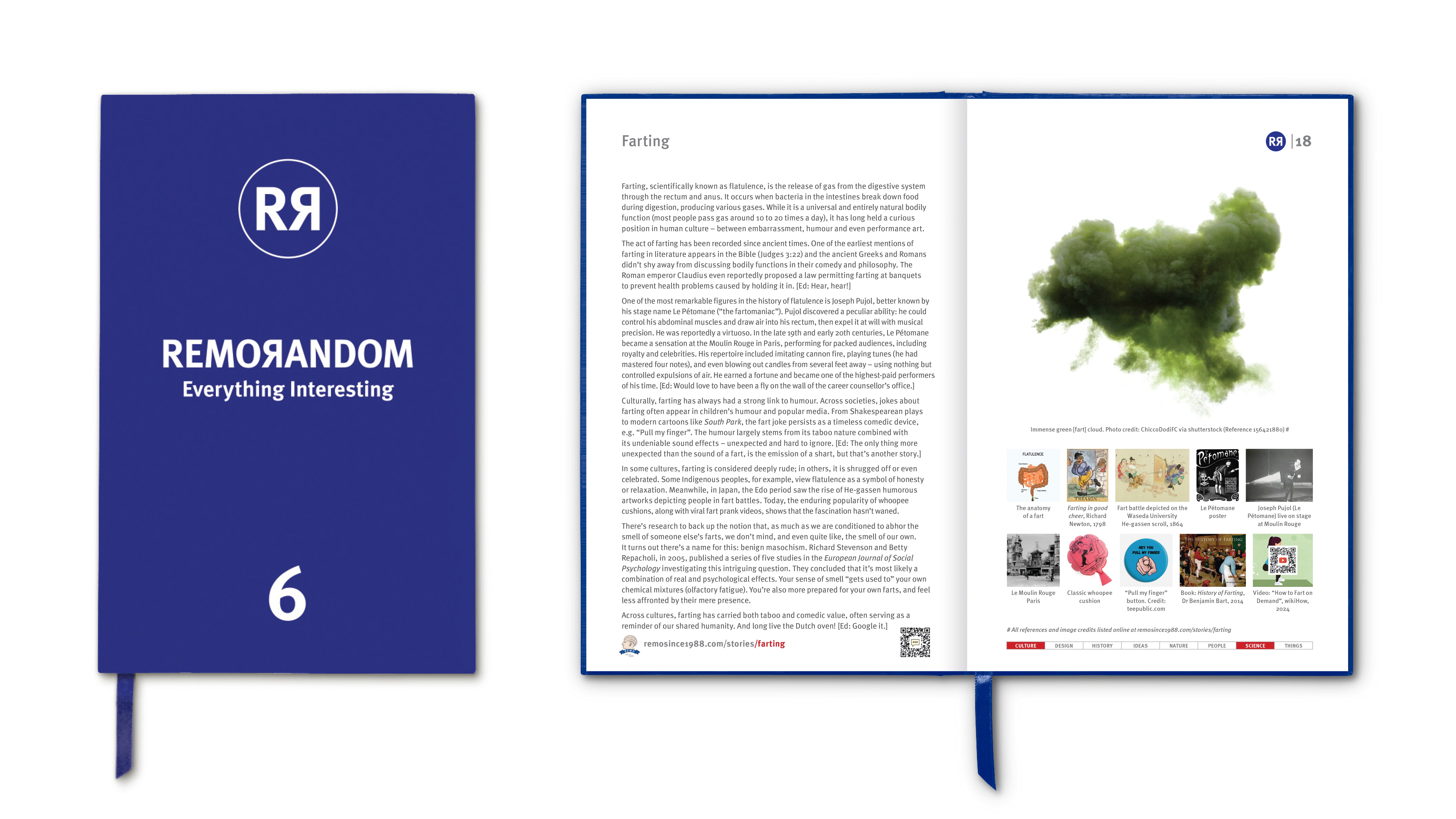
Farting, scientifically known as flatulence, is the release of gas from the digestive system through the rectum and anus. It occurs when bacteria in the intestines break down food during digestion, producing various gases. While it is a universal and entirely natural bodily function (most people pass gas around 10 to 20 times a day), it has long held a curious position in human culture – between embarrassment, humour and even performance art.


The act of farting has been recorded since ancient times. One of the earliest mentions of farting in literature appears in the Bible (Judges 3:22) and the ancient Greeks and Romans didn’t shy away from discussing bodily functions in their comedy and philosophy. The Roman emperor Claudius even reportedly proposed a law permitting farting at banquets to prevent health problems caused by holding it in. [Ed: Hear, hear!]


One of the most remarkable figures in the history of flatulence is Joseph Pujol, better known by his stage name Le Pétomane (“the fartomaniac”). Pujol discovered a peculiar ability: he could control his abdominal muscles and draw air into his rectum, then expel it at will with musical precision. He was reportedly a virtuoso. See for yourself below or HERE. In the late 19th and early 20th centuries, Le Pétomane became a sensation at the Moulin Rouge in Paris, performing for packed audiences, including royalty and celebrities. His repertoire included imitating cannon fire, playing tunes (he had mastered four notes), and even blowing out candles from several feet away – using nothing but controlled expulsions of air. He earned a fortune and became one of the highest-paid performers of his time. [Ed: Would love to have been a fly on the wall of the career counsellor’s office.]


Culturally, farting has always had a strong link to humour. Across societies, jokes about farting often appear in children’s humour and popular media. From Shakespearean plays to modern cartoons like South Park, the fart joke persists as a timeless comedic device, e.g. “Pull my finger”. The humour largely stems from its taboo nature combined with its undeniable sound effects – unexpected and hard to ignore. [Ed: The only thing more unexpected than the sound of a fart, is the emission of a shart, but that’s another story.]
In some cultures, farting is considered deeply rude; in others, it is shrugged off or even celebrated. Some Indigenous peoples, for example, view flatulence as a symbol of honesty or relaxation. Meanwhile, in Japan, the Edo period saw the rise of He-gassen humorous artworks depicting people in fart battles.
Today, the enduring popularity of whoopee cushions, along with viral fart prank videos, shows that the fascination hasn’t waned.


But wait – there’s more:
There’s research to back up the notion that, as much as we are conditioned to abhor the smell of someone else’s farts, we don’t mind, and even quite like, the smell of our own. It turns out there’s a name for this: benign masochism. Richard Stevenson and Betty Repacholi, in 2005, published a series of five studies in the European Journal of Social Psychology investigating this intriguing question. They concluded that it’s most likely a combination of real and psychological effects. Your sense of smell “gets used to” your own chemical mixtures (olfactory fatigue). You’re also more prepared for your own farts, and feel less affronted by their mere presence.
Across cultures, farting has carried both taboo and comedic value, often serving as a reminder of our shared humanity. And long live the Dutch oven! [Ed: Google it.]
Videos
REMORANDOM Chapter