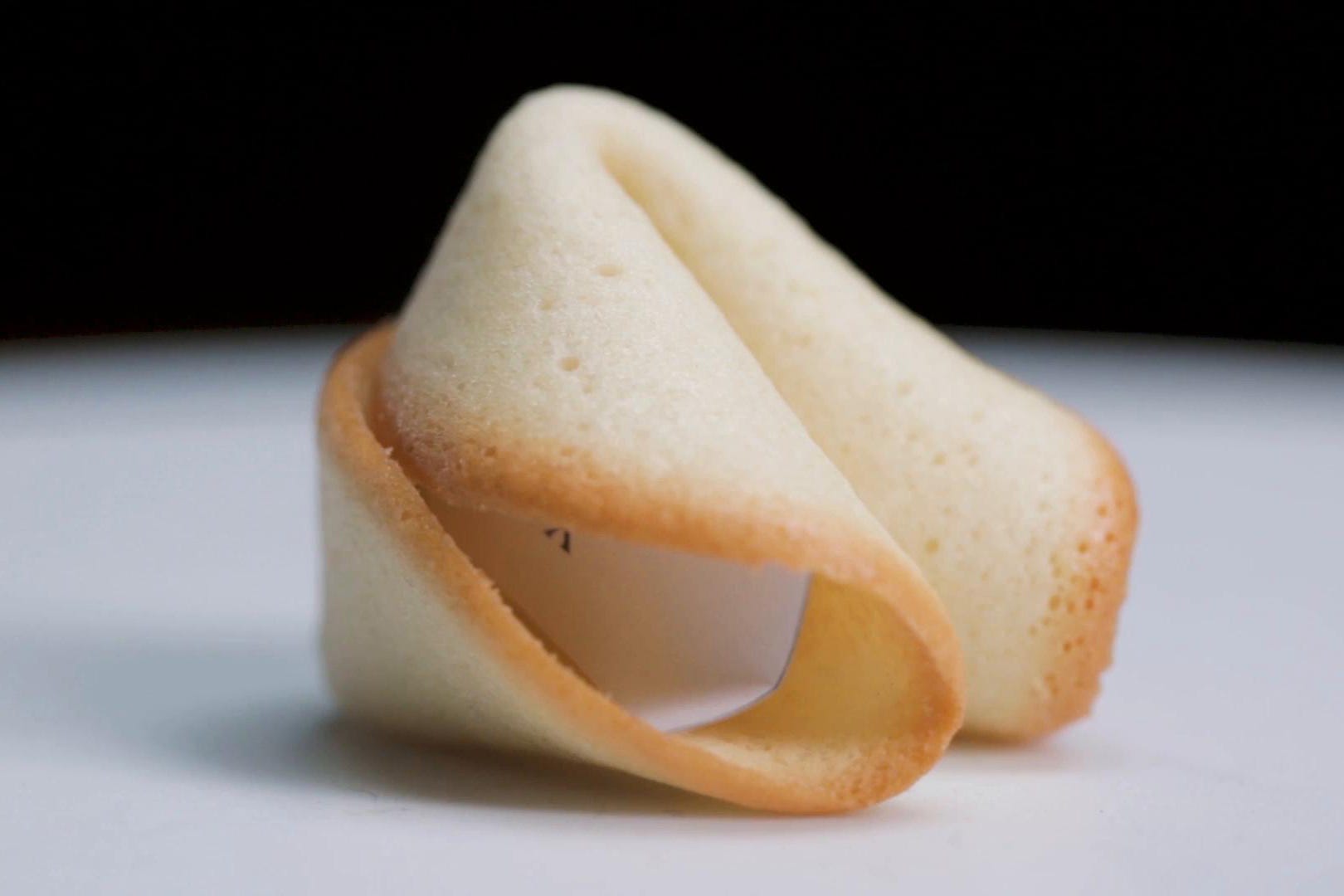
As far back as the 19th century, a cookie very similar in appearance to the modern fortune cookie was made in Kyoto, Japan. The Japanese version of the cookie contains a fortune, but the small slip of paper is wedged into the bend of the cookie rather than placed inside the hollow portion. This kind of cookie is called tsujiura senbei (辻占煎餅) and is still sold in some regions of Japan.
Despite a competing claim from David Jung, founder of the Hong Kong Noodle Company in Los Angeles, Makoto Hagiwara of Golden Gate Park’s Japanese Tea Garden in San Francisco is reported to have been the first person in the United States to have served customers the modern version of the so-called “fortune cookie” when he did so at the tea garden in the 1890s or early 1900s. Those fortune cookies were made by a San Francisco bakery, Benkyodo.


Fortune cookies (typically made with a base of flour, sugar, vanilla and sesame oil) moved from being a confection dominated by Japanese-Americans to one dominated by Chinese-Americans sometime around World War II. This may have occurred because of the Japanese American internment during World War II, which forcibly put 100,000 Japanese-Americans in internment camps, including those who had produced fortune cookies. This gave an opportunity for Chinese-American manufacturers to become dominant.
Today, more than 3 billion fortune cookies are made each year globally, most of them consumed in the United States as a novelty treat served after meals at Chinese restaurants.


The largest manufacturer of the cookies is Wonton Food, Inc., headquartered in Brooklyn, New York. They make more than 4.5 million fortune cookies per day.
And what about the fortunes themselves?
Since 2017, James Wong, whose family founded Wonton Food, has written fortunes for the company, which has a database of more than 10,000 messages. In a 2019 interview with the BBC, Wong said it can be challenging to write universally pleasing and uplifting sentiments.
“We need to bring happy messages. We want to make people feel good,” he said, “and, there’s always an expectation of some type of fortune-telling”.
He has become expert in the wily craft of ambiguous messaging whereby just about anything can be interpreted favourably by the reader. Over the years, the inspiration for Wonton Foods’ fortunes have come from diverse sources, ranging from Chinese proverbs to New York City subway signs, and the company has outsourced some fortune writing to freelance writers as well.
Custom fortune cookies have also emerged over the decades, offering personalised, targeted or funny messages. They’ve been vehicles for everything from marriage proposals to political slogans. “You’ll be called to execute good judgement. Vote KENNEDY,” read a 1968 cookie message from Robert F. Kennedy’s presidential campaign.
The humble fortune cookie continues to evolve, and in the end, not knowing what’s in store for us is exactly what makes them such a treat.
Story Idea: Eileen Gittins
Video
Video Podcast
REMORANDOM Chapter
2026: Chinese Year of the Horse