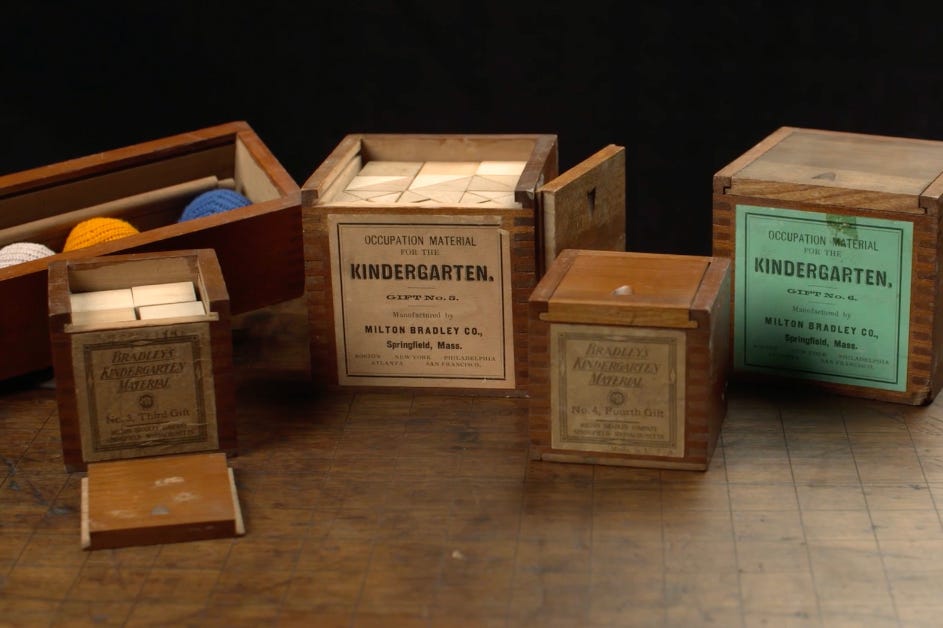
Froebel’s gifts (German: Fröbelgaben) are educational play materials for very young children, developed by German pedagogue Friedrich Fröbel in 1837 for use in what was the world’s first ever kindergarten at Bad Blankenburg.
Prior to Friedrich Fröbel, very young children were not educated. Fröbel was the first to recognise that significant brain development occurs between birth and age three.
Froebel’s gifts were designed to help young children understand and internalise basic concepts of geometry, mathematics and the physical world through play, and formed the foundation of Fröbel’s educational philosophy, which emphasised hands-on learning and the development of creativity and imagination. Originally numbered from 1 to 6 and eventually extended to 10, they were meant to be given in a particular order, growing more complex over time and teaching different lessons about shape, structure and perception.


A soft knitted ball could be given to a child just six weeks old, followed by a wooden ball and then a cube, illustrating similarities and differences in shapes and materials. Then kids would be given a cylinder (which combines elements of both the ball and the cube) and it would blow their little minds. Then, so on and so forth …
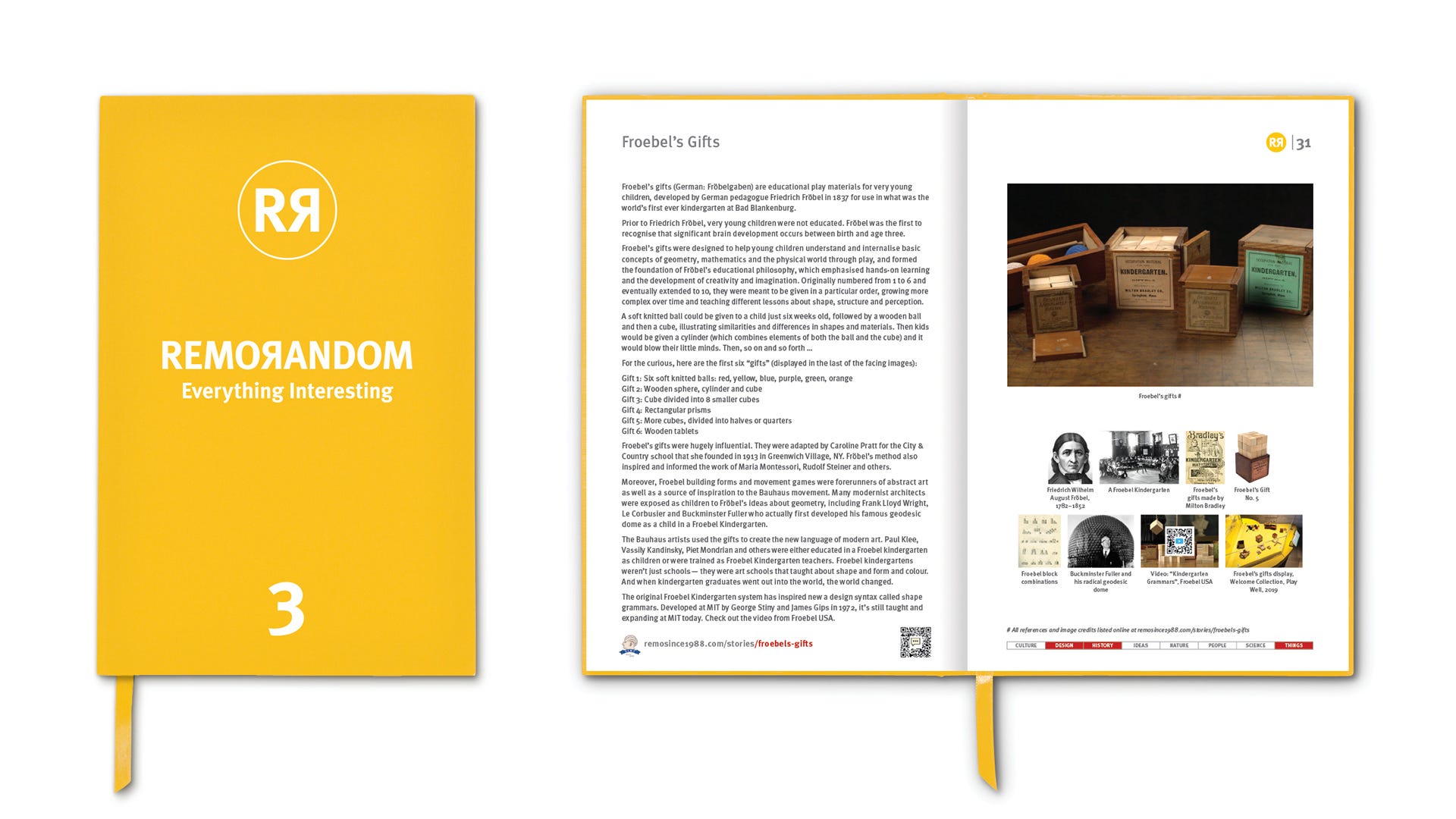
For the curious, here are the first six “gifts” (displayed in the last image below):
Gift 1: Six soft knitted balls: red, yellow, blue, purple, green, orange
Gift 2: Wooden sphere, cylinder and cube
Gift 3: Cube divided into 8 smaller cubes
Gift 4: Rectangular prisms
Gift 5: More cubes, divided into halves or quarters
Gift 6: Wooden tablets
Froebel’s gifts were hugely influential. They were adapted by Caroline Pratt for the City & Country school that she founded in 1913 in Greenwich Village, NY. [Ed: Remo’s daughter Lola attended this school for a time.] Fröbel’s method also inspired and informed the work of Maria Montessori, Rudolf Steiner and others.
Moreover, Froebel building forms and movement games were forerunners of abstract art as well as a source of inspiration to the Bauhaus movement. Many modernist architects were exposed as children to Fröbel’s ideas about geometry, including Frank Lloyd Wright, Le Corbusier and Buckminster Fuller who actually first developed his famous geodesic dome as a child in a Froebel Kindergarten.


The Bauhaus artists used the gifts to create the new language of modern art. Paul Klee, Vassily Kandinsky, Piet Mondrian and others were either educated in a Froebel kindergarten as children or were trained as Froebel Kindergarten teachers. Froebel kindergartens weren’t just schools — they were art schools that taught about shape and form and colour. And when kindergarten graduates went out into the world, the world changed.
The original Froebel Kindergarten system has inspired new a design syntax called shape grammars. Developed at MIT by George Stiny and James Gips in 1972, it’s still taught and expanding at MIT today.
Check out the video from Froebel USA on Vimeo HERE.
REMORANDOM Book Chapter