


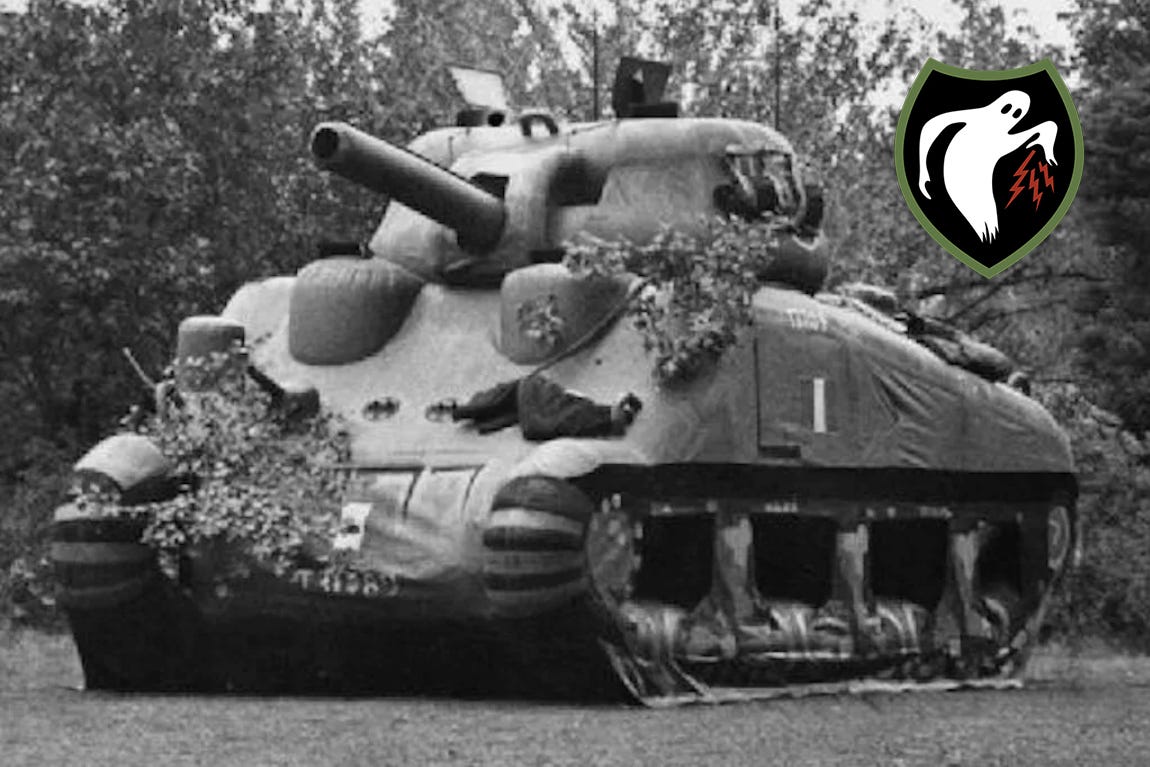
The WWII “Ghost Army” was one of the most imaginative and effective deception units in military history – a top-secret American operation that fought the war not with bullets, but with illusion, sound and stagecraft.
Officially known as the 23rd Headquarters Special Troops, the Ghost Army operated in the European Theatre of Operations from 1944 to 1945, and its very existence was kept classified for more than half a century.
The unit was made up of about 1,100 men, many of whom were recruited not from traditional combat backgrounds but from art schools, advertising agencies, architecture firms and sound engineering programs.
Their job was to mislead German forces about the location and size of Allied units. To do this, they created entire fake armies – sometimes within hours – using inflatable rubber tanks, trucks, artillery and aircraft that, from the air or a distance, were nearly indistinguishable from the real thing.


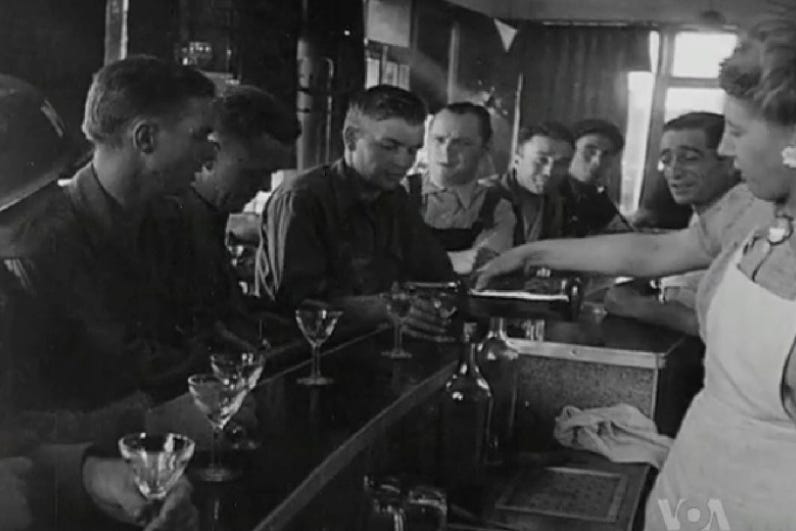
The deception went far beyond visual trickery. The Ghost Army also employed “sonic deception”, blasting carefully produced sound effects through massive speakers mounted on half-track vehicles. These recordings – of tank engines, marching soldiers, construction noises and radio chatter – could be heard up to 25 kilometres away, convincing German forces that large armoured divisions were moving into place. At the same time, radio operators sent fake transmissions, closely mimicking the communication styles and habits of real army units, so that German signal intelligence would be fooled. And actors, posing as Allied force generals, would “talk loose” in local cafés over bottles of wine to reinforce the decoy information.
One of the most remarkable aspects of the Ghost Army was how quickly it had to work. Units might arrive in a location, inflate dozens of tanks, set up fake headquarters, generate traffic tracks in dirt roads, and stage visible “activity” in just a few hours, all while wearing the insignia of the divisions they were impersonating. Speed was essential. The illusion only worked if it looked natural and effortless.
Among their most important missions was their role in covering the movements of real Allied forces after the D-Day [RR2:01] landings, helping to mask build-ups and river crossings such as the crossing of the Rhine. By convincing German commanders that major attacks were coming in the wrong place, the Ghost Army helped reduce resistance and saved countless lives.
Many of the men involved went on to become famous after the war. Fashion designer Bill Blass, painter Ellsworth Kelly and photographer Art Kane all served in the unit, bringing their creative sensibilities to a very unusual battlefield role. Yet for decades they were unable to talk about their wartime service, as the operation remained classified until the 1990s. Public recognition began to build after declassification through books, museum exhibitions and a 2013 PBS documentary, The Ghost Army.


The most significant formal honour came in January 2022, when the United States Congress passed legislation to award the unit the Congressional Gold Medal, one of the highest civilian honours in the United States. The medal was formally presented in a ceremony at the US Capitol on 21 March 2024, with surviving Ghost Army veterans (by then only a handful) and their families in attendance.
Video
REMORANDOM Chapter
