Swiss-trained, Munich-based artist Otto Künzli is a globally renowned and respected contemporary jeweller. He was Professor and Head of Postgraduate Studies in Goldsmithing and Jewellery at the Academy of Fine Arts in Munich from 1991 to 2014.
Otto has had a longstanding fascination with gold, as both material and symbol.
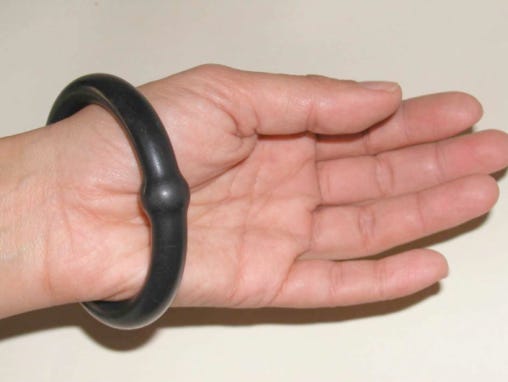
His 1980 artwork Gold Makes Blind is a bangle made from black rubber and gold; although the gold is comprised solely of a completely encased and concealed 12mm diameter sphere. So, you can’t actually see any gold.
The bangle was Otto’s way to return gold to the darkness, from deep inside the mountain where it was mined, out into the world, and back into darkness.
The bangle was also a reaction to what Otto perceived at the time to be an arbitrary use of that ancient and sacred metal by creators who would use it in gratuitous ways in order to imbue their work with “value”. Gold Makes Blind was his pissed-off response. It’s a work that is about knowing without seeing. It’s about trust … and it challenges one’s perceptions about truth and material value.
The thing about Gold Makes Blind is that you are asked to believe.


We asked Otto to reminisce about Gold Makes Blind and here are some of his words:
“The first one I made for my wife and she is still wearing it very often. The second one I gave to a Munich artist-friend in exchange for a piece of his art and he gave it to his girlfriend. She never took it off and he complained that the hard ball sometimes hurt his back when she kept the bangle on in bed (while making love). Some people tried it on once and never took it off again. Others abandoned all their other jewellery for it. Some feel naked and incomplete without it …”
And then there was the American banker and collector who, when giving presentations to investors, used to show them his bangle, telling the story of it and that there was a gold sphere inside. He would say that one would either have to trust the artist, or if not, destroy the bangle in order to find out if it was true. And he would conclude that this was the same with the bank. Investors must either trust the bank; or, if not, destroy its foundation. [Ed: Somewhat self serving … but an interesting metaphor nonetheless.]


Finally, Otto tells this amusing story:
“One bangle I sold via a Munich Gallery to a rich lady who gave it to her teenage son. This piece came back for repair just a few weeks after delivery. The eye-shaped opening in the rubber (a result of wear over time) looked a bit awkward but I replaced the tubing as per my promise to all buyers. One week later it came back again. Now I took a closer look and could clearly see that the rubber must have been cut with a sharp knife. I could also see a mark on the gold sphere. I spoke – via the gallery – with the mother and she was shocked but had immediately a suspicion. Her son was showing off in front of his friends telling them that there was a gold sphere inside and if they didn’t believe it he offered to cut the bangle open and even told them that the artist was anyway going to repair it for free. With the agreement of the mother I put a wooden sphere into the new rubber tubing! And yes, after he cut it open AGAIN, he had to face his mother to share the bad surprise news … and she forced him to bring it back to me in person, and to apologise …”
Video
Book Chapter