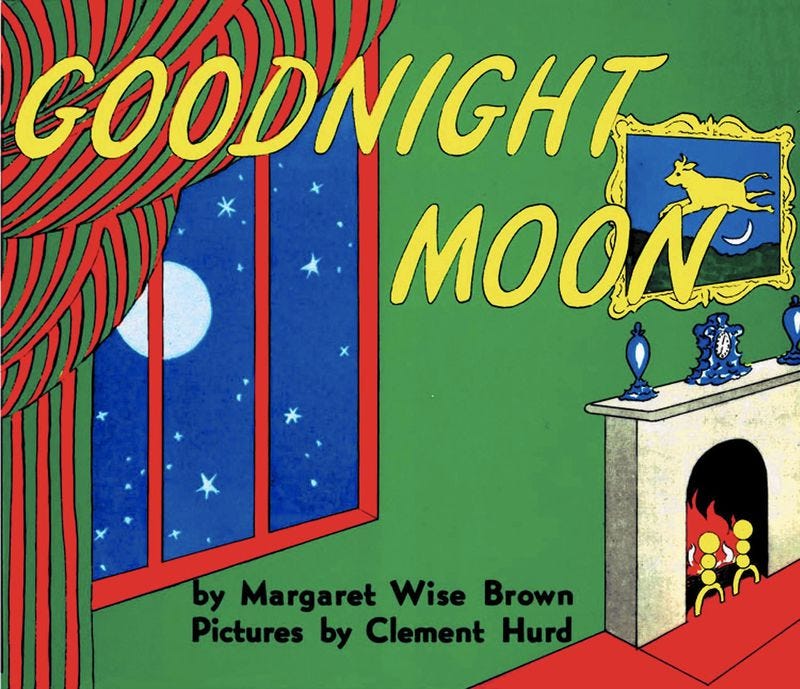
Goodnight Moon is a highly acclaimed and much loved bedtime story written by Margaret Wise Brown and illustrated by her friend Clement Hurd. It was published on 3 September 1947.
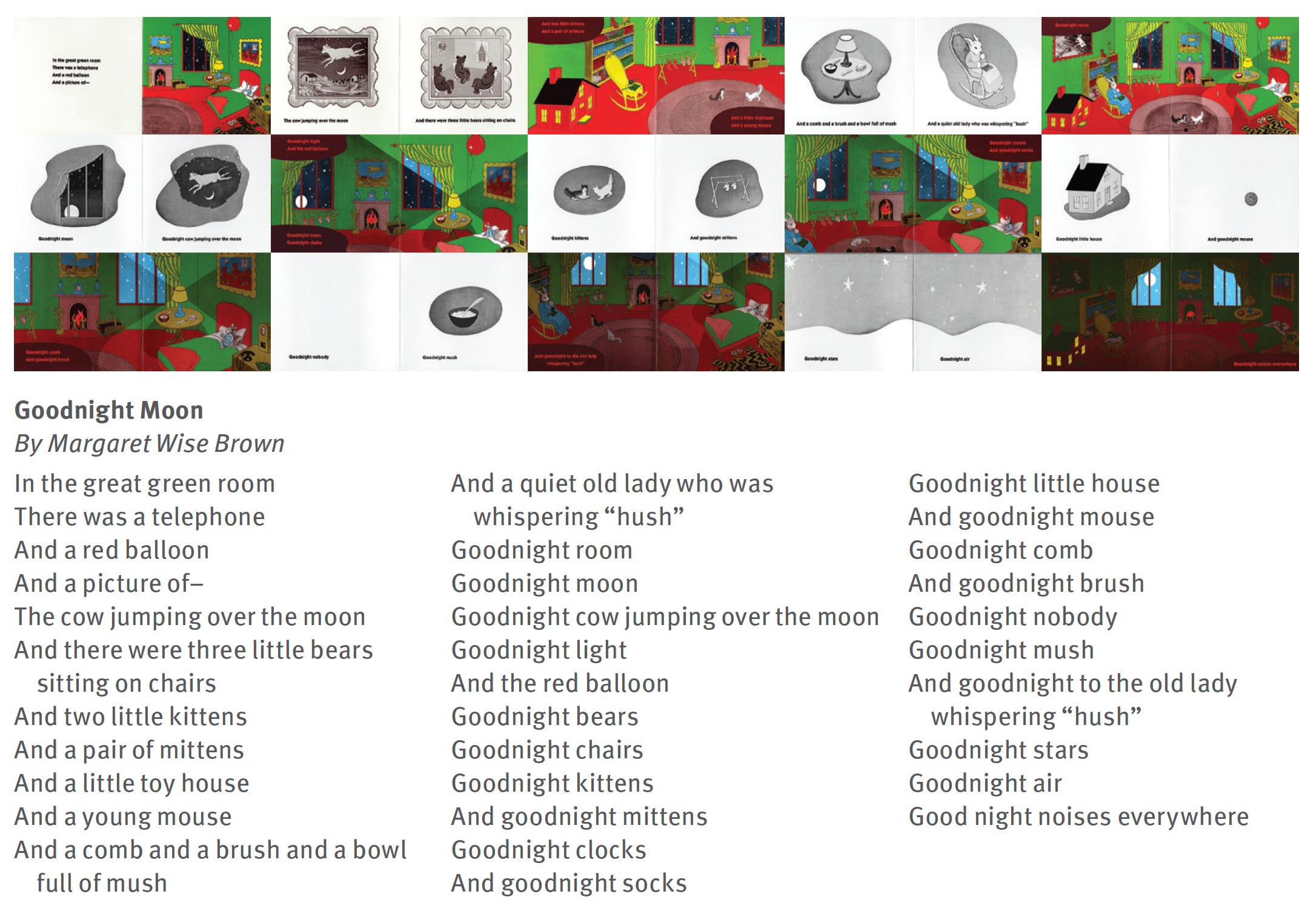
The “plot”, delivered by a rhyming and often repetitive poem, could not be simpler: A young bunny says goodnight to the objects and creatures in a green-walled bedroom: a red balloon, a pair of socks, a dollhouse, a bowl of mush, two kittens, the stars, the air, nobody, drifting gradually to sleep as the lights dim, the clock hands edge forward (for your interest, 10 minutes per spread) and the moon glows in a big picture window.


Margaret Wise Brown reportedly based Goodnight Moon on her own childhood ritual of saying goodnight to the toys and other objects in the nursery she shared with her sister Roberta, a memory that came back to her in a vivid dream as an adult.
When Goodnight Moon went on sale for US$1.75 in the fall of 1947, The New York Times praised the combination of art and language, urging parents that the book “should prove very effective in the case of a too wide-awake youngster”. Even so, it initially did very poorly.
Only 6,000 copies were sold upon its initial release in 1947. However, by 2017 it had sold an estimated 48 million copies. It has been translated into French, Spanish, Dutch, Chinese, Japanese, Catalan, Hebrew, Brazilian Portuguese, Russian, Swedish, Korean, German and Hmong. Indeed, countless parents around the world have read it to their sleepy children.


But it wasn’t always plain sailing. From the time of its publication in 1947 and until 1972, the book was “banned” by the New York Public Libraries due to the then head children’s librarian Anne Carroll Moore’s hatred of the book. Moore had strong feelings about what was good and bad for kids. Her favourites were mostly once-upon-a-time fairy tales and fables, and not the kind of books that celebrated the every day, in a style that educational reformer Lucy Sprague Mitchell, founder of the Bank Street school for student teachers (where Margaret worked), called “Here-and-Now”. At Bank Street they believed that children were curious about the immediate world around them, not just magical realms, and that fantasy actually confused and alienated them. “It is only the blind eye of the adult that finds the familiar uninteresting”, Mitchell wrote. So they created children’s books with less emphasis on flights of imagination than on everyday experiences.
Author Susan Cooper writes that the book is possibly the only “realistic story” to gain the universal affection of a fairy-tale, although she also noted that it is actually a “deceptively simple ritual” rather than a story. Writer Ellen Handler Spitz suggests that Goodnight Moon teaches “young children that life can be trusted, that life has stability, reliability, and durability”.
The tone is somber, but not sad, a departure without being a farewell. By bidding goodnight to all, it’s as though Brown is reminding us that they will still be there in the morning.
Video
PS: Here’s a reading of Goodnight Moon by the actor Susan Sarandon. It’s the least daggy one that we were able to find. Enjoy.
Book