


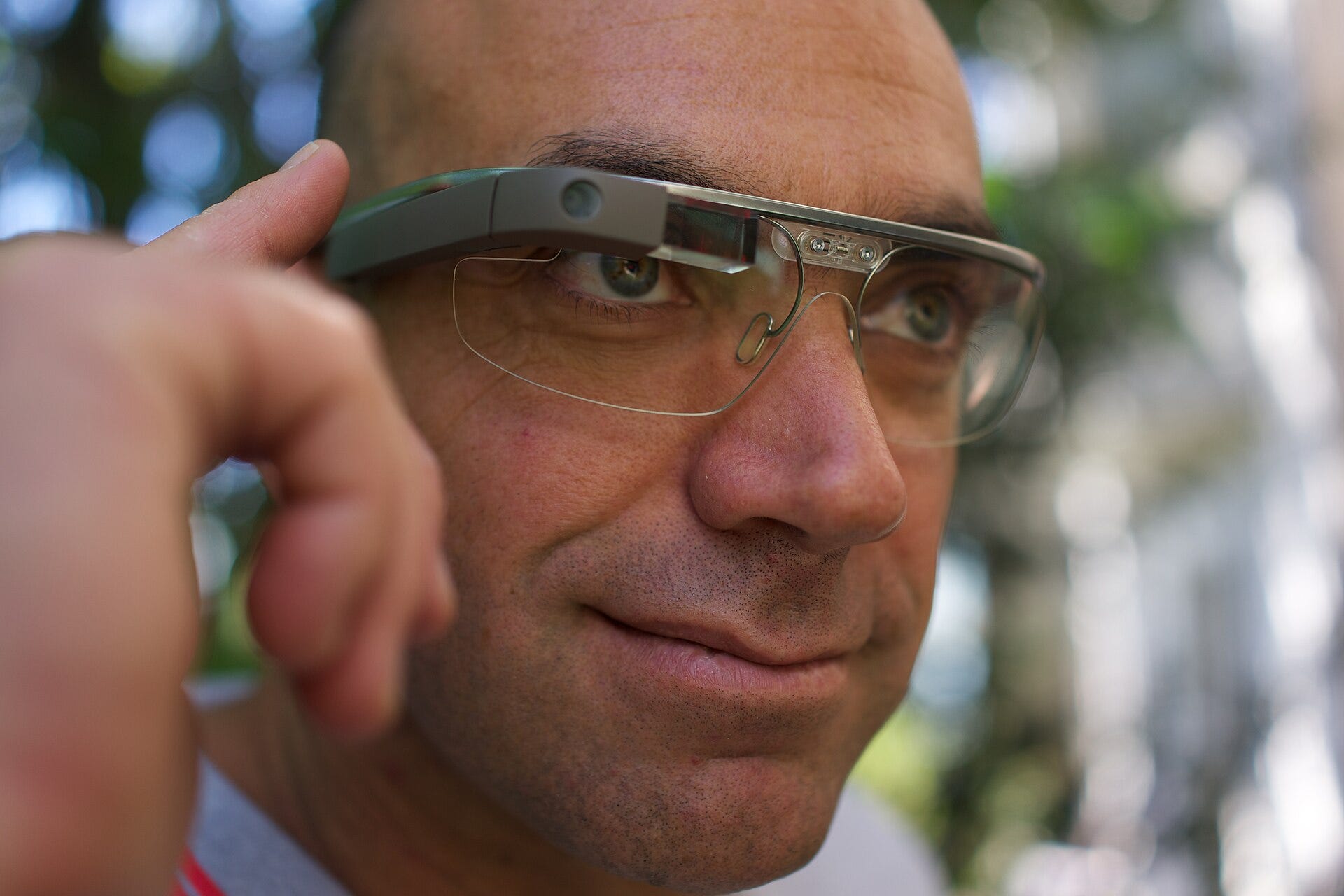
When Google unveiled Google Glass in 2012, it felt to some that the future had arrived.
The project emerged from Google X, the company’s semi-secret “moonshot” lab for experimental technologies. The idea was to create a wearable computer in the form of lightweight eyeglasses, capable of projecting information into the user’s field of vision. Early prototypes featured a small, prism-shaped display above the right eye, a camera, voice control and a touchpad built into the temple of the frame. The ambition was nothing less than to redefine human-computer interaction by making it seamless, mobile and socially integrated.


The Glass project was introduced to the public by Google co-founder Sergey Brin, who demoed it with skydivers live-streaming their descent into a Google I/O conference. This bold theatrical launch generated enormous excitement, casting Glass as the next frontier in consumer technology.
In 2013, Google released the Explorer Edition for developers and early adopters at a cost of US$1,500. This pre-release strategy was designed to gather feedback and spark innovation around potential applications, from hands-free photography to real-time translation. Brin took to the stage at the annual TED [RR1:79] conference in 2013 [Ed: I was there.] to explain why he felt that the days of looking down at a phone rather than up and into the world were numbered. Watch that short talk HERE.
Despite the hype, real-world use quickly revealed challenges. Battery life was short, the display resolution limited and voice commands often unreliable. But the most pressing issue wasn’t technical – it was social. The built-in camera, always ready to record, raised immediate privacy concerns. Bars, cinemas and even casinos banned Glass, worried about covert filming. The term “Glasshole” entered popular vocabulary, describing wearers who seemed oblivious to social norms or etiquette. What was intended as a cool, futuristic accessory came to symbolise arrogance, surveillance and tech culture’s blind spots.


Market uptake never matched the initial promise. Only a few thousand units were sold, and Google ended the consumer Explorer program in 2015. The company quietly repositioned the technology for enterprise applications. Industries like healthcare, manufacturing and logistics found value in a hands-free display that allowed workers to consult instructions, livestream procedures or receive remote guidance without breaking focus. This shift turned Glass into a niche but functional tool, shedding its failed mass-consumer identity.
Culturally, Google Glass left a lasting imprint far beyond its limited sales. It became a touchstone in debates about surveillance, wearable tech and the uneasy merging of digital and physical life. And its high-profile failure also served as a cautionary tale in Silicon Valley: bold visions must grapple with human factors, not just engineering.


Google Glass also demonstrated the social risk of facial wearables. People are selfconscious, and wearing something unusual on your face is always going to be risky. [Ed: I have three words to add: Apple, Vision, Pro.]
For facial wearables to gain broad acceptance, companies need to shoot for a form factor that feels cool [RR2:03] and not daggy [RR4:25].
See also: Segway [RR3:72]
Video
REMORANDOM Chapters

