Yesterday’s New York Times reported on the imminent closure of the 355 year old Hudson’s Bay Company, a vast empire that was North America’s oldest corporation, once owning a third of the real estate in Canada. And so today, we are inspired to bring you our story of the Hudson’s Bay point blanket, featured in REMORANDOM 2.
The Hudson’s Bay Company (HBC) was founded in London in 1670. A fur trading business for much of its existence, it is the oldest company in Canada, and still owns and operates retail stores across the country. [Ed: Whoops! Not for long. See above.]
A Hudson’s Bay point blanket is a type of wool blanket traded by HBC in British North America (now Canada and the United States) from 1779 to present. The blankets were typically traded to First Nations people in exchange for beaver pelts as an important part of the North American fur trade. The beaver pelts were shipped to Europe to meet the demand for beaver fur top hats. That was the thing back then. Native Americans were happy to be doing the trading. They prized the blankets because of their ability to hold heat even when wet; and treasured them to the point where elders would choose to be buried with them.


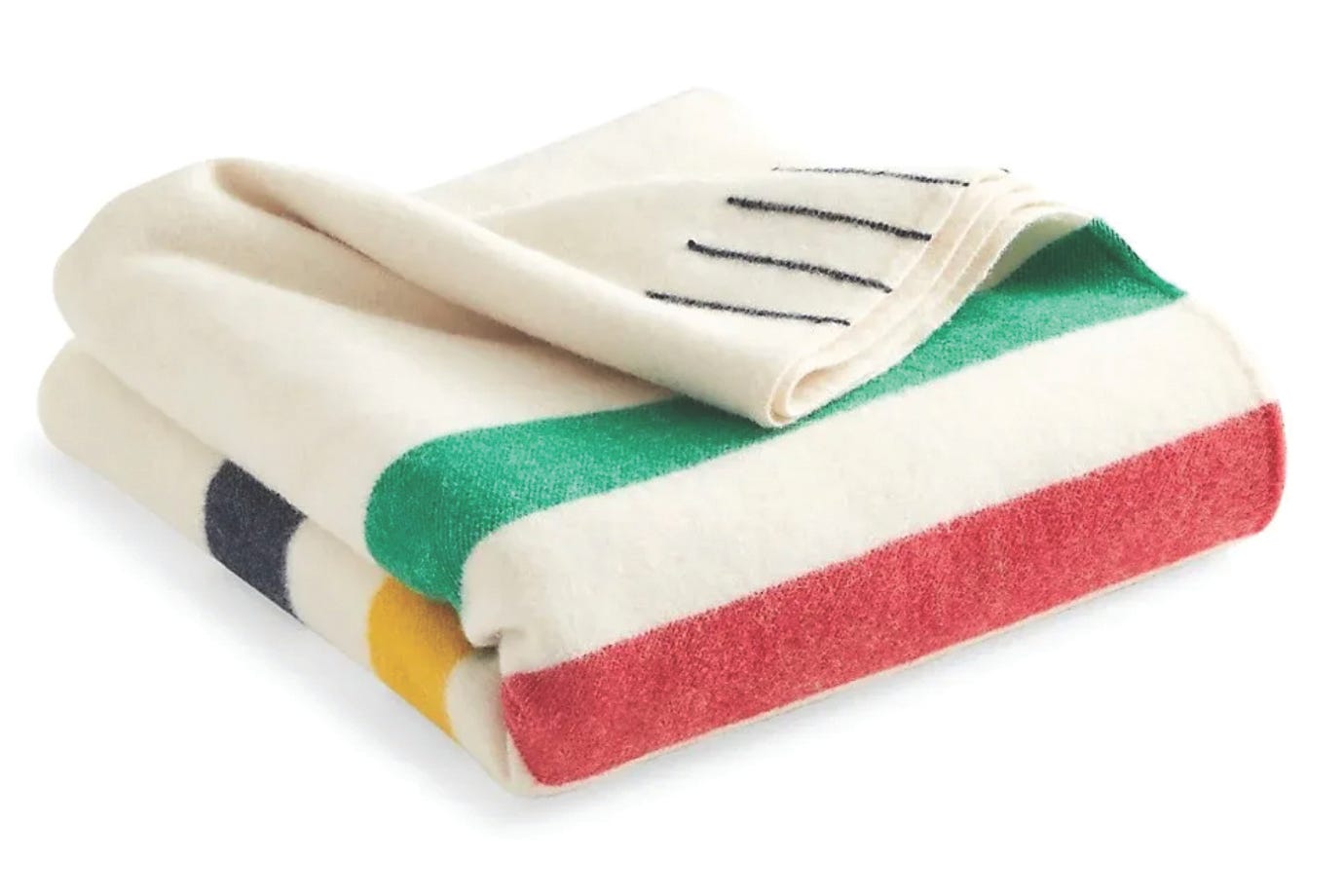
Originally point blankets had a single stripe across each end, usually in blue or red. But, by the mid-1800s, some blankets began to be made with distinctive stripes: green, red, yellow and indigo … on a warm white background. (Why those colours? They were popular and could be easily produced using good colourfast dyes at that time.) Another distinctive feature of the blankets are the “points” … short black lines woven into the selvage of the blanket along the edge. About 10cm in length (except in the case of half points, which are 5cm), they indicate the finished overall area of a blanket and allow easy determination of its size … even when folded. French weavers invented the point system in the mid-1700s since then, as now, blankets were shrunk as part of the manufacturing process. The word point derives from the French empointer, meaning “to make threaded stitches on cloth”.


The blankets have always been made in England, and today they are made by John Atkinson, a sub-brand of A.W. Hainsworth & Sons Ltd Wools from Britain, Australia and New Zealand are used in the manufacture of blankets. “The blend is painstakingly true to the original recipe,” explains Julie Roberts, marketing manager at A.W. Hainsworth. “What makes the Hudson’s Bay Point Blankets unique is that they’re made from a specific mix of seven different types of wool.”


The blankets continue to be sold by HBC department stores and are available in point sizes of 3.5 (twin), 4 (double), 6 (queen) and 8 (king).
The connections many have to Hudson’s Bay point blankets are both deeply personal and sometimes political. Not all memories are happy ones. For some, they elicit fond childhood memories or are embedded in family histories, while for others, they are hurtful reminders of the enduring impact of colonialism and systemic racism.
In recognition of this bitter sweetness, HBC has, since 2020, donated 100% of the net proceeds from the sale of the blankets to Oshki Wupoowane | The Blanket Fund, providing support, through grant schemes, for Indigenous cultural, artistic and educational activities throughout Canada.
Video
Book