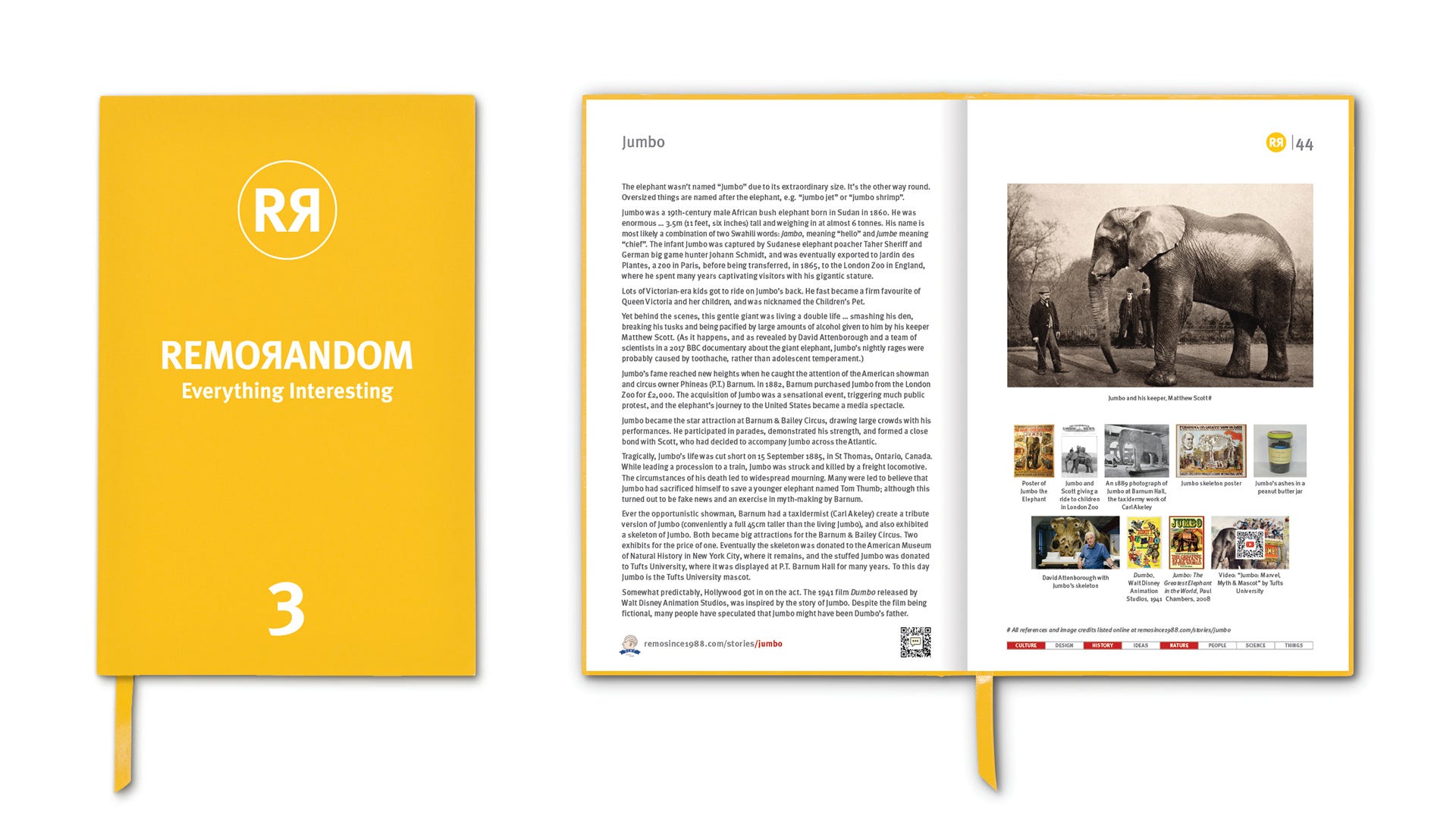
Jumbo was a 19th-century male African bush elephant born in Sudan in 1860. He was enormous … 3.5m (11 feet, six inches) tall and weighing in at almost 6 tonnes. His name is most likely a combination of two Swahili words: jambo, meaning “hello” and jumbe meaning “chief”. The infant Jumbo was captured by Sudanese elephant poacher Taher Sheriff and German big game hunter Johann Schmidt, and was eventually exported to Jardin des Plantes, a zoo in Paris, before being transferred, in 1865, to the London Zoo in England, where he spent many years captivating visitors with his gigantic stature.
Lots of Victorian-era kids got to ride on Jumbo’s back. He fast became a firm favourite of Queen Victoria and her children, and was nicknamed the Children’s Pet.
Yet behind the scenes, this gentle giant was living a double life … smashing his den, breaking his tusks and being pacified by large amounts of alcohol given to him by his keeper Matthew Scott. (As it happens, and as revealed by David Attenborough and a team of scientists in a 2017 BBC documentary about the giant elephant, Jumbo’s nightly rages were probably caused by toothache, rather than adolescent temperament.) Jumbo’s fame reached new heights when he caught the attention of the American showman and circus owner Phineas (P.T.) Barnum. In 1882, Barnum purchased Jumbo from the London Zoo for £2,000. The acquisition of Jumbo was a sensational event, triggering much public protest, and the elephant’s journey to the United States became a media spectacle.


Jumbo became the star attraction at Barnum & Bailey Circus, drawing large crowds with his performances. He participated in parades, demonstrated his strength, and formed a close bond with Scott, who had decided to accompany Jumbo across the Atlantic.
Tragically, Jumbo’s life was cut short on 15 September 1885, in St Thomas, Ontario, Canada. While leading a procession to a train, Jumbo was struck and killed by a freight locomotive. The circumstances of his death led to widespread mourning. Many were led to believe that Jumbo had sacrificed himself to save a younger elephant named Tom Thumb; although this turned out to be fake news and an exercise in myth-making by Barnum.


Ever the opportunistic showman, Barnum had a taxidermist (Carl Akeley) create a tribute version of Jumbo (conveniently a full 45cm taller than the living Jumbo), and also exhibited a skeleton of Jumbo. Both became big attractions for the Barnum & Bailey Circus. Two exhibits for the price of one. Eventually the skeleton was donated to the American Museum of Natural History in New York City, where it remains, and the stuffed Jumbo was donated to Tufts University, where it was displayed at P.T. Barnum Hall for many years. To this day Jumbo is the Tufts University mascot.
Somewhat predictably, Hollywood got in on the act. The 1941 film Dumbo released by Walt Disney Animation Studios, was inspired by the story of Jumbo. Despite the film being fictional, many people have speculated that Jumbo might have been Dumbo’s father.
Video
Book