


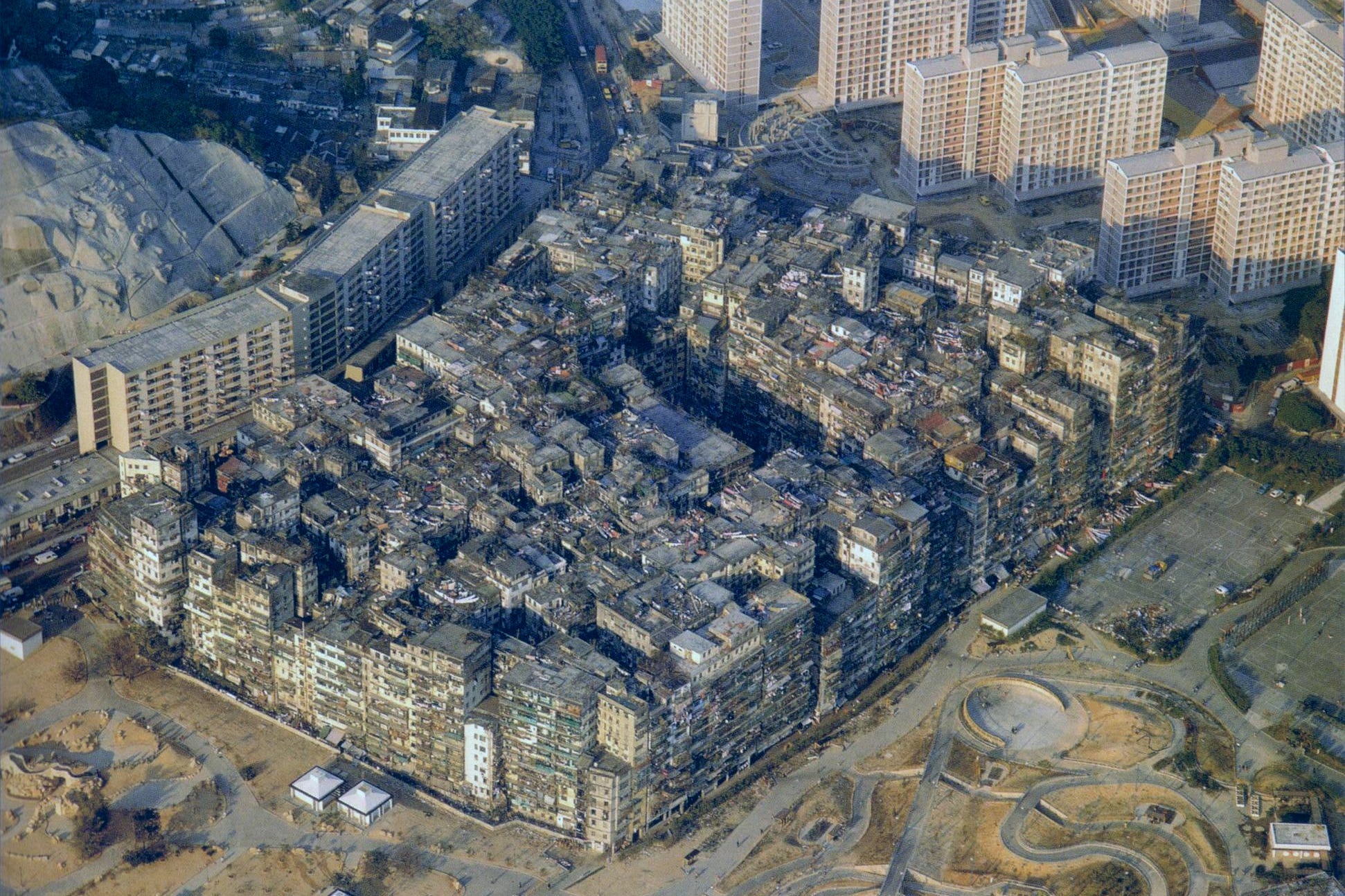
Kowloon Walled City (Chinese: 九龍城寨) known colloquially as the “city of darkness” was an extremely densely populated enclave of China that existed within the boundaries of Kowloon City in Hong Kong.
It began life as a Chinese military fort during the Qing Dynasty, but its modern story really took shape in the late 19th century. When Hong Kong was temporarily ceded to Britain, the Walled City became a strange diplomatic loophole – technically Chinese territory, but enclosed by what was, at the time, British-controlled Hong Kong. Its population increased dramatically after the end of the Japanese occupation of Hong Kong during World War II.


By the 1980s, roughly 50,000 people were living inside just 2.6 hectares – making it the most densely populated place on Earth. From the outside, it looked like a single, solid block of concrete, 12 to 14 storeys high, pierced only by a chaotic tangle of pipes, cables, balconies, makeshift stairwells and dangling laundry. From the inside, it was a dim maze of narrow corridors, barely lit by daylight, where electric wires and water pipes snaked along the ceilings. Sunlight reached only the top floors; lower levels lived in a perpetual twilight. It had no central planning, no building codes, and for decades, almost no police presence. People could come to Kowloon, and, in official terms, disappear.
The lower floors were notorious for illegal factories, unlicensed dentists, opium dens, gambling rooms and brothels, many linked to the five Triad gangs who all took up residence: King Yee, Sun Yee On, 14K, Wo Shing Wo and Tai Ho Choi.


But it was not simply a criminal slum. It was also a functioning, tightly knit community. Families lived there for generations. Children played in rooftop courtyards. Neighbours shared water lines, electricity and favours. There were small temples, noodle factories, schools and workshops that produced everything from fish balls to plastic goods.
Life was improvised but organised.


Because planes from the nearby Kai Tak Airport flew directly overhead [Ed: Remember that?], building height was capped by aircraft safety, creating a relatively flat, crowded rooftop skyline – like a concrete mesa. Photographers and journalists portrayed it as a vertical slum, a cyberpunk vision of overcrowding and decay. It inspired countless films, novels, video games and a cool 1993 book of photographs: City of Darkness by Ian Lambot and Greg Girard.
To outsiders, the Walled City became a symbol of urban dystopia. [Ed: Very Silo.] To residents, it was simply home – cheap, central and alive with opportunity. The science fiction writer, William Gibson, a Walled City fan, saw in the unregulated, organic chaos, an embodiment of his famous concept of “cyberspace” – or, as we would call it today, the internet.


By the late 1980s, both British and Chinese authorities had finally agreed that the place had to go. By 1993, the city had been fully evacuated, and demolition began. Residents were compensated and rehoused. Today, its footprint is a peaceful public park, with stone markers and a reconstructed gate marking where the chaos once stood.
Video
REMORANDOM Chapter

RemoRandom proving itself absolutely fascinating – as always!