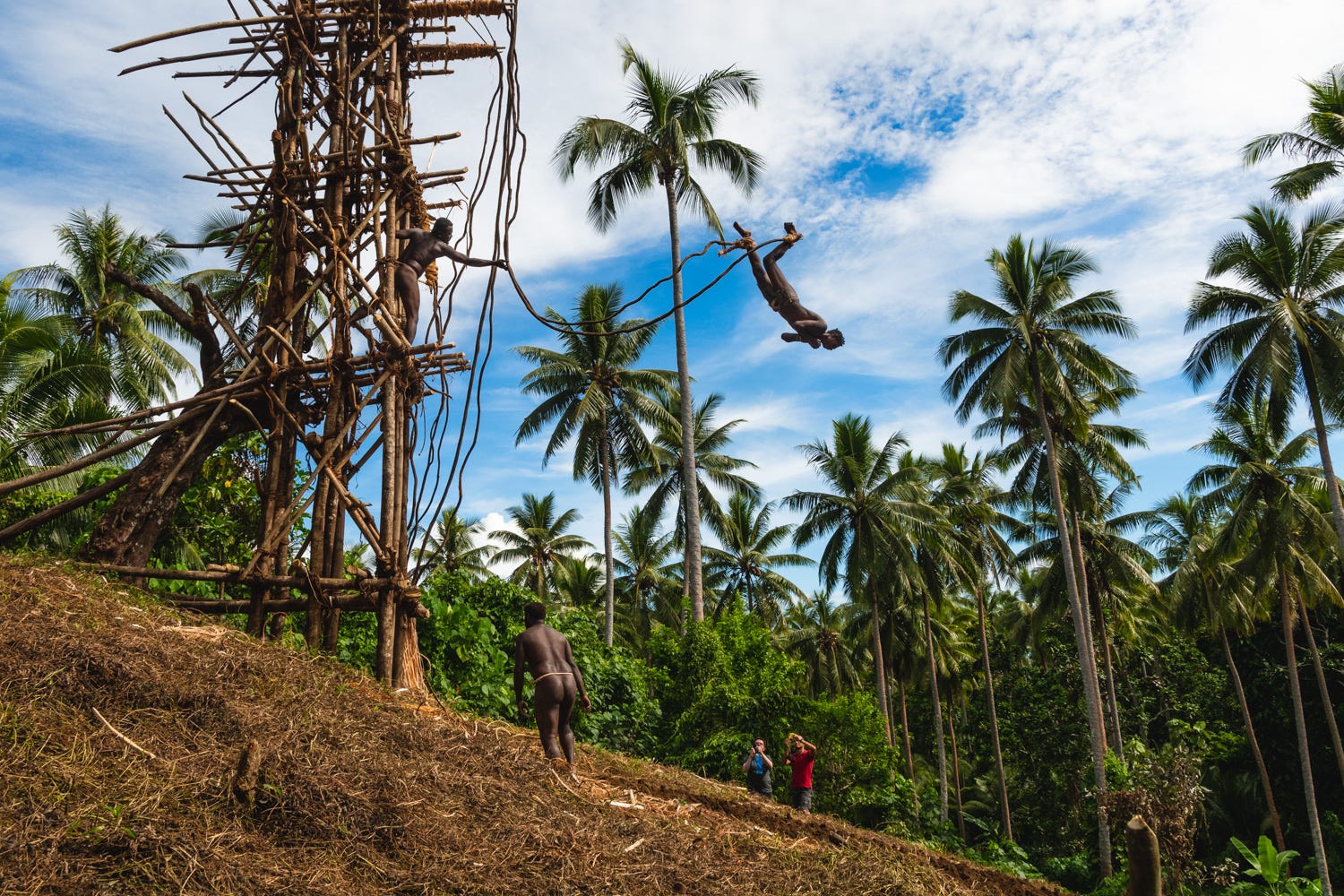
Land diving on Pentecost Island, known as Naghol or the “land diving ritual”, is a culturally significant tradition practised by the people living on an island in Vanuatu, located in the South Pacific. It’s a ceremonial rite in which men leap headfirst from tall wooden towers, ranging from 20 to 30 metres (65 to 100 feet) high, with only vines tied to their ankles. The goal is to dive as close as possible to the ground even to the point of indenting the softened surface, an act of bravery and skill. The ritual has been practised for centuries and is considered the precursor to modern bungee jumping.
The ritual is deeply rooted in the traditions of the Sa tribe and is associated with the Yam Festival, celebrating the harvest. It is believed to ensure a bountiful yam crop and to appease ancestral spirits.


For young men, completing a land dive is a rite of passage, symbolising their transition to adulthood. The men who choose not to dive or who back out of diving are humiliated as cowards. [Ed: That would make me a coward in this particular community.] Also, in some interpretations, the dive is performed to bless the land with fertility.
The villagers build the tower using local materials like liana vines and wood. The vines are chosen carefully to ensure they are strong enough to support the diver without breaking, but also elastic enough to absorb the shock of the fall.
The jumping tower is a sight to behold. Its construction typically takes around 20 to 30 men between two and five weeks to construct. According to Margaret Jolly (“Kastom as Commodity: The Land Dive as Indigenous Rite and Tourist Spectacle in Vanuatu”, 1994), the tower: “symbolically represents a body, with a head, shoulders, breasts, belly, genitals and knees. The diving platforms represent the penises and the struts beneath represent the vaginas”. [Ed: If you say so.]
The land diving ritual typically takes place between April and June, during the yam harvest season when the vines are at their most elastic after the rainy season.
Although the practice is meticulously planned, land diving is inherently risky. According to the Guinness World Records, the g-force experienced by those at their lowest point in the dive is the greatest experienced in the non-industrialised world by humans.
Sometimes people die, like one time in 1974 when both of a diver’s vines snapped. He broke his back from falling, and later died in hospital. Unfortunately this all happened in front of the late Queen Elizabeth II while she was paying a visit to the island. The issue here was that the vines were not elastic enough because it was the wrong season, the middle of the wet season. Tragic.


Land diving remains an integral part of the cultural identity of Pentecost Island, and has become a tourist attraction for the villagers.
Lindblad Expeditions guests were witness to the rare ceremony during the inaugural expedition of National Geographic Orion. Check out some of the video by Jim Napoli below or HERE.
Postscript
An adventurous New Zealand entrepreneur by the name of A.J. Hackett heard about the Naghol ritual and was instantly obsessed with the idea. He hired a team of scientists to develop a strong elastic cord equivalent of the Naghol vines, flew to France, climbed up the Eiffel Tower at night and jumped off the following morning. He was arrested for his unauthorised jump but the publicity stunt immediately caught the attention of the global media and commercial bungee jumping quickly took off, with the first dive site opening shortly after on the Kawarau Bridge in Queenstown, still a popular bungee site to this day. The A.J. Hackett Bungy company today is still busy throwing people off bridges and buildings.


Video
REMORANDOM Book Chapter