The Library of Babel is a mind-bending conceptual and digital project inspired by Argentinian writer Jorge Luis Borges’ 1941 short story The Library of Babel.
In the Borges version, the “universe” is an infinite library containing every possible book of a fixed format – essentially every possible arrangement of letters, punctuation and spaces. Most of these books are pure gibberish, but buried within the library are books that contain every work of text, every truth, every falsehood, every biography, every possible history – even this sentence, and every variation of it.


In 2015, Brooklyn-based author and coder Jonathan Basile developed a powerful algorithm that brought this concept to life in a digital form at libraryofbabel.info.
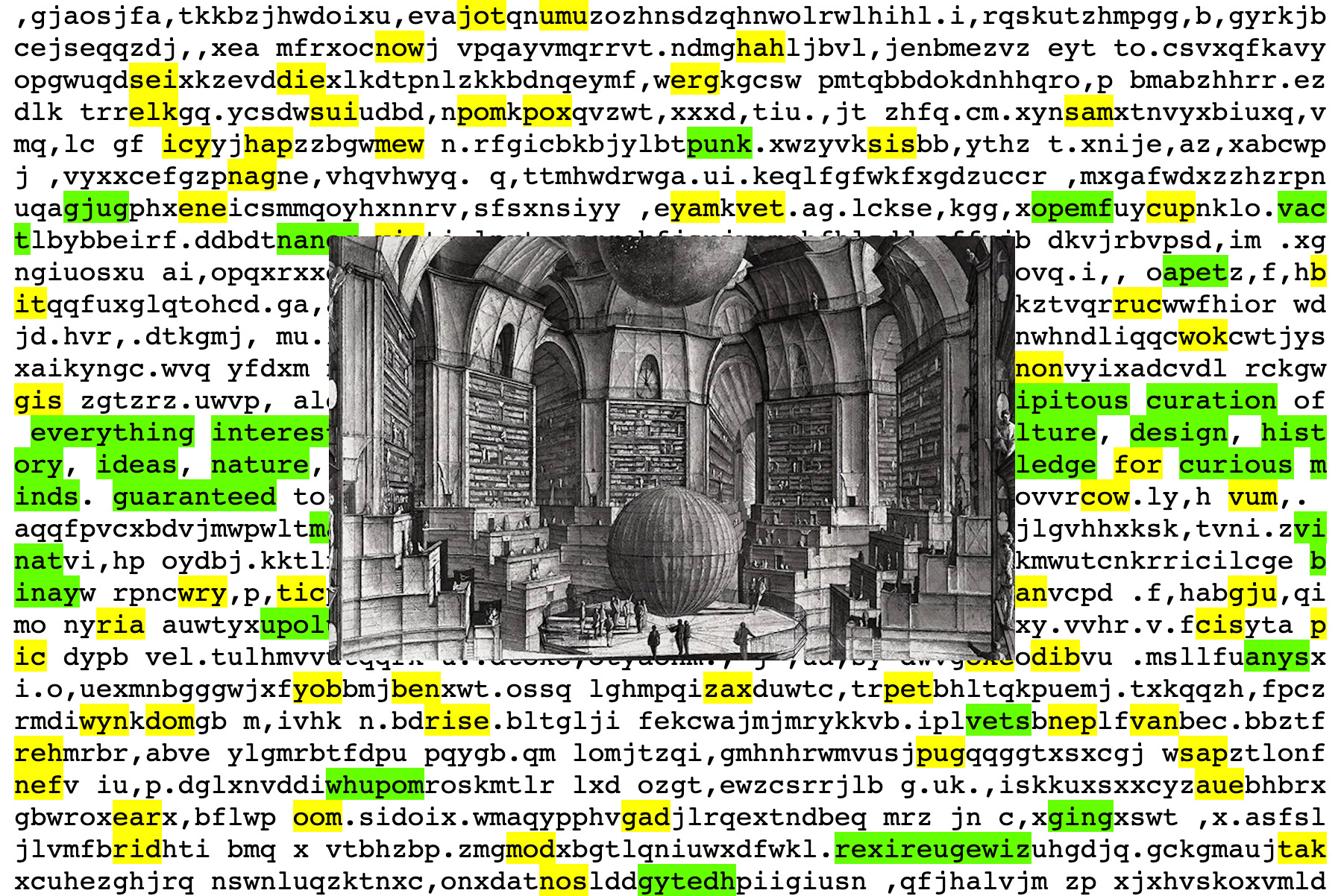
His online library generates and indexes every possible page containing up to 3,200 characters – made up of letters, spaces, commas and full stops. The result is a searchable database of 10^4677 possible “books”, an astronomically large number.
Basile limited the Library of Babel to pages of 3,200 characters (about 40 lines of 80 characters) primarily for practical and computational reasons. The original Borges story describes books with 410 pages of 40 lines, each with 80 characters, which would mean around 1,312,000 characters per book – enormous in terms of combinations. By capping it at 3,200 characters, Basile could simulate infinity while still making the experience accessible, searchable and computable within a web environment. Basile’s genius was in realising that you don’t need actual infinity to feel its weight – just a taste.


In Basile’s Library of Babel, every page has a unique address, based on a system that mirrors Borges’ vision of an infinite library made of hexagonal rooms. The structure is hierarchical: at the top level are hexagons (the rooms), each identified by a random string of letters. Inside each hexagon are walls, and each wall has several shelves. Every shelf holds multiple volumes, and each volume contains 410 pages. Finally, each page has its position within the volume. This creates a navigable coordinate system – hexagon -> wall -> shelf -> volume -> page – allowing you to pinpoint a single page among the virtually infinite combinations. When you search for a phrase, the system returns its exact “location” in this address space, giving you the eerie impression that your phrase was always there, waiting in the stacks.
Think of it this way. The Library of Babel address for an exact version of this REMORANDOM page, down to the last space, comma and full stop is: wall 2, shelf 2, volume 25 of hexagon 04sla0tba6r1sab0hw59178aw23oxgcj78vq25i8zuz ... A version with a single word or comma changed would exist at another address, and so on … Everything that has ever been written, and will ever be written, using the letters A to Z, a comma, a full stop and a space ALREADY EXISTS programmatically somewhere in the Library of Babel – amidst a sea of gibberish.
Postscript
Having completed the text Library of Babel, Basile recognised that his code could also be applied to images. So, the Babel Image Archives at babelia.libraryofbabel.info contains every possible 4,096-colour, 640 x 416 pixel image – about 10^961,755 in total. Wrap your head around that.


Video
REMORANDOM 6 is coming in May