There’s a twist associated with today’s post. It’s not a story that you’ll find in any of our books. It was meant to be featured in REMORANDOM 3, but at the 11th hour we we were informed via our long time print broker in Hong Kong that the Chinese printing factory were not willing to print the book containing this chapter. It was off-limits subject matter. This meant that I had to scramble not only to come up with an alternative chapter (April Fools Day, see below) – but also re-alphabetise and re-number the entire book. We had received copy change requests from the factory before – but never the requested removal of an entire topic. I was a bit surprised as the content was somewhat declarative and not especially critical. Anyway, as a treat for you Substackers, below is a copy of the REMORANDOM chapter that never was.
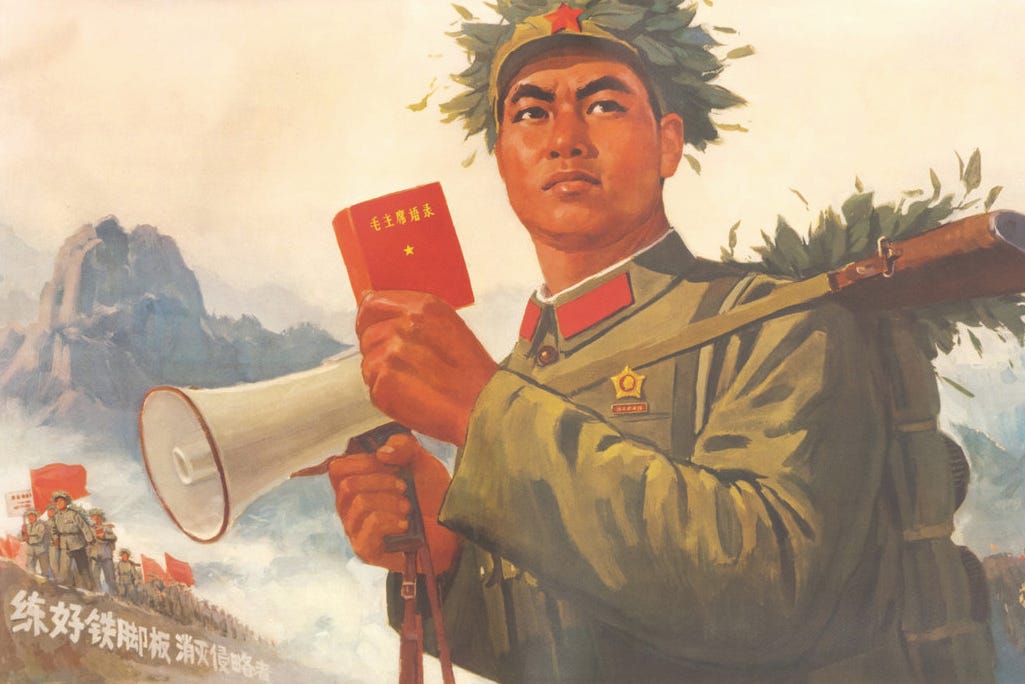
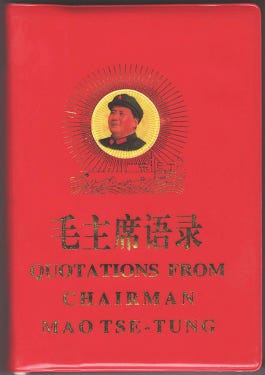
The Little Red Book is a book containing 427 quotations attributed to Máo Zédōng 毛泽东 (1893–1976) aka “The Great Helmsman”, the founder in 1949 of the People's Republic of China (PRC) and Chairman of the Chinese Communist Party from 1943 up until his death.
Formally titled Quotations from Chairman Mao Tse-tung, The Little Red Book was published from 1964 until about 1976 and widely distributed throughout China, with translated versions available to the rest of the world.
It is the world’s second most published book, after the Bible. Reputedly a billion copies circulated during the Cultural Revolution, invariably covered in red plastic and designed to be portable … shrunk to fit the pocket of an army uniform (or indeed the back pocket of a Western radical student’s jeans).


The preface was written by Lin Biao, general of the People's Liberation Army (PLA) from 1927 to 1971, the key driver behind the creation of Mao Zedong's personality cult. Here are some sample quotes from the book (organised into 33 topics):
"Every Communist must grasp the truth: Political power grows out of the barrel of a gun."
“The people, and the people alone, are the motive force in the making of world history.”
"A revolution is not a dinner party, or writing an essay, or painting a picture, or doing embroidery … A revolution is an insurrection, an act of violence by which one class overthrows another."
The book remains a primary symbol of the Cultural Revolution, and part of the essential kit for the PLA Red Guards. But, in China, it was way more ubiquitous than that, “viral” before the word was used in that context. The Little Red Book was everywhere, waved enthusiastically more than it was read, recited more than it was discussed … a physical talisman that symbolised a creed and without which in your possession you ran great risks. Indeed, all Chinese citizens were expected to own a copy of the book. Don’t leave home without it!


Today in China, the book is mostly seen as a piece of nostalgia. It can be purchased at shops in Beijing, Shanghai other major cities in China, as well as at some tourist attractions. It’s no longer a talisman, but now a relic, a symbol of a not-quite forgotten but largely discarded period in China’s history. Ironically, The Little Red Book has now achieved what looks like being its most enduring significance: as a piece of capitalist kitsch.
Replacement Book Chapter