


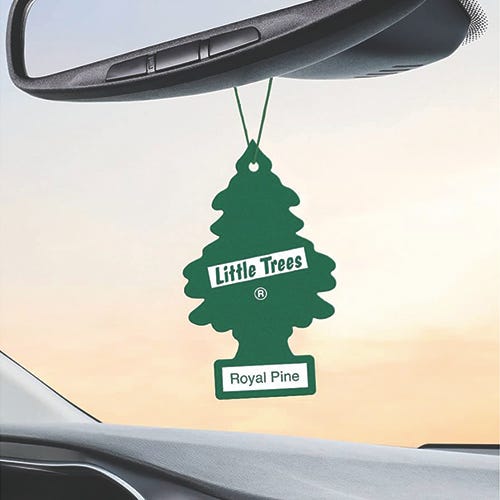
Why the right guy? Julius Sämann was a chemist who had fled Nazi Germany and had spent time in the pine forests of Canada studying the aroma of alpine trees. Snap!
To address the smelly car issue, Julius combined fragrance (originally natural pine oil, but today goodness-knows-what-chemicals) with specialised blotting paper material and attached a string, thereby inventing the first car air freshener.


The freshener originally took the shape of a buxom pin-up girl [Ed: Couldn’t find image; believe me I tried], but Julius ultimately settled on the form of an abstract (little) tree in honour of his years extracting aromatic oils from pine trees in Canada.
Orders started rolling in to the newly formed Car-Freshner Corporation [sic] from all over the country, and “Little Trees” brand air fresheners quickly gained an international following.
The iconic little tree (usually dangling from the rear vision mirror of a car) has since appeared in countless movies and television shows.
While the first fragrances were Royal Pine, Spice and Bouquet, the range expanded to include Caribbean Colada, Vanillaroma, New Car Scent and a couple with very Zoolanderish names: Black Ice and Pure Steel.


Today, Little Trees air fresheners are made in factories in Watertown, NY (the headquarters) and DeWitt, IA; and several companies in Europe produce Little Trees under license from Bermuda-based Julius Sämann Ltd, using the names “Wunder-Baum” (in Austria, Switzerland, Denmark, Finland, Germany, Norway, Poland, Romania, Slovenia, Hungary and Sweden) and “Arbre Magique” (in France, Belgium, the Netherlands, Italy, Portugal and Spain). It was formerly known as “Magic Tree” in the United Kingdom until the “Little Tree” name was adopted in 2011.
The company is fiercely protective of its Little Trees air fresheners and is known for pursuing lawsuits aggressively to protect its trademarks.


The company also remains tight-lipped about the composition of its fragrances, comparing them, perhaps presumptuously, to the recipe for Coca-Cola [RR7:20]. “The makeup of the Little Trees air fresheners is a closely guarded secret,” said a spokesperson for the company when questioned.
Little trees in sweet-smelling cars have clearly become a big business.
Finally, for a nice summary check out this Bloomberg “Behind the Design” video on “How Little Trees Air Fresheners Got Their Smell” from 2018.
Story Idea: Bonnie Siegler
REMORANDOM Chapter
