


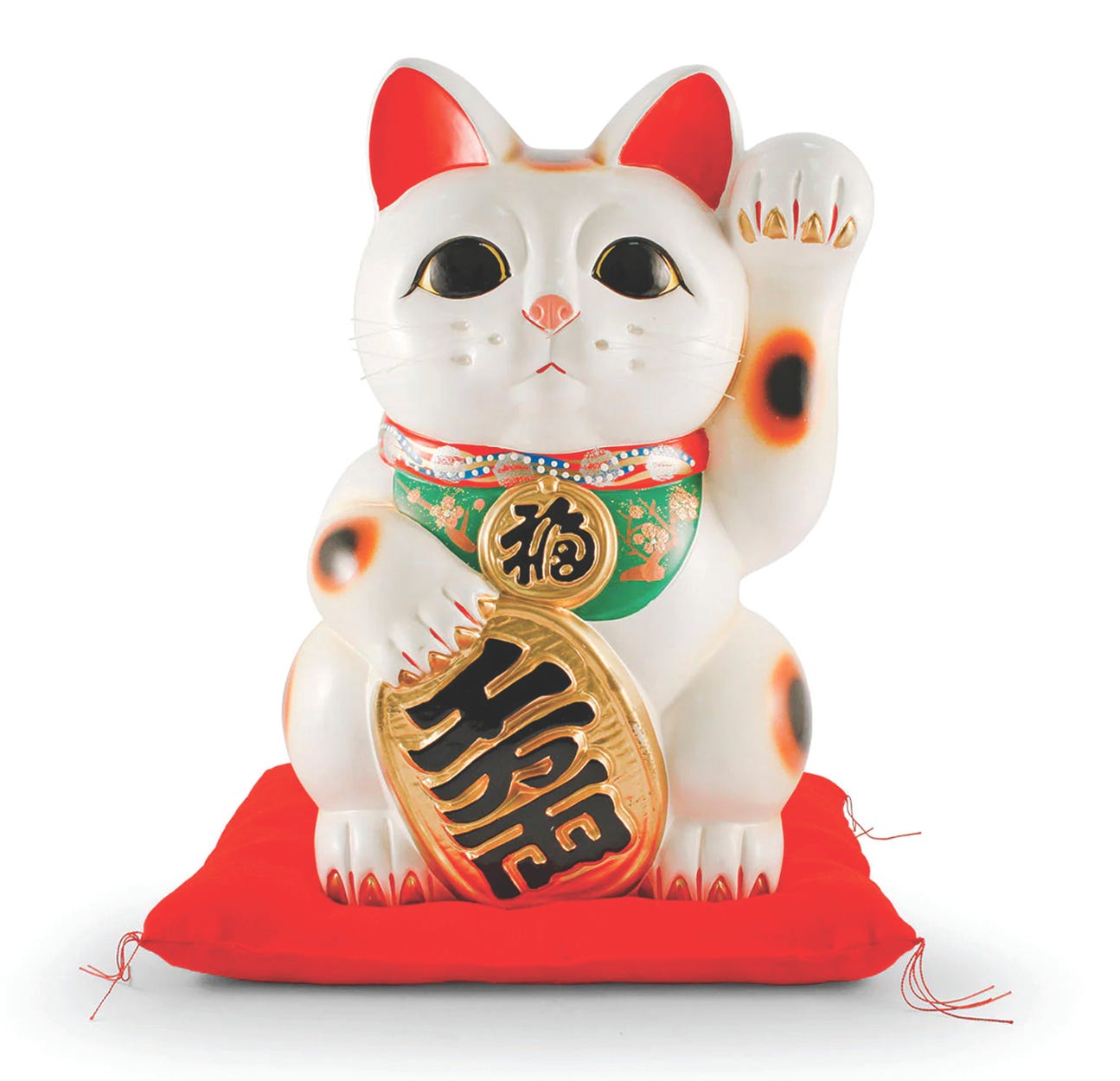
The figurine depicts a cat holding a koban (oval gold coin) with a paw raised in a beckoning gesture. Despite how it might look to some Westerners, the cat is not waving. This is an interesting cultural difference. The Japanese beckoning gesture is made by holding up the hand, palm down, and repeatedly folding the fingers down and back, just as it looks with the maneki-neko.
Maneki-neko were traditionally carved from wood or made from clay; but these days, they are generally made of ceramic or plastic. Some maneki-neko are equipped with a mechanical paw which slowly moves back and forth. Maybe you’ve seen one at your local Japanese restaurant or Chinese laundry.
The figurines are often displayed in shops, restaurants, pachinko parlours, dry cleaners, laundromats, bars, casinos, hotels, nightclubs and other businesses – generally near the entrance, as well as within homes.


It matters which paw is being used to do the beckoning. A statue with the left paw raised invites more customers, while the right paw raised invites more money. Hence it is also said that the left paw one is for the place of business, and the right is for the home.
Maneki-neko style Japanese cat dolls can be traced back to the Edo period (1603–1868), or shortly beforehand. They probably first appeared in the Buddhist temples Gotokuji, Saihoji, or Jishoin, all located in Edo, today’s Tokyo. By the late Edo period they had found appeal with urban consumers. Clear evidence of this is found in Utagawa Hiroshige’s ukiyo-e print from 1852, which depicts a stall selling numerous cat dolls.


The origin story for maneki-neko is not entirely agreed upon. Perhaps it was the cat that saved the life of Setagaya daimyo (feudal lord) Ii Naokoto by beckoning him into Gotokuji temple on a stormy night in the early Edo period. Or it may have been the cat which brought an unassuming old pauper great fortune in the 1850s. Or was it the famous courtesan Usugumo of Tokyo’s former pleasure district who decapitated her pet cat only for its severed head to chomp down a venomous snake in the bathroom?
Irrespective of origin, the perceived luck-bringing properties of maneki-neko are undisputed, and as such, they have become deeply ingrained in the Japanese psyche. The figurines are also popular in China and Chinese communities worldwide, to the extent that they’re often mistaken for being Chinese in origin.


There are many museums that celebrate maneki-neko, e.g. the Maneki-Neko Museum in Seto City, Aichi Prefecture contains 5,000 beckoning cats, the Manekineko Museum of Art in Okayama has another 700. In coastal Onomochi at the Maneki Neko Museum you’ll find 3,000 such figurines. And for those of you living in the United States, there’s even a Lucky Cat Museum in Cincinnati, OH that features more than 2,000 beckoning paws.
Video
NB: Oddly, the Today show hosts get it wrong about the right and left paw variation. As outline above, if the cat is lifting its right paw, it’s said to be inviting wealth, prosperity, and financial success into your home or business. A left paw raised maneki-neko is thought to attract visitors, clients or general social connection.
REMORANDOM Chapter
