


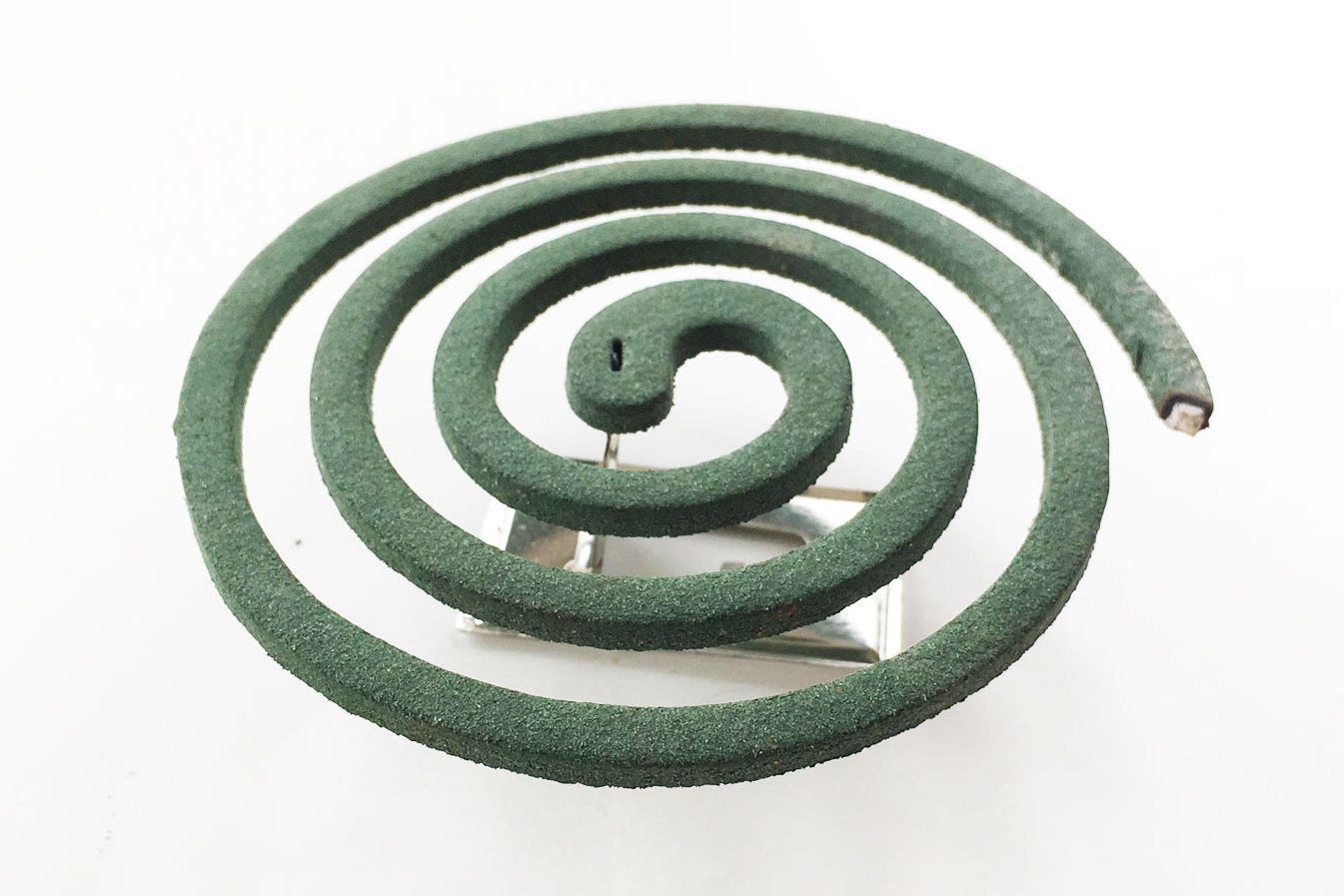
There are many more modern ways to keep the mozzies at bay (indeed, come summer time, social media seems to be full of solutions), but none are quite as atmospheric and chilled as a slow burning (and, it is submitted, preferably dark green) mosquito coil smoking away in the corner. For many they trigger vivid memories of things like holidays away, camping trips and other outdoor activities – often from a time when life was slower.
Mosquito coils have been widely used throughout Asia, Africa, South America, Canada, Mexico and Australia – but for some reason they never really caught on in North America and Europe. They were invented in Japan, at the end of the 19th century. Ueyama Eiichiro was in the business of exporting mandarins when Fukuzawa Yukichi, a famous author and founder of Keio University, introduced him to a seed trader in the United States. This dealer offered Ueyama seeds of a flowering plant that he claimed would knock insects dead. Ueyama decided to import the seeds and start growing the plant in Japan.


It was a member of the aster family, Tanacetum cinerariifolium, and certainly didn’t look too sinister. With two rows of overlapping white petals and a cheery yellow center, the flower resembled nothing so much as the common daisy. But sure enough, there was something in the flower heads, when dried and ground into a powder, that proved lethal to insects. The active components are called pyrethrins; they attack the nervous systems of all insects, and inhibit female mosquitoes from biting.
Initially, Ueyama mixed the flower powder into starch bases to create incense sticks that would repel insects. They worked quite well but burned down too quickly, barely lasting 40 minutes. Then, in 1895, his wife Yuki suggested he make longer sticks and coil them into a spiral shape. Voila! The defining idea. The coils were a hit and were hand-rolled until 1957 when production was mechanised.
Since then, very little has changed about Ueyama’s “Kincho” brand coils, including the deep green colour and the old school packaging with the trademark red rooster head.


After World War II, Ueyama’s company, Dainihon Jochugiku Co. Ltd, now headquartered in Osaka, established joint venture companies in various countries, including China and Thailand, to produce mosquito repelling products based on local conditions; and that’s why you see other Asian brands like “White Crane”, “Pug Cat” and “Zebra” (China); “Tiger” (Malaysia); “Fish” (Hong Kong SAR) and Chinese Taiwan’s “Cock”.
All the animals of the world united in the noble quest to kill mosquitos!


Dai Nihon Jochugiku continues to produce for a mosquito coil market that is alive and well, with strongest sales to older consumers who grew up with them. The status of the Kincho mosquito coils is such that the brand received the Good Design Long Life Award from the Japan Ministry of Economy, Trade and Industry in 2012.
One consequence of the power shortages following the Great East Japan earthquake and tsunami in 2011 was a resurgence of interest in mosquito coils, with more people keen to conserve electricity by turning off their air conditioners and reviving the old practices for keeping comfortable in summer.
REMO Mosquito Coil Design | 1992
Browse Mosquito Coil merchandise HERE


REMORANDOM Chapter
