Humour has well documented benefits. It’s physically and psychologically healthy. It reduces stress and makes us mentally flexible — able to manage change, take risks and think creatively. It also serves as a social lubricant, making us more effective in dealing with people.
One quintessential manifestation of humour is the single-panel cartoon, and at the top of that particular food chain lives the New Yorker cartoon. The New Yorker has featured cartoons in its magazine since it began publication in 1925.


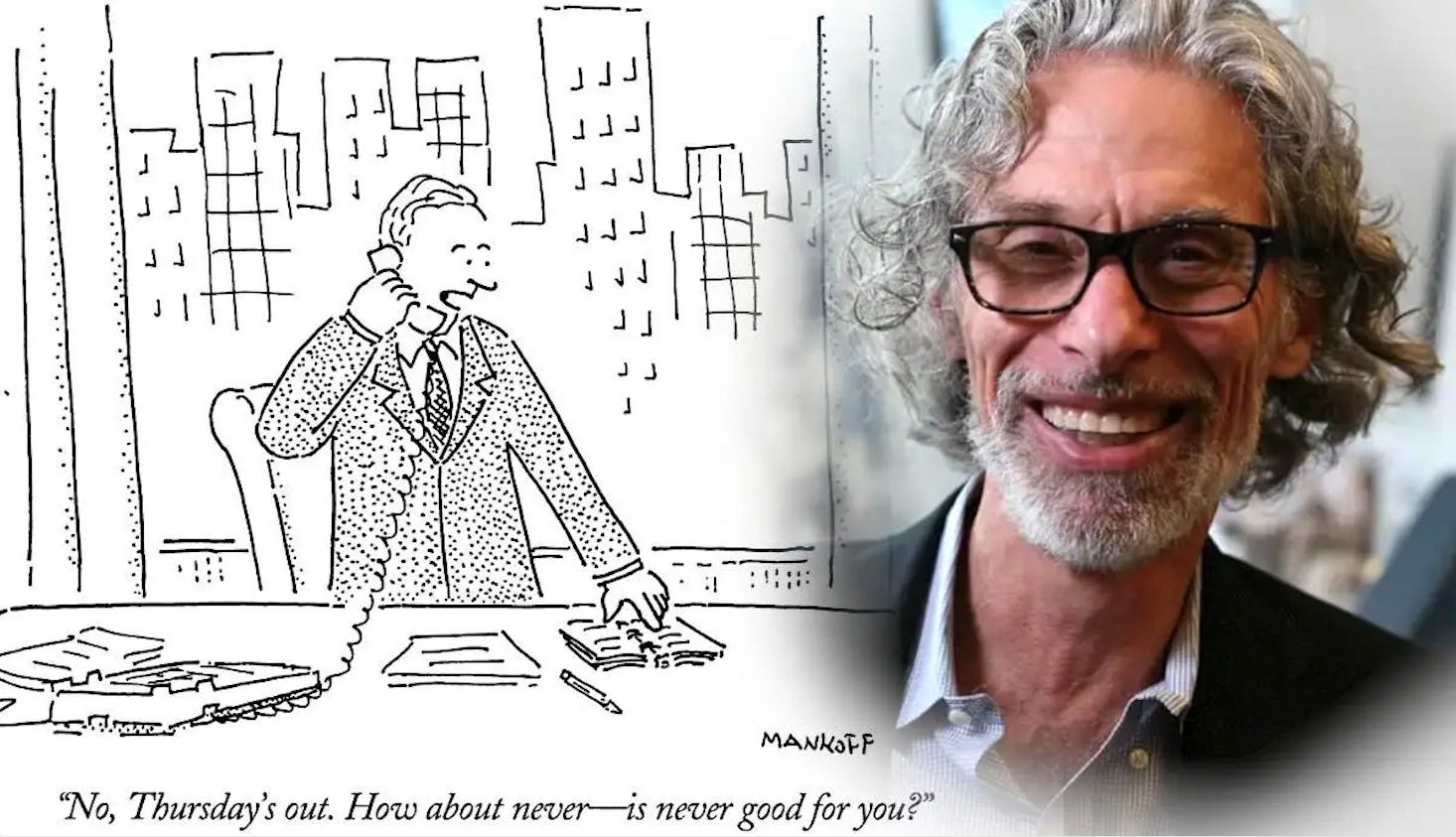
For this story we collaborated with Bob Mankoff, the ultimate New Yorker cartoon insider. Mankoff is the president of CartoonStock, the world’s largest database of single-panel cartoons, but prior to this he was a staff cartoonist for The New Yorker for 35 years and its celebrated and revered Cartoon Editor from 1997 to 2017.
Mankoff would review over a thousand cartoons a week in order to help select the 15 or so that got into the magazine. It’s not easy to get your cartoon published in The New Yorker, and indeed there is an entire subculture that has grown up around the rejected New Yorker cartoon. It took even Bob three years and 2,000 submissions to see his name in the corner of one of his cartoons. Getting published in The New Yorker takes dogged perseverance.
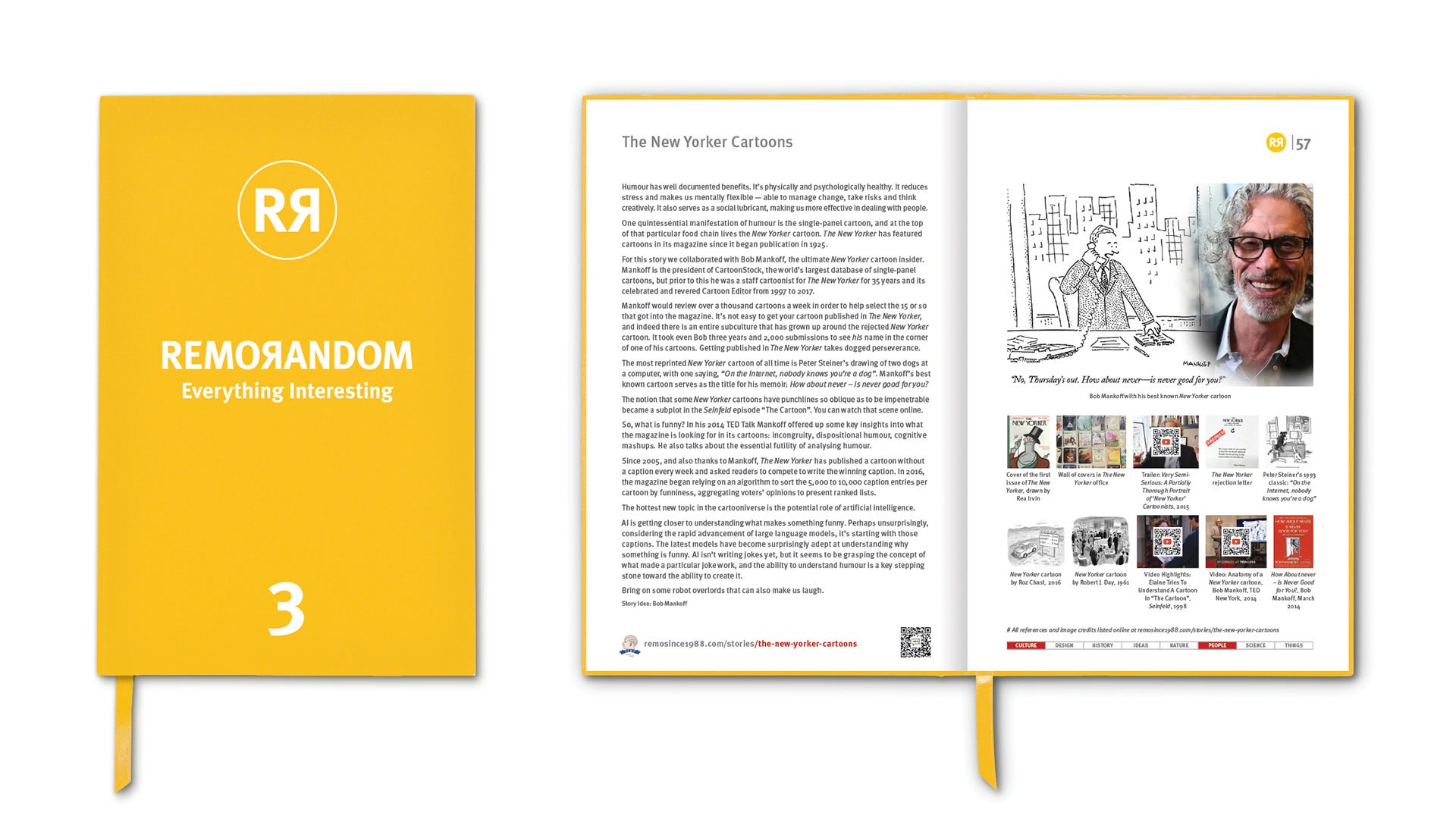
The most reprinted New Yorker cartoon of all time is Peter Steiner’s drawing of two dogs at a computer, with one saying, “On the Internet, nobody knows you’re a dog”. Mankoff’s best known cartoon serves as the title for his memoir: How about never – is never good for you? – available, with Bob’s blessing, as a REMO design HERE.


The notion that some New Yorker cartoons have punchlines so oblique as to be impenetrable became a subplot in the Seinfeld episode “The Cartoon”. You can watch that scene HERE or below.
So, what is funny? In his 2014 TED Talk Mankoff offered up some key insights into what the magazine is looking for in its cartoons: incongruity, dispositional humour, cognitive mashups. He also talks about the essential futility of analysing humour.
Since 2005, and also thanks to Mankoff, The New Yorker has published a cartoon without a caption every week and asked readers to compete to write the winning caption. In 2016, the magazine began relying on an algorithm to sort the 5,000 to 10,000 caption entries per cartoon by funniness, aggregating voters’ opinions to present ranked lists.
The hottest new topic in the cartooniverse is the potential role of artificial intelligence.
AI is getting closer to understanding what makes something funny. Perhaps unsurprisingly, considering the rapid advancement of large language models, it’s starting with those captions. The latest models have become surprisingly adept at understanding why something is funny. AI isn’t writing jokes yet, but it seems to be grasping the concept of what made a particular joke work, and the ability to understand humour is a key stepping stone toward the ability to create it.
Bring on some robot overlords that can also make us laugh.
Story Idea: Bob Mankoff
Videos
REMORANDOM Book Chapter