The Oxford English Dictionary (OED) is the grandfather of all dictionaries, and one that has consistently based its entries on real evidence of how words have actually been used throughout the history of the English language. Its development presents us with an epic example of what would be referred to today as “crowdsourcing” and “user-generated content”, and involves a fascinating journey involving many people, spanning more than a century.
The idea of creating a comprehensive dictionary of the English language was conceived by members of the Philological Society of London. In 1857, they formed a committee to oversee the project. [Ed: Always an ominous move.] Due to the enormity of the task, progress was slow. But then, in 1879, Scottish lexicographer James Murray was appointed editor for the project, now being underwritten by a contract with Oxford University Press. Murray was an experienced linguist and had worked on other dictionaries. Under his leadership, the project gained momentum.


Recognising the vastness of the English language and its extensive historical roots, Murray and his team sought the help of the public. They issued an appeal for “volunteers” to contribute quotations that illustrated the usage of words over time. Copies of the new appeal were sent to all corners of the globe, and new readers began to come forward in their hundreds, and eventually thousands.
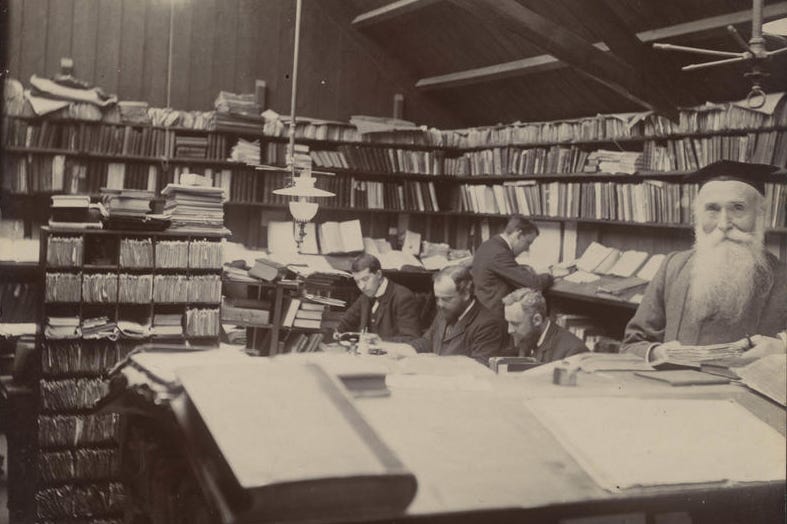
Murray worked from a corrugated iron outbuilding that he called the “Scriptorium”, which was lined with wooden planks, bookshelves, and 1,029 pigeon-holes for the incoming quotation slips. Murray received and replied to so many letters that the Post Office installed a pillar box outside his house on Banbury Road in Oxford.
Murray was originally hoping that the new dictionary would be done by around 1890. That would turn out to be gross underestimation of the amount of work involved. It would take almost four more decades for the 12-volume first edition of the OED to be completed in 1928 (13 years after Murray’s death). By the time it was finished, its 414,825 entries (excluding the word “cunt”, but that’s a whole other story) had been crowdsourced from a surprising and diverse group of people, from archaeologists and astronomers to murderers, naturists, novelists, pornographers, queer couples, suffragists, vicars and vegetarians – as colourfully documented by Australian lexicographer Sarah Ogilvie in her 2023 book The Dictionary People: The Unsung Heroes Who Created the Oxford English Dictionary.
And the work continues. The OED is a living document that undergoes regular updates and revisions. The involvement of the public continues to be crucial for keeping the dictionary current and reflective of the ever-changing English language.


In 2005 the OED linked up with the BBC for another kind of appeal to the public. The Wordhunt asked BBC television viewers for help in finding earlier examples of a selection of 50 words and phrases; and the results were presented the following year in the television series Balderdash & Piffle. Fun.
Finally, another book, The Meaning of Everything by Simon Winchester (2003) is a scintillating account of the creation of the OED, the greatest monument ever erected to a living language. Recommended.
PS: For another relevant example of user generated content, see Wikipedia [RR4:85]
Video
REMORANDOM Book Chapters