


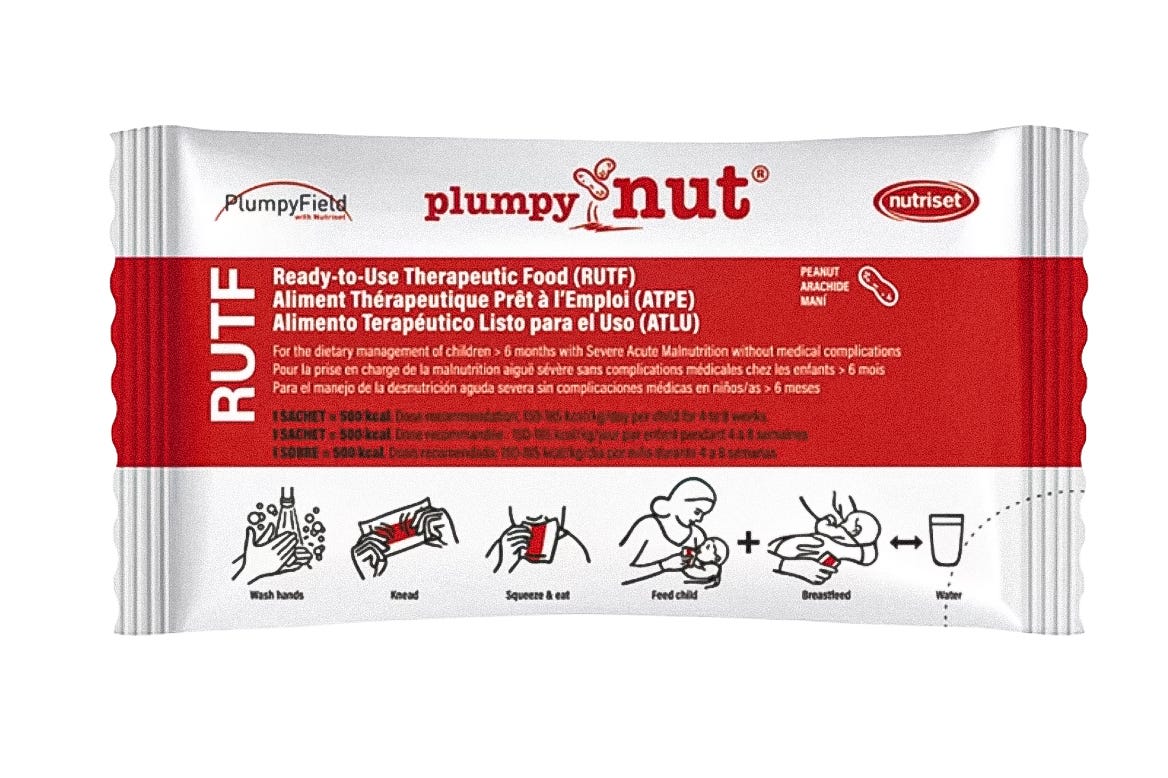
The product was invented in 1996 by French paediatric nutritionist André Briend and food engineer Michel Lescanne. The idea was sparked, improbably, by Nutella. [Ed: “Inspired by Nutella” are three words that I never imagined I would be writing.]
Briend observed that Nutella had several ideal properties: it was calorie-dense, shelf-stable and required no preparation. By swapping hazelnuts for peanuts – cheaper and more widely available in regions affected by famine – and fortifying the mixture with milk powder, sugar, vegetable oil and essential vitamins and minerals, the pair created a powerful therapeutic food. The product was commercialised by the French company Nutriset.


Plumpy’Nut became the leading example of what is known as a Ready-to-Use Therapeutic Food (RUTF), now widely deployed by organisations such as UNICEF and Médecins Sans Frontières. Each 92-gram sachet contains roughly 500 calories along with a full complement of nutrients, enabling rapid weight gain in severely malnourished children.
According to a 2012 NPR analysis each packet of Plumpy’Nut delivers: the calories of two McDonald’s hamburger patties, the protein of half a chicken breast, the calcium of three cups of milk, the vitamin C of an orange, the iron of a bunch of spinach, the folic acid of nine asparagus spears … and more.


What made Plumpy’Nut revolutionary was not just its nutritional content, but its product design. It requires no water, which is critical in areas where clean water is scarce, and it does not need refrigeration, with a shelf life of up to two years. Packaged in small, single-use sachets, it is hygienic, portable and easy for caregivers to administer (the paste is sucked directly from the packet). Most importantly, it enabled a shift from hospital-based treatment of malnutrition to home-based care, allowing far more children to be reached.
In structured programs, recovery rates for the acutely malnourished can exceed 90 percent. Production has increasingly shifted to local facilities in Africa, Asia and the Caribbean, helping reduce costs and support local economies. In Ethiopia in the early 2000s, Plumpy’Nut played a central role in a shift toward community-based management of acute malnutrition. A few years later, during the 2007 food crisis in Niger, large-scale distribution of Plumpy’Nut by UNICEF and its partners demonstrated that mass treatment of malnutrition could be delivered efficiently at the community level.


Despite its impact, Plumpy’Nut has also been the subject of controversy. Nutriset patented the formulation and production process in many countries, giving it significant control over supply. Critics, including Médecins Sans Frontières, argued that these patents limited competition and kept prices higher than necessary, potentially restricting access in emergencies.
Over time, the company has introduced licensing agreements that allow approved local manufacturers to produce the paste, easing some of the tension. Moreover, most of the patents have now lapsed.
Today almost 9 million children a year are treated for severe malnutrition with Plumpy’Nut
Random Fun Postscript
On 7 April 2026, Nutella received viral attention when, during a live stream of the Artemis II moon mission, a jar of the spread was seen floating around the crew space of the Integrity vehicle.


REMORANDOM 7
Plumpy’Nut will feature in print in REMORANDOM 7. Subscribe HERE to receive RR6 immediately and RR7 in October 2026.
