


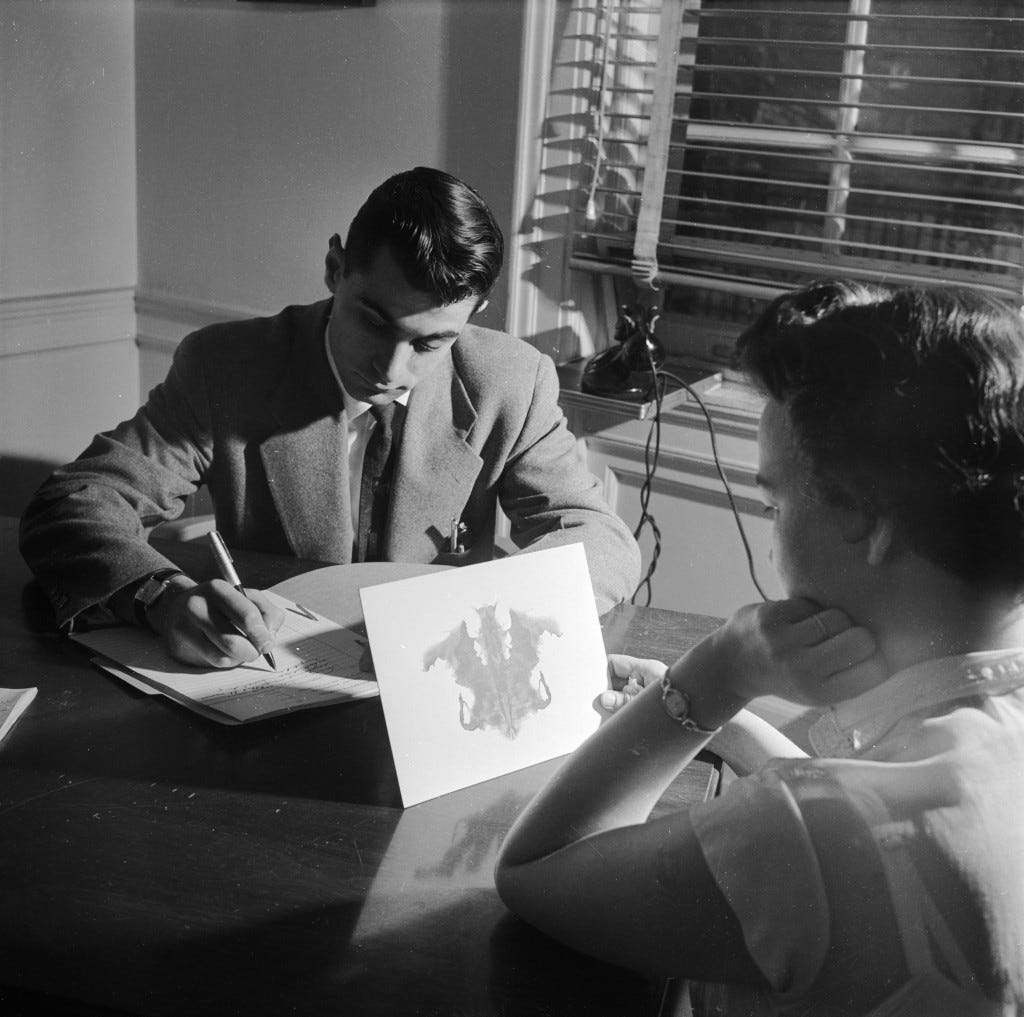
For years Hermann Rorschach had grappled with the theories of Freud and Jung while also absorbing the aesthetic of a new generation of modern artists. He had come to believe that who we are is less a matter of what we say, than what we see, and the process we use to see it.
The Rorschach test is a psychological test in which subjects’ perceptions of symmetrical inkblots are recorded and then analysed using psychological interpretation, complex algorithms, or both.
Some psychologists use this test to examine someone’s personality characteristics and emotional functioning. It has been employed to detect underlying thought disorders, especially in cases where patients are reluctant to describe their thinking processes openly.


The use of interpreting “ambiguous designs” to assess an individual’s personality is an idea that actually goes back to Leonardo da Vinci and Botticelli. Interpretation of inkblots was central to a game called Gobolinks, from the late 19th century. The Rorschach test, however, was the first systematic approach of this kind.
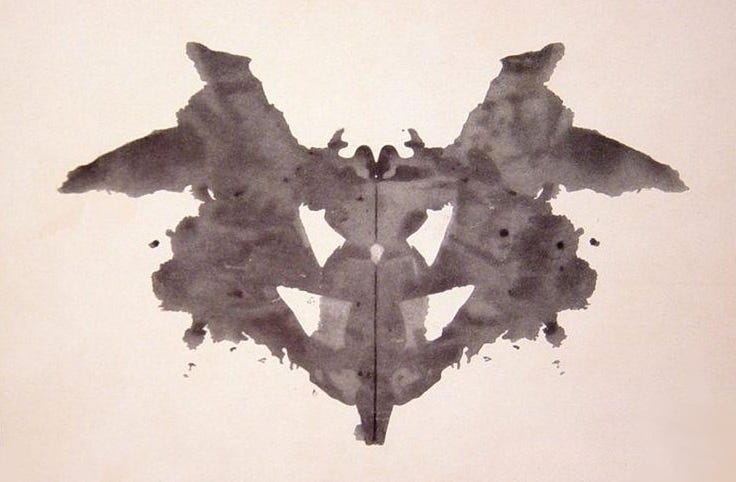
In 1921, after studying 300 mental patients and 100 control subjects, Rorschach wrote his book Psychodiagnostik, which was to form the basis of the inkblot test. After experimenting with several hundred inkblots which he drew himself, he selected a set of ten for their diagnostic value. See them in order in our image gallery.


Rorschach suffered a ruptured appendix and died the following year, but his creation continued to grow and become part of the culture, documented with style in a 2017 book The Inkblots: Hermann Rorschach, His Iconic Test, and the Power of Seeing by Damion Searls.
The Rorschach test made its way to the United States, where it took on a life of its own, becoming used for purposes never envisioned by Rorschach. Co-opted by the military after Pearl Harbor, it was a fixture at the Nuremberg trials and in the jungles of Vietnam. It became an advertising staple, a clich. in Hollywood and journalism, and an inspiration to everyone from Andy Warhol to Jay-Z. The test was also given to millions of defendants, job applicants, parents in custody battles, workers applying for jobs, and people suffering from mental illness … or simply trying to understand themselves better. And it is still used today.
The Rorschach test has shaped our view of human personality and become a fixture in popular culture.
Curious to know more? Watch the TED-Ed video by Damion Searls that explains in some detail how the Rorschach test actually works.
Finally, Australian artist Ben Quilty has used the Rorschach technique in his paintings, by thickly applying oil paint onto a canvas and then pressing a second, unpainted, canvas onto the first, and proceeding to create an artwork from the shape created by this method.
Story Idea: Melanie Giuffré
Videos
REMORANDOM Chapter
