


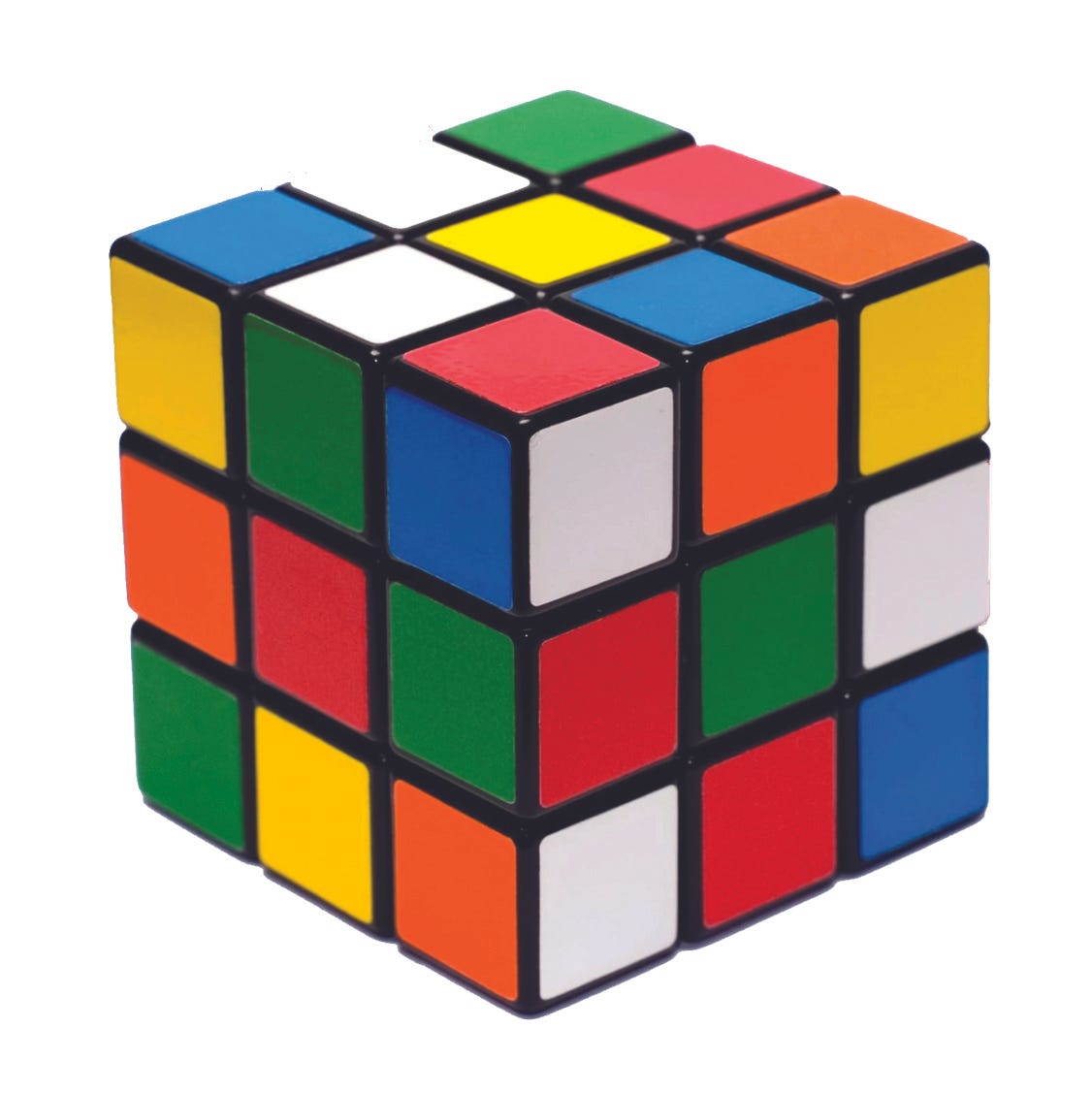
In the mid-1970s Ernő Rubik, a Hungarian sculptor and professor of architecture working at the Academy of Applied Arts and Crafts in Budapest, developed a teaching tool for his students that he initially called the “Magic Cube”. The cube was designed to help them solve the structural problem of moving the parts of the cube independently without the entire mechanism falling apart. A fairly specific problem.
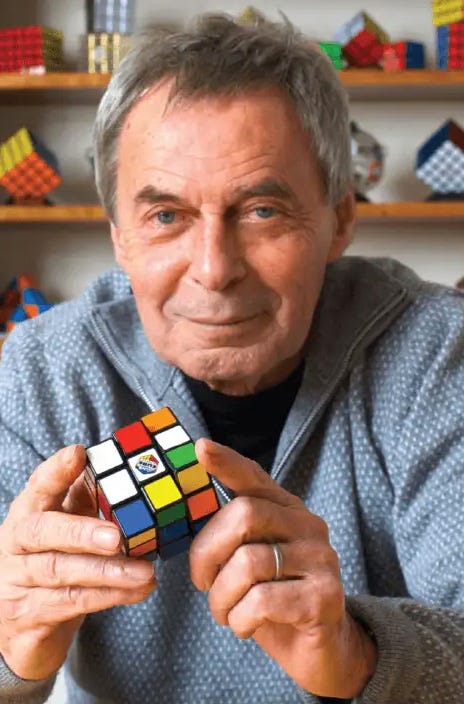
Rubik did not realise that he had created a puzzle until the first time he scrambled his new cube and then tried to restore it. It took him a month.


The first test batches of the Magic Cube were produced in late 1977 and released in Budapest toy shops. The rest is history. The renamed “Rubik’s Cube” made its debut at the Nuremberg Toy Fair in 1977, instantly captivating puzzle enthusiasts worldwide. More than 350 million cubes have sold globally. (If you were to include knockoffs, the number is far higher.) They continue to captivate computer programmers, philosophers and artists.
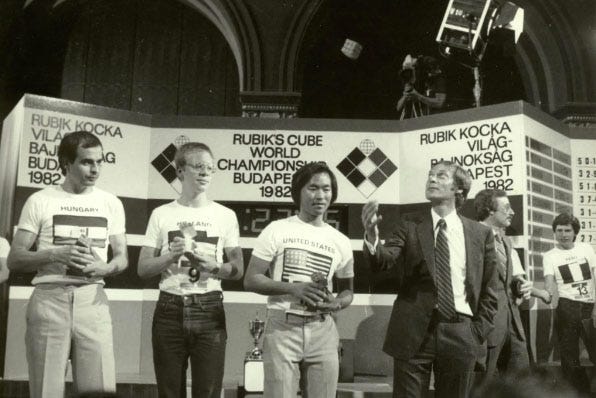
Competitions and events have been organised to showcase people’s skills and innovation. You might be aware of “speedcubing”, the practice of trying to solve a Rubik’s Cube in the shortest time possible. There are a number of speedcubing competitions that take place around the world and an entire subculture that shares its collective feats online. The current record of just 2.51 seconds, was set by Xuanyi Geng (China) at the Guangzhou Grand Open on 4–5 October 2026. [Ed: Fresh!]
You might not be aware of:
Blindfolded Solving. The contestant first studies the scrambled cube by looking at it normally with no blindfold, and is then blindfolded before beginning to turn the cube’s faces. Their record time for this event, including both the time spent memorising the cube and the time spent manipulating it, is 11.56 seconds set by Tommy Cherry of the United States on 28 June 2026 at the Mid-Atlantic Quiet Championship 2026.
Feet Solving. The world record fastest Rubik’s Cube solve with one’s feet is 15.56 seconds, set by Mohammed Aiman Koli of India on 27 December 2019 at VJTI Mumbai Cube Open 2019.

As an aside, there are 43 quintillion possible permutations of the cube. If you had one standard-sized Rubik’s Cube for each permutation, you could cover the Earth’s surface 275 times, or stack them in a tower 261 light years high.
To this day, Rubik’s invention remains a symbol of perseverance and creativity. To celebrate the 40th birthday of the cube, Rubik appeared on the NBC News TODAY Show in the US. When asked to explain the key purposes of the cube, Rubik replied:
“The key is very simple. Never give up. That’s the key question. You need patience, because – that’s life; and we need to solve our problems in life.”
The Rubik’s Cube has come to embody “much more than just a puzzle”, the cognitive scientist Douglas Hofstadter wrote in 1981:
“It is an ingenious mechanical invention, a pastime, a learning tool, a source of metaphors, an inspiration.”
Video
References
nytimes.com/2020/09/16/books/erno-rubik-rubiks-cube-inventor-cubed.html
Video: Rubik’s Cube Creator On How It Became A Global Phenomenon | TODAY
REMORANDOM Books
Order our books on the REMO store website HERE. Subscribe to receive all future volumes and other printed goodies HERE.
