



“Scissors paper rock” (the most common ordering of the words in Australia) is a game most often played between two people, in which each player simultaneously forms one of three shapes with an outstretched hand: “rock” (a closed fist), “paper” (a flat hand) and “scissors” (a fist with the index finger and middle finger extended).
Rock beats scissors. Paper beats rock. Scissors beats paper.

The earliest form of scissors paper rock-style game originated in China during the Han Dynasty (206 BCE–220 CE) and was subsequently imported into Japan, where it became known as jan-ken, reaching its modern standardised form – before being spread throughout the world in the early 20th century.
The game has three possible outcomes: a draw, a win or a loss. Mathematically, there is no best option when it comes to playing scissors paper rock. No matter how often you play, if you randomly choose a strategy, there is a one-third chance that you win.


Scissors paper rock is often used as a fair choosing method between two people or two equally acceptable outcomes, similar to coin flipping, drawing straws, or throwing dice in order to settle a dispute or make an unbiased group decision. Unlike truly random selection methods, however, scissors paper rock can be played with some degree of skill by recognising and exploiting non-random behaviour in opponents, e.g. by analysing historical patterns. As a result, there have been programming competitions for algorithms that play scissors paper rock.
The game, which is both very popular and global, has been featured in many films, TV shows and books, and is still sometimes used in business or legal settings to resolve disputes or make impartial decisions.
In 2005 Takashi Hashiyama, the CEO of Japanese television equipment manufacturer Maspro Denkoh, mandated a single game of scissors paper rock for the selection of an auction house to take a priceless collection of Impressionist paintings to market. Sotheby’s went with “paper”. Christie’s won the match with “scissors”, and sold the US$20 million collection, earning millions of dollars of commission.


Finally, a bit of robotic supremacy fun:
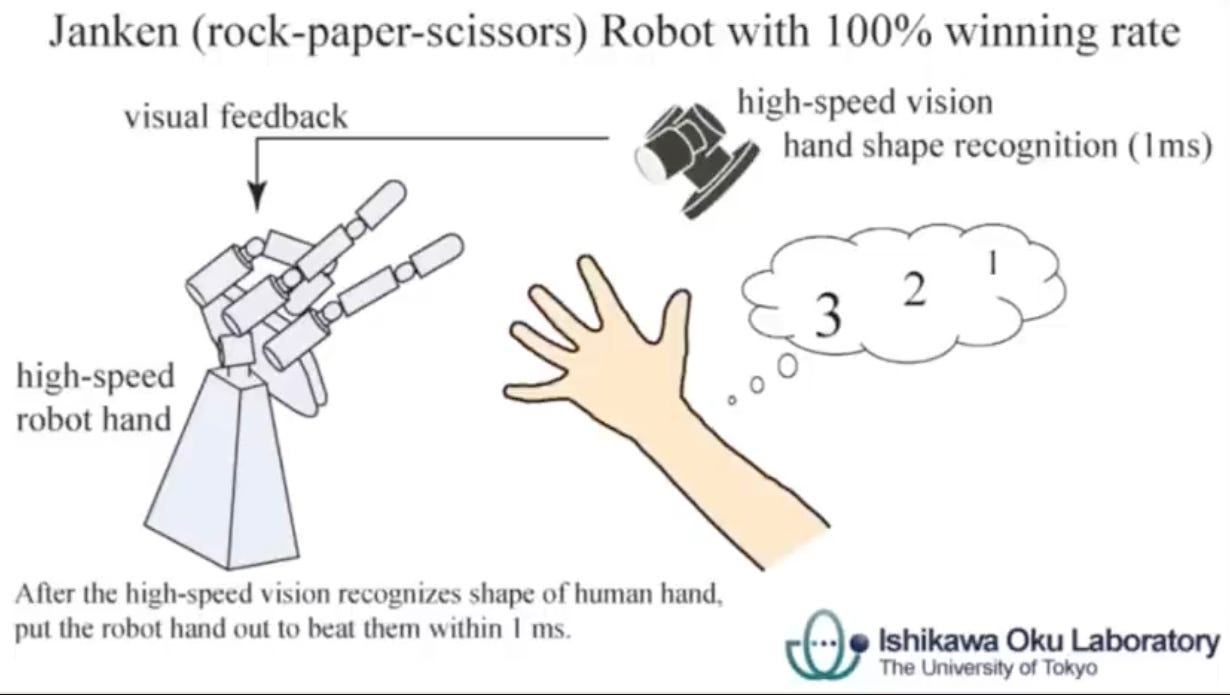
In 2012, researchers from the Ishikawa Watanabe Laboratory at the University of Tokyo created a robot hand that can play scissors paper rock with a 100% win rate against a human opponent. Using a high-speed camera the robot recognises within one millisecond which shape the human hand is making, then produces the corresponding winning shape. Watch the video evidence HERE or below.
Video
REMORANDOM Chapter
