


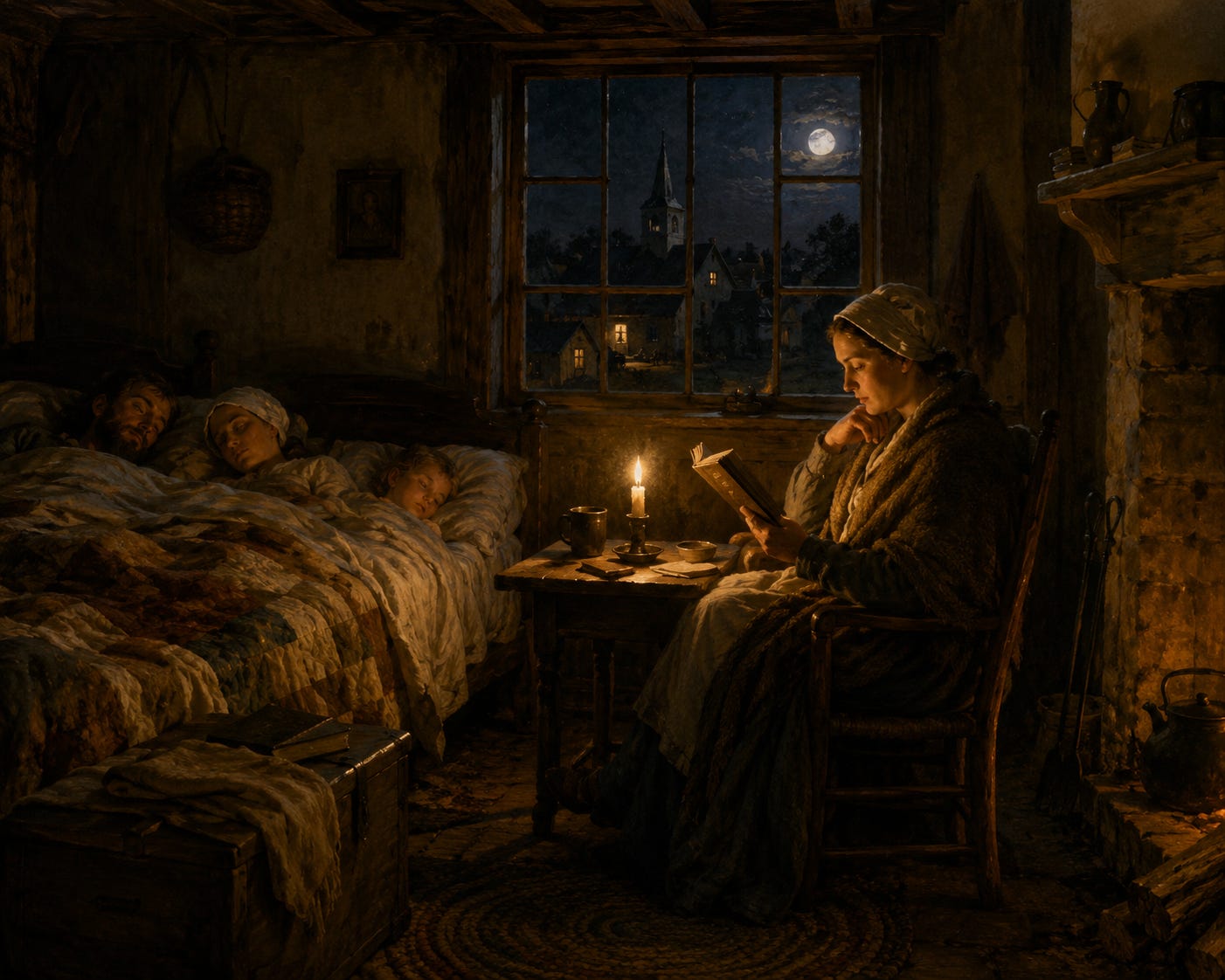
For much of human history, a full night of sleep was not a single, uninterrupted block. Instead, many people followed a pattern known as “first sleep” and “second sleep.” This biphasic rhythm – two distinct periods of sleep separated by an hour or more of wakefulness in the middle of the night – was common in Europe and elsewhere until the early modern period.


The idea was brought to widespread attention by historian Roger Ekirch, professor of history at Virginia Tech. His research into diaries, court records, medical texts and literature revealed hundreds of matter-of-fact references to “first sleep” and “second sleep” in pre-industrial societies. Writers such as Geoffrey Chaucer and Charles Dickens casually mentioned people waking after their first sleep to pray, talk, smoke, read or even visit neighbours before returning to bed for the second.
A typical night might have begun shortly after dusk. People would sleep for three or four hours – the “first sleep” – then wake naturally at around midnight. This waking interval, sometimes lasting an hour or two, was known as “the watch” and was often described as a peaceful and reflective time. The French called it dorveille, or wake-sleep, a hypnotic state. It was a surprisingly useful window during which to get things done – and also, as it happens, for having sex. Afterward, people would return to bed for their “second sleep”, which lasted until dawn.


Far from being a peculiarity of the Middle Ages, Ekirch began to suspect that the method had been the dominant way of sleeping for millennia – an ancient default that we inherited from our prehistoric ancestors. The first record Ekirch found was from the 8th Century BCE, in the Greek epic The Odyssey.


Modern sleep science suggests that this pattern may have been biologically natural under conditions without artificial lighting. The human sleep cycle is strongly influenced by the circadian rhythm, the roughly 24-hour internal clock that responds to environmental light and darkness. When researchers for a 1992 study placed people in long periods of darkness – similar to winter nights before electric lighting – their sleep divided spontaneously into two segments, separated by a calm waking phase.
This mid-night wakeful period may also have distinctive neurological characteristics. Studies suggest that levels of the hormone prolactin remain elevated during this time, producing a state that is relaxed and contemplative rather than alert or stressed. Some researchers believe this may explain why historical accounts describe the interval as serene rather than frustrating.
The gradual disappearance of “second sleep” appears to have coincided with social and technological changes beginning in the 17th century and accelerating during the Industrial Revolution. Improved street lighting, the spread of coffee houses [Ed: Caffeine as culprit] and the growing expectation of nighttime productivity pushed bedtimes later. With people staying awake longer after sunset, the long winter night that once accommodated two sleep phases effectively shortened.
By the late 19th century, references to “first sleep” and “second sleep” had largely vanished from everyday language, replaced by the modern expectation of a single continuous eight-hour block. Ironically, many people today experience middle-of-the-night awakenings and assume they are suffering from insomnia. Some sleep researchers suggest that these awakenings may simply be a faint echo of humanity’s earlier, biphasic sleeping pattern.
REMORANDOM Book Series
Really interesting piece about how sleep has changed over the centuries. You might be interested to know though that the archive image of a ‘man sleeping’ is actually an image of an oil painting called the Death of Chatterton by Henry Wallis (the poet Chatterton had poisoned himself with arsenic in 1770).