


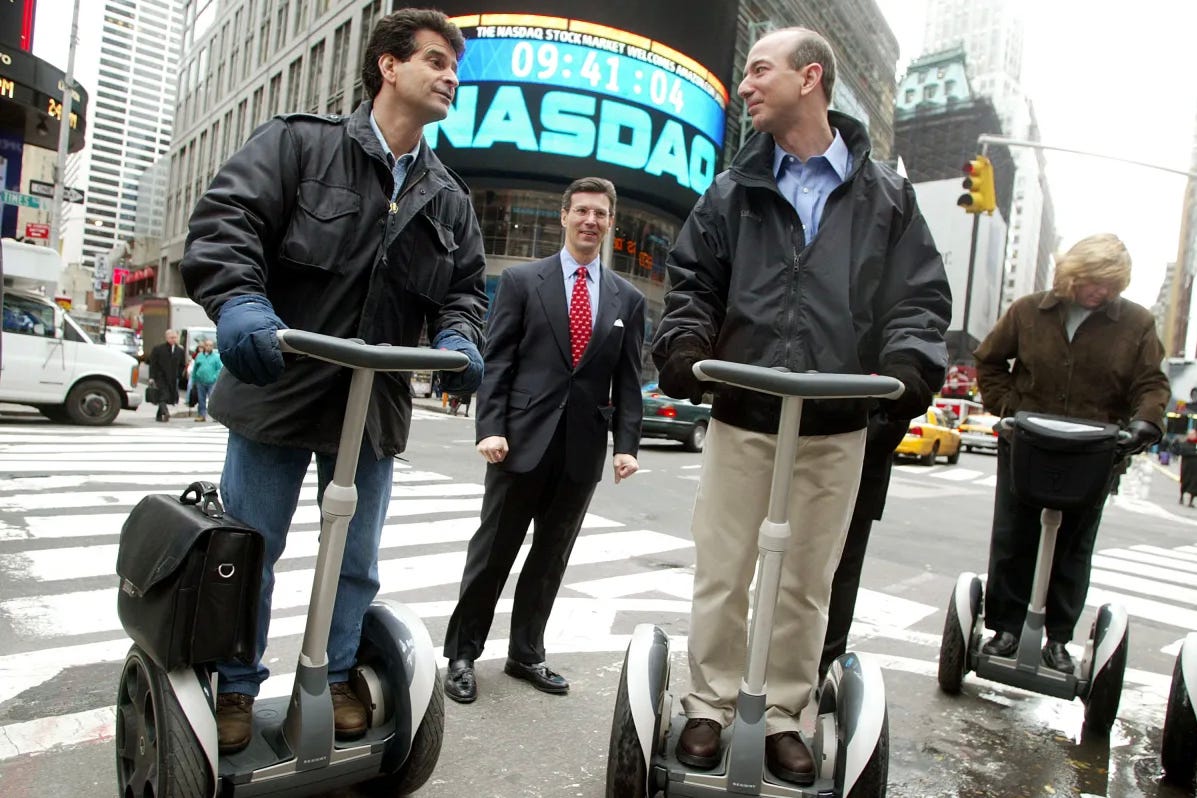
The Segway is a two-wheeled, self-balancing personal transporter that operates using a combination of gyroscopes and sensors. Developed at a cost of more than US$100 million, the vehicle is a complex bundle of hardware and software that mimics the human body’s ability to maintain its balance.
The Segway was also the most hyped tech product of the early 21st century.
Alternately codenamed “Ginger” (after actor and Fred Astaire dance partner Ginger Rogers) and “IT” during the secretive development period prior to it launch, the device engendered serious conversations among tech leaders and futurists about the ways in which it would transform our cities. It’s inventor and company founder Dean Kamen believed that it would completely revolutionise transportation. “I believe the Segway HT will do for walking what the calculator did for pad and pencil,” Kamen said in 2001, the year he unveiled it on the ABC News morning program Good Morning America.


Kamen was already a famous inventor. His innovations greatly influenced the medical profession. Inspired by his “iBOT” wheelchair, a six-wheel machine that goes up and down stairs, he claimed that his next product would be transformational. So without any information other than Kamen’s track record as a genius, the hype train began.
Segway had some heavyweight investors and supporters, all beating the same drum. Apple co-founder Steve Jobs predicted that it would become as big as the PC. Amazon founder Jeff Bezos called it “one of the most famous and anticipated product introductions of all time” even before the product first went on sale to the public – naturally on Amazon.com. [Ed: I remember when it was actually given real estate as part of the Amazon.com website header.] Legendary Silicon Valley venture capitalist John Doerr speculated that it would be more important than the internet.
The satirical animated TV show South Park devoted an episode to making fun of the hype even before the product was released. Watch a clip of that HERE or below.


Needless to say, Segway didn’t conquer the world. While the vehicle became a fixture in law enforcement and tourism, it did not gain traction among the wider public. It wouldn’t be the first time a much hyped product or technology failed to cut through and make sense to the man or woman on the street (or in this case rather … on the footpath).
Segway Inc. was acquired by British businessman Jimi Heselden from Kamen in December 2009. Tragically, and ironically, he died a year later after plunging from a cliff into the River Wharfe while riding his (you guessed it) Segway and walking his dog. (He was reportedly giving way to a fellow dog walker.)
In 2015 Segway Inc. was acquired by Ninebot, a Chinese robotics company, and the brand’s product line was expanded to include electric scooters and other personal transport devices. In 2020 Ninebot ceased production of Segway, and laid off 21 employees at its New Hampshire plant who were working on the project.
Depending on who you ask, the Segway is either a cautionary tale about the tech hype cycle or an innovative product that was just too much, and too soon, for this world.
Story Idea: Bob Carey
Videos
REMORANDOM Chapter
