


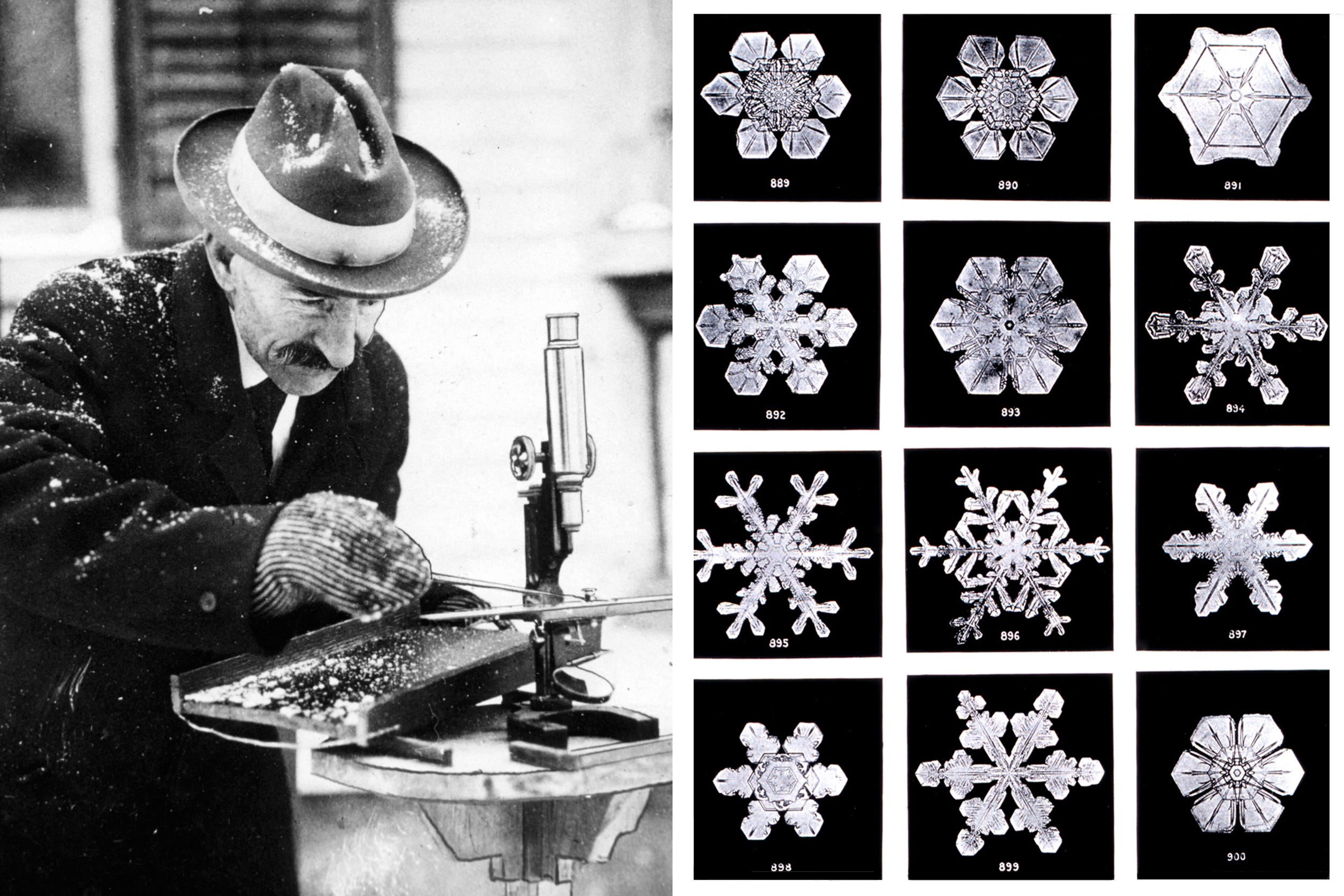
Wilson “Snowflake” Bentley (1865–1931) was a Vermont farmer who became the first person to photograph individual snowflakes using a microscope. Fascinated by their beauty, Bentley spent his life capturing more than 5,000 snowflake images.
As a child he used a microscope given to him by his mother to study “drops of water, tiny fragments of stone, a feather dropped from a bird’s wing, a delicately veined petal from some flower”. From the very beginning it was the snowflakes that fascinated him the most.
Under his microscope, Bentley discovered that each snowflake had its own careful and fleeting geometry. “Every crystal was a masterpiece of design and no one design was ever repeated,” he wrote. “When a snowflake melted, that design was forever lost.”


To document this wonder, he first tried his hand at drawing the snowflakes, but found that they were too elaborate for him to reproduce with adequate fidelity. Eventually, he got the idea to capture them photographically instead, via the incorporation of his microscope.
So, how did he go about it?
Bentley perfected a process of catching flakes on black velvet in such a way that their images could be captured before they either melted or sublimated (converted from solid to gas without becoming liquid). When a snowstorm blew through Jericho, Vermont, he would head outside with a black slate to catch flakes as they fell and then examine them with a handheld magnifier. He would transfer the captured crystal to a microscope slide and press it to the glass with a feather. Then it was a race against the clock to focus the camera and make the lengthy exposure – a task that could take as long as two minutes – before the snowflake was no more. He later recalled the day he’d developed his first successful negative as “the greatest moment of my life”.


In collaboration with George Henry Perkins, professor of natural history at the University of Vermont, Bentley published an article in which he argued that no two snow crystals were alike. This concept caught the public imagination and he published other articles in magazines, including National Geographic, Nature, Popular Science and Scientific American.


His work laid the foundation for modern snowflake science, and he published a book in 1931, Snow Crystals, showcasing 2,453 of his photographs, that is still in print today.
Postscript
The idea that “no two snowflakes are alike” is technically true. At a molecular level, each snowflake forms under slightly different conditions of temperature, humidity and turbulence, which influence its growth. However, given the sheer number of snowflakes that have fallen in Earth’s history, some have likely been extremely similar.
Story Idea: Elly Bieszczad
REMORANDOM Chapter

Technically speaking, to borrow your phrase, no two of anything can be confirmed as identical. Refer to the Heisenberg Uncertainty Principle.
So love that this story flutters down into my lap, precisely during work on a project that features – you guessed it – snowflakes. Thank you, oh ye gods and goddesses of RemoRandom!