


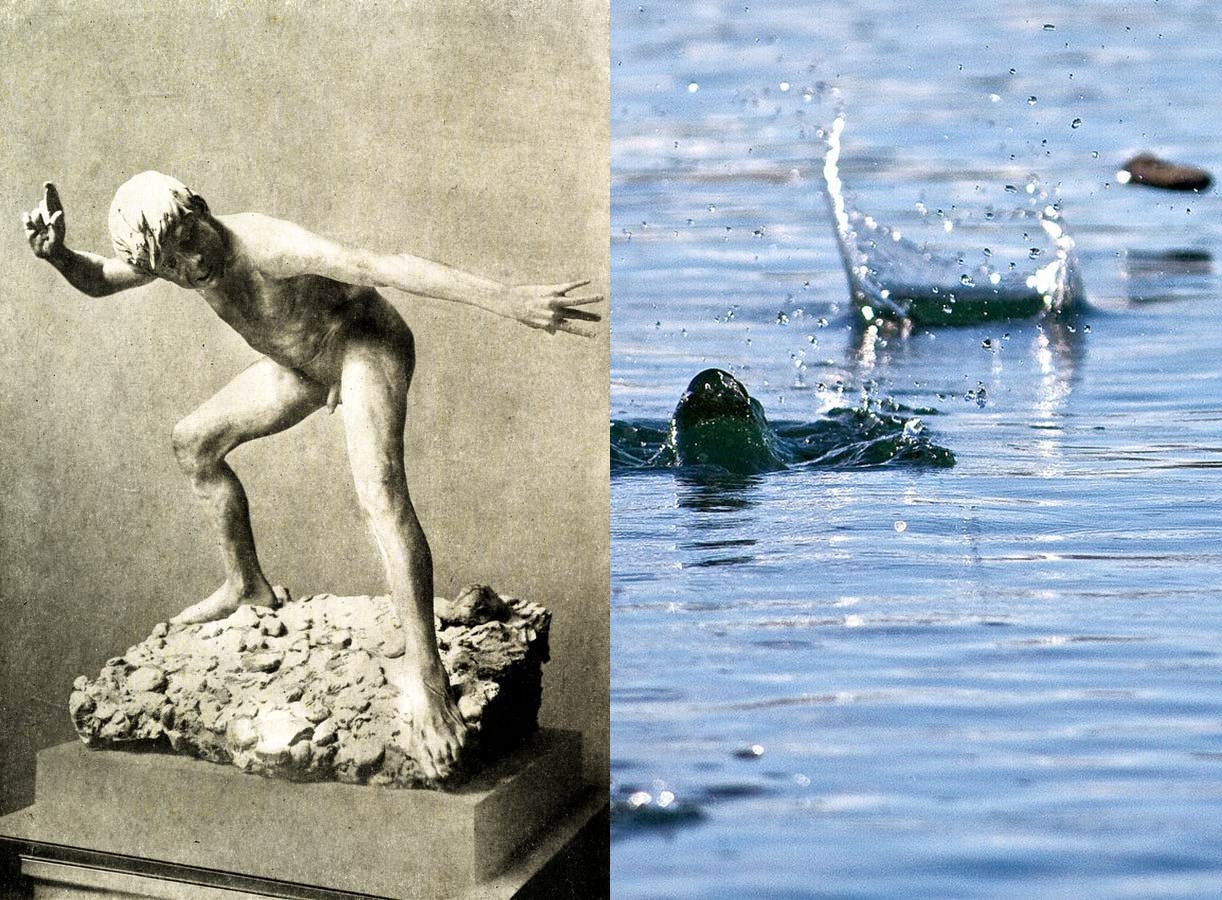
Stone skipping – sometimes called stone skimming – is the art of throwing a flat stone across water in such a way (usually sidearm) that it bounces off the surface. “Skipping” counts the number of bounces, whereas “skimming” measures the distance traveled.
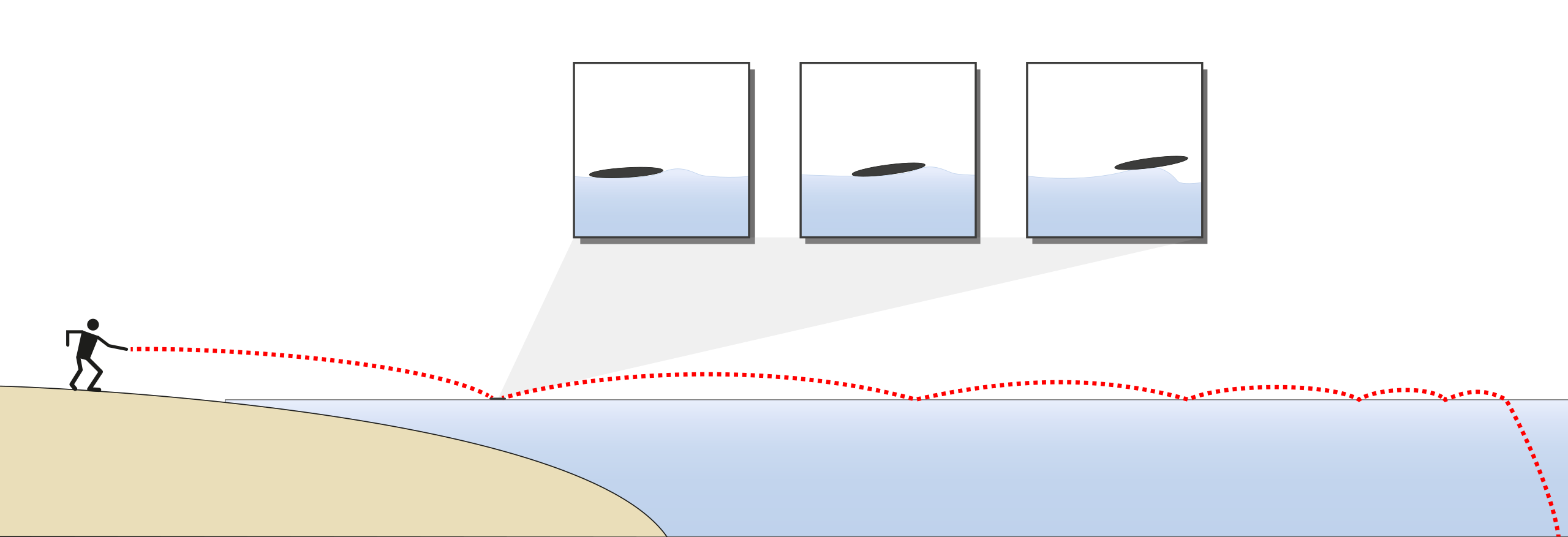
The earliest evidence of stone skipping is prehistoric in nature, and inferred rather than recorded. Archaeologists note that flat river stones naturally attract human hands: ideal for toolmaking, marking and, inevitably, throwing. The earliest explicit cultural reference appears in Classical Greece, where Pliny the Elder wrote about people throwing flat pebbles “so that they bound across the water”, suggesting not only familiarity but an early understanding of technique.
By the medieval period, stone skipping appears in folklore, metaphor, and children’s rhymes across Europe. In Japan, the practice – known as mizukiri, or “cutting the water” – is mentioned in 12th- and 13th-century poetry, capturing the elegance and almost meditative quality of a well-thrown stone.


In England, stone skipping is known as “ducks and drakes”, in France, as “ricochet”, in Ireland, as “stone skiffing”, in Denmark as “smutting”, and every language, from Hindi to Russian to Chinese, has a unique word or term for skipping stones.
In the 19th and early 20th centuries, skipping became a standard element of childhood across the Western world. But it wasn’t until the late 20th century that stone skipping evolved from casual pastime into organised sport. Formal competition began in Scotland, where the abundance of perfectly formed slate pebbles around Easdale Island fostered a local skipping culture.
The World Stone Skimming Championships were founded there in 1983. Since then, the event has grown into an annual gathering, attracting competitors from around the world. The rules are simple: stones must be naturally occurring, thin and weigh no more than 70 grams; throws are judged on distance, but only if they skip at least twice.
In the United States, organised skipping took a more competitive turn, with associations formalising rules and record-keeping. Modern elite skippers favour high spin rates that stabilise a stone’s flight through gyroscopic effect. The physics of skipping has even drawn academic attention. In 2002, French physicist Lydéric Bocquet modelled the optimal angle of impact – around 20 degrees – confirming what great skippers already sensed intuitively.
More recently, the purity of the sport was tested. In 2025, the World Stone Skimming Championships were shaken by a cheating scandal when several competitors were found to be using “doctored” stones – artificially ground or smoothed to improve performance. Since rules require naturally formed Easdale slate, the offenders were disqualified.

The Guinness World Record for the most skips is 88, set on 6 September 2013 at Red Bridge, Pennsylvania, by Kurt Steiner. Steiner previously held the world record from 2002 to 2007. See the record throw below or HERE – and watch the subsequent video to hear from the man himself and see how he throws.


Postscript
While the myth of George Washington throwing a silver dollar across the Rappahannock River is not actually true, the story of his supposed feat has been so influential that throwing events are now held in his honour, particularly on his birthday.
Videos
REMORANDOM Chapter
