


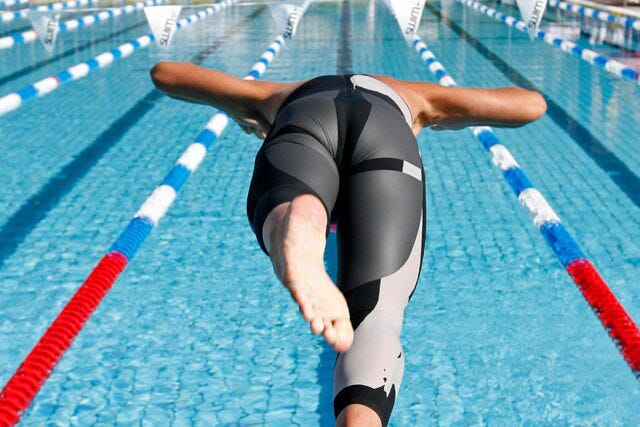
Australian Cameron McEvoy’s recent 50-metre freestyle world record swim of 20.88 seconds is all the more remarkable given what he was wearing – or rather not wearing.
In 2004 the research and development division of swimwear company Speedo conducted a computational fluid dynamics study. What it told them was that viscous drag represents around 25% of the total retarding force faced by competitive swimmers.
Shortly after the Olympic Games that year, Speedo approached NASA to help them design a swimsuit that could radically reduce drag. There was no shortage of internal scepticism. According to Stuart Isaac, senior vice president of Team Sales and Sports Marketing at Speedo at the time: “People would look at us and say ‘this isn’t rocket science’ and we began to think, ‘well, actually, maybe it is.’”


For three years, they worked with everybody from universities and sporting institutes to NASA scientists to create the “LZR Racer”, a next-generation full-body swimsuit that reduced drag, increased buoyancy, maximised muscle support and helped keep swimmers free in their range of motion.
The LZR Racer was made up of two types of material, one woven and coated with water repellant, the other an extremely smooth polyurethane membrane – both engineered to create very little friction when water flows over it. Another feature of the LZR is compression: it is designed to hug the body 70 times tighter than other suits. This has the effect of squashing the body together like a corset to make it more streamlined. [Ed: no pain, no gain.]
These suits had a significant impact on performance, leading to numerous world records being shattered. At the 2008 Olympic Games in Beijing, LZR swimmers won 94% of the gold medals on offer and broke 23 of the 25 records set at the games. “I feel like a rocket,” said swimming superstar Michael Phelps, who helped test the suits and subsequently won an unprecedented eight gold medals at the Games.


The use of these suits sparked debates over fairness and the legitimacy of the new records. Critics argued that the suits provided an artificial advantage, undermining the integrity of the sport and making it more about technology than athletic skill. Opponents of the hi-tech suits argued that the buoyancy they create amounts to “technological doping”.
Also, the high cost of the suits (US$550) and the fact that they that were so fragile and only lasted for a few wears, also raised concerns about accessibility, as not all athletes or national swimming federations could afford them … potentially creating a disparity in competition.


In response to the growing controversy, the International Swimming Federation (FINA) implemented regulations in 2009. They banned full-body swimsuits and set limits on the amount of coverage (waist to knee for men) and thickness of swimsuits. The new regulations required swimsuits to be made of textile fabrics and banned non-permeable materials like polyurethane. After the ban, the performance boost seen during the “swimsuit wars” era declined. Swimmers had to adapt to the new regulations, and the focus returned more to athletic skill and training.
The period left a lasting impact on the development of competitive swimwear. While the high-tech suits have been banned, companies continue to innovate within the new regulations, focusing on optimising suit design for performance.
Videos
REMORANDOM Chapter
