


Tempus Fugit also happens to be the name of an iconic REMO-branded weekly wallplanner, the 2026 version of which starts being useful TODAY. First published in 1991 and still going strong, the 2026 version covers the 60 weeks that run from 1 December 2025 (today) to 24 January 2027. These days we sell the digital file HERE. You can take the PDF to your local print shop for printing at any size. A1 is popular. The wall space in my office is limited. So, I usually opt for A2. So, get organised early, and learn about the origin of the phrase “Tempus Fugit” below.
Remo
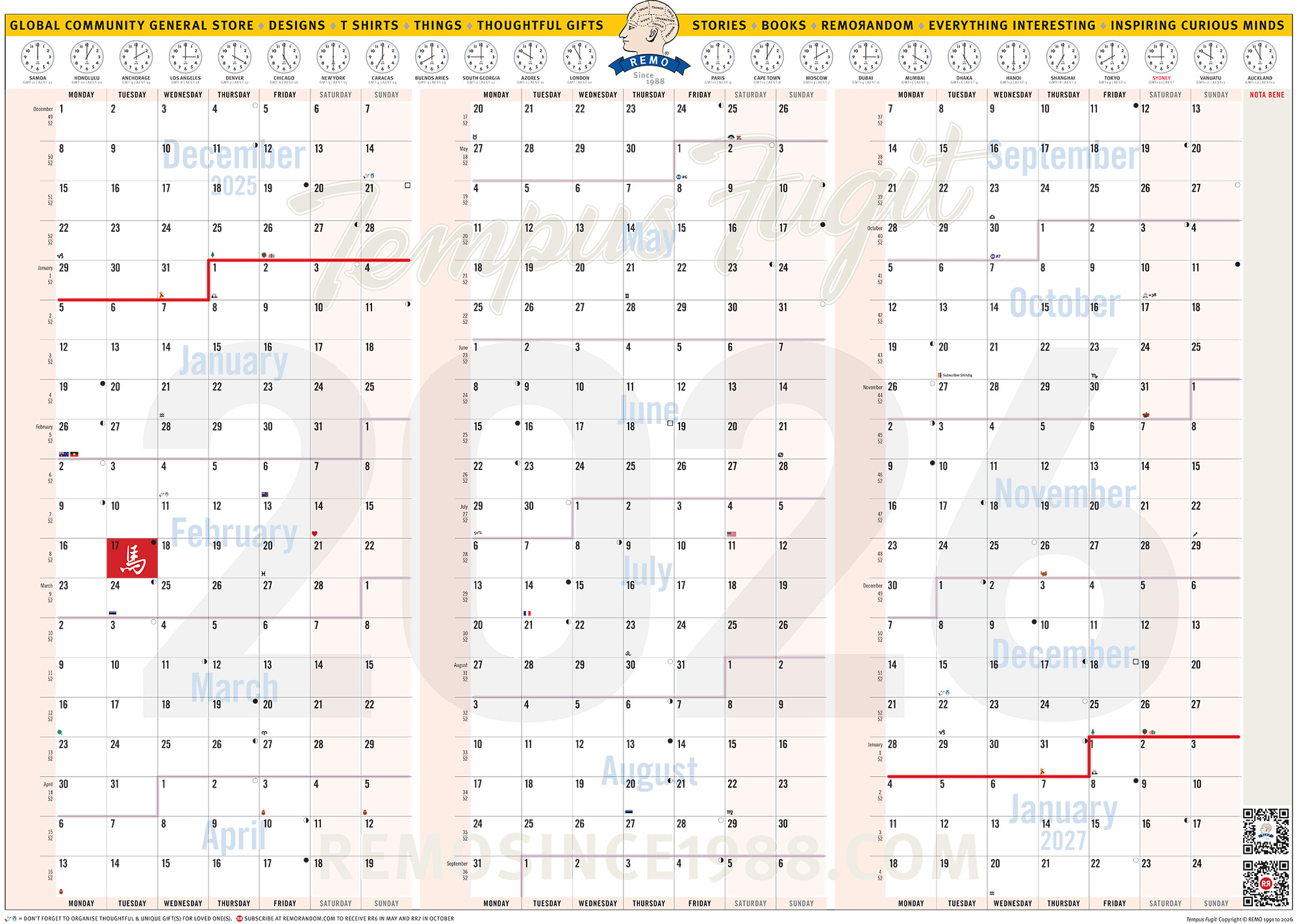


Tempus fugit is a Latin phrase, usually translated into English as “time flies”. However, the literal translation of fugit is actually “flees” and not “flies”.

The expression comes from line 284 of book 3 of Virgil’s Georgics, written around 29 BCE, where it appears as fugit irreparabile tempus: “it escapes, irretrievable time”.
The phrase was later condensed and adopted into common Latin usage. Its survival across centuries reflects an enduring human preoccupation with the speed and impermanence of life. The phrase is used in both its Latin and English forms as a proverb with that sentiment – and is a common motto, particularly on sundials, clocks – and sometimes on gravestones.


The expression entered widespread use during the medieval and Renaissance periods, when Latin functioned as the primary written language of scholarship, science and religion. It appeared frequently in manuscripts, philosophical commentaries and sermons. Christian writers used it to remind readers that earthly time is finite and that moral action should not be delayed. The phrase was also incorporated into early mechanical clocks and public inscriptions, especially in Europe from the 16th century onward. Many clockmakers engraved Tempus Fugit into clock faces as a concise motto about the passing of hours.
By the 18th and 19th centuries, the phrase became a common feature of English-language literature. Writers such as Henry Fielding, Charles Dickens and Mark Twain used it to frame reflections on aging, progress, memory and mortality. The adoption of classical mottos into Victorian domestic culture further entrenched the phrase. It appeared in household objects: mantelpiece clocks, bookplates, graduation gifts and memorial cards.
Artists and designers adopted Tempus fugit as a symbolic motif. It appeared in funerary art, especially on headstones featuring hourglasses, wings and skulls – the traditional imagery of vanitas. The phrase functions as a stabilising link between ancient Latin literature and modern memento mori traditions. (Memento mori is Latin for “remember that you will die”.) [Ed: Thanks for the reminder Latin scholars.]


The phrase also entered broader popular culture. It has appeared in films, television, song lyrics and tattoos. It is used by institutions ranging from universities to military units as a motto representing discipline, urgency and respect for the limited nature of time. Even marketing campaigns have deployed the phrase, usually to evoke nostalgia or to suggest that an opportunity will not last. [Ed: I’m looking at you, Tempus Fugit Spirits.]
And indeed, since 1991 REMO, the head brand for REMORANDOM, has used it as the product brand for its popular annual wallplanner – once available as an A1 poster, but now orderable online as a digital print-ready PDF. Browse REMO’s “Tempus Fugit” HERE.


The phrase persists because it captures a universal idea in an economical and ye olde elegant way. It is brief, memorable and recognisable even to audiences with limited knowledge of Latin. It applies equally to personal life, historical processes, and scientific observations about change.
REMORANDOM 6 is Coming in May 2026
Staring up at my Tempus Fugit calendar last year gave me the idea to compose this piece for a quartet of percussionists, each exploring a "clock of objects" upon the surface of the drum. It was also quite funny to arrive at the rehearsal to see each percussionist was playing a drum with "REMO" written across the top of the drum skin - a popular drum brand. https://www.youtube.com/watch?v=moI38bzytjw
That's brilliant Elizabeth! Thanks for sharing.