


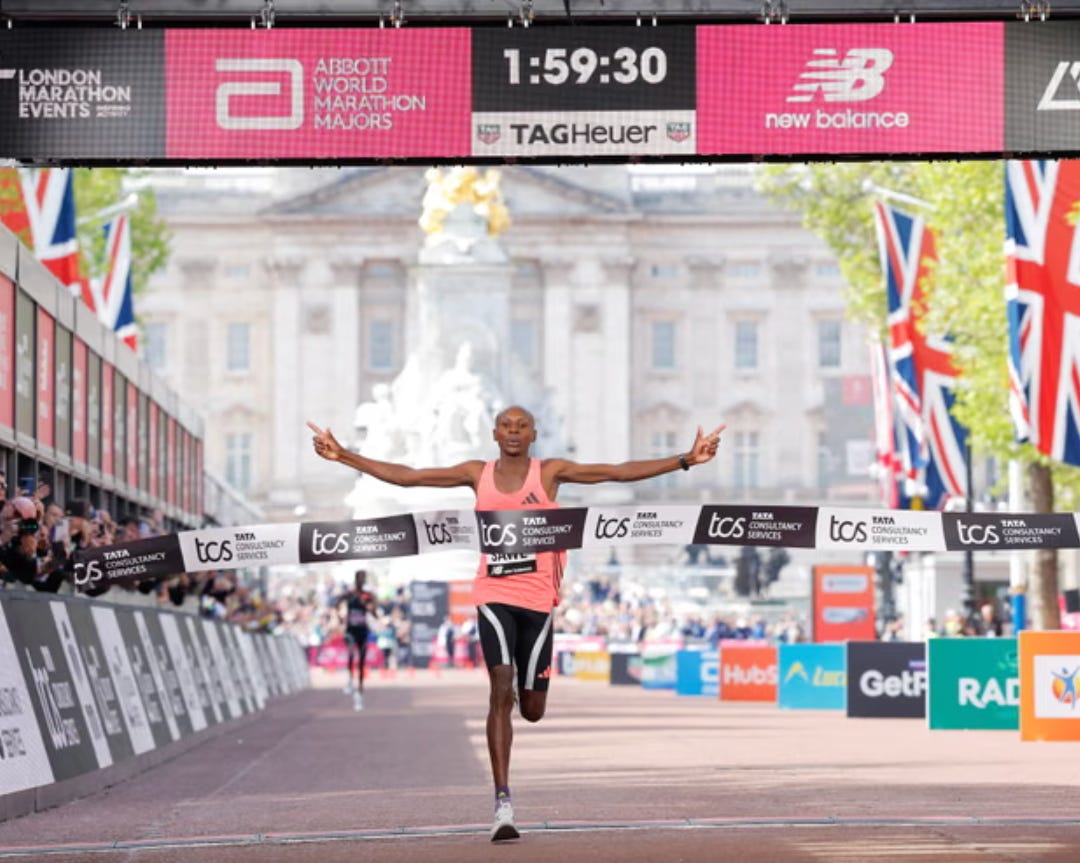
This famous foot race takes its name from Marathon, a small town on the northeastern coast of Greece, and is tied to a story that has been retold for more than two millennia.
According to legend, in 490 BCE, the Athenian army defeated Persian forces at the Battle of Marathon. After the victory, a messenger – most commonly named Pheidippides – was dispatched to run from the battlefield to Athens to announce the news. Upon arriving, he reportedly cried out Nenikēkamen! (“We have won!”) before collapsing and dying from exhaustion.
This dramatic tale, first recorded centuries later by writers such as Plutarch and Lucian, and no doubt embellished over time, remains a foundational myth of the marathon that has captured the imagination of the modern world.


The marathon as a sporting event was created in the late 19th century, inspired by this classical story. When the first modern Olympic Games were organised in Athens in 1896, French linguist Michel Bréal proposed a race that would commemorate the ancient messenger.
The course ran from the town of Marathon to the Panathenaic Stadium in Athens, covering approximately 40 kilometres. The race proved immensely popular, and its winner, Spyridon Louis – a Greek water carrier – became a national hero.
In the years that followed, marathons were organised in cities around the world, but the distance was not standardised. Races varied in length depending on local routes and preferences. The now-familiar distance of 42.195 kilometres (26 miles, 385 yards) emerged somewhat accidentally at the 1908 London Olympics. The organisers extended the course so it could start at Windsor Castle and finish in front of the royal box at White City Stadium. This distance stuck, and in 1921 the International Amateur Athletic Federation formally adopted it as the official marathon length.


During the 20th century, the marathon evolved from an elite athletic contest into a mass participation event. Iconic races such as the Boston Marathon, first run in 1897, became annual traditions.
The inclusion of women took some time. They were officially barred from Olympic marathons until 1984, despite having competed unofficially for decades. The first women’s Olympic marathon, won by Joan Benoit, marked a major turning point.
Today, marathons are run on every continent, attracting millions of participants each year. The World Marathon Majors (WMM) is an official series launched in 2006 to unify the most important annual marathons into a single global competition. The original goal was to create a season-long championship for elite runners, similar to a tennis Grand Slam.


The seven core marathons (“The Big Seven”) take place in: Boston, London, Berlin, Chicago, New York City, Tokyo (added in 2013) and Sydney (added in 2025).
The most famous marathons endure not because they are the longest or fastest, but because they combine story, place and human drama. Collectively they reflect the marathon’s evolution from ancient legend to modern global ritual.
Video
REMORANDOM Chapter
