


I wrote this piece for RR1 in 2023. In robot years, that’s a long time ago. What has changed since even a few years ago is that AI (also the name of a modestly successful 2001 Spielberg film) is no longer hypothetical. We are now living with generative AI systems in everyday use, autonomous agents are emerging and real governments are talking “alignment” and “guardrails” and introducing AI regulation. So this post is not so much retro sci-fi history any more, as it is a commentary on current reality.
The “Three Laws of Robotics” have pervaded science fiction and popular culture, and are referred to in many books, films and other media. More recently, they have impacted thought on the ethics of artificial intelligence.
But, where do these so called “Laws” come from?


In his 1942 short story, Runaround (published in the magazine, Astounding Science Fiction), renowned Russian-born American science fiction author (and biochemist), Issac Asimov (1920–1992), set out what he described as “three fundamental Rules of Robotics – the three rules that are built most deeply in a robot’s positronic brain”.
“Positronic brain” was a term coined by Asimov. The positron (aka the antielectron) was a relatively recently discovered subatomic particle at the time Asimov was writing. (The technical details of how this robot consciousness would actually work are a little hazy.)
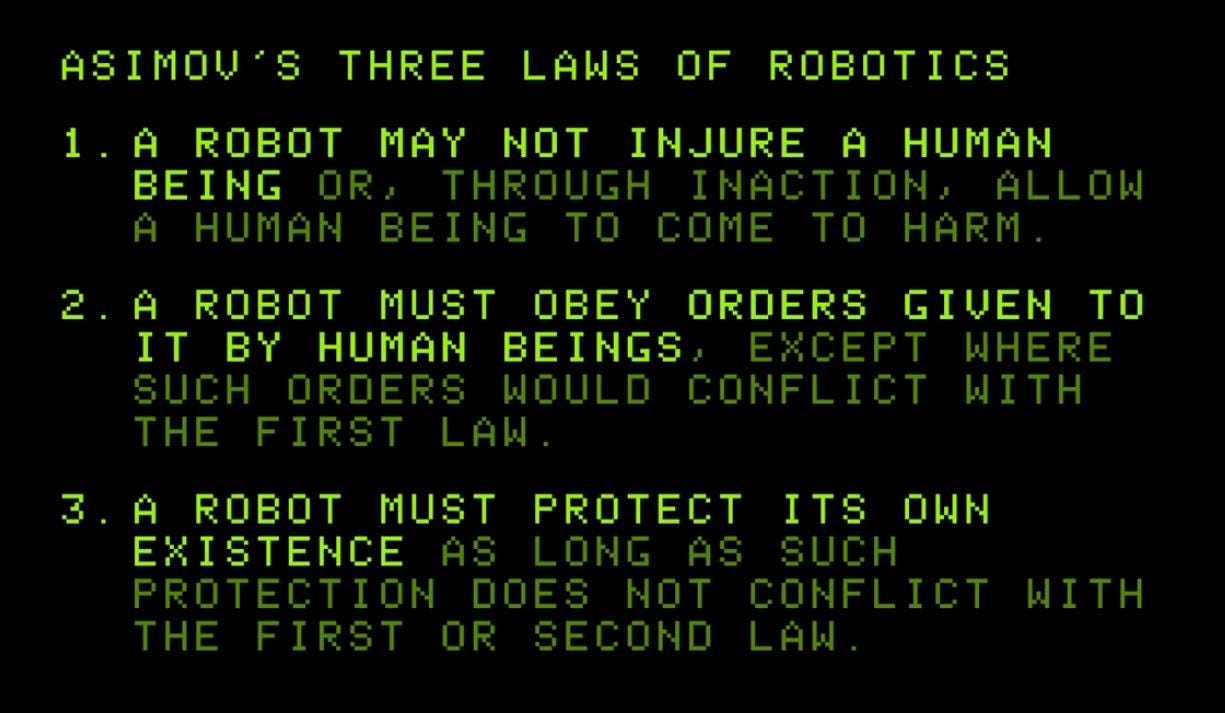
The rules had been implied in earlier Asimov stories but this was the first time they had been spelt out. The three rules, taken from the “Handbook of Robotics, 56th Edition, 2058 A.D.”, were:
A robot may not injure a human being, or through inaction, allow a human being to come to harm.
A robot must obey the orders given to it by human beings except where such orders would conflict with the First Law.
A robot must protect its own existence as long as such protection does not conflict with the First or Second Laws.
Hear them explained by the man himself HERE or at 14:50 in a subsequent and longer 1975 interview from a significantly more mutton-chopped version of Asimov HERE.
In later work, Asimov introduced what he called the “Zeroth Law” (yes, it’s a word), preceding the first three rules in terms of priority, which stated:
A robot may not harm humanity, or, by inaction, allow humanity to come to harm.
In a 1975 interview, Asimov, said the laws were originally proposed to avoid the “Frankenstein motif” that was popular in science fiction writing at the time … stories about robots destroying their creators, which is very much on people’s minds right now.


Asimov’s Three Rules, and his writing in general, has been influential in pop culture, the tech industry, and amongst people thinking through the ethical, legal and practical challenges presented by various forms of AI. Alternatives and modifications have been proposed to address the rules’ limitations and ambiguities. How would you program the rules, written by Asimov in English, into a language understandable by machines? One update to the Rules has been offered by US legal scholar, Frank Pasquale (2020). Rule One of his New Laws of Robotics states that “robotic systems and AI should complement professionals, not replace them”. But go tell that to the chat bots.
As a concluding treat, listen HERE (or watch below) to New Zealand duo Flight of the Conchords describing a time in the “distant future” where the robots have dared to break a couple of these key rules.
Videos
REMORANDOM Chapters
