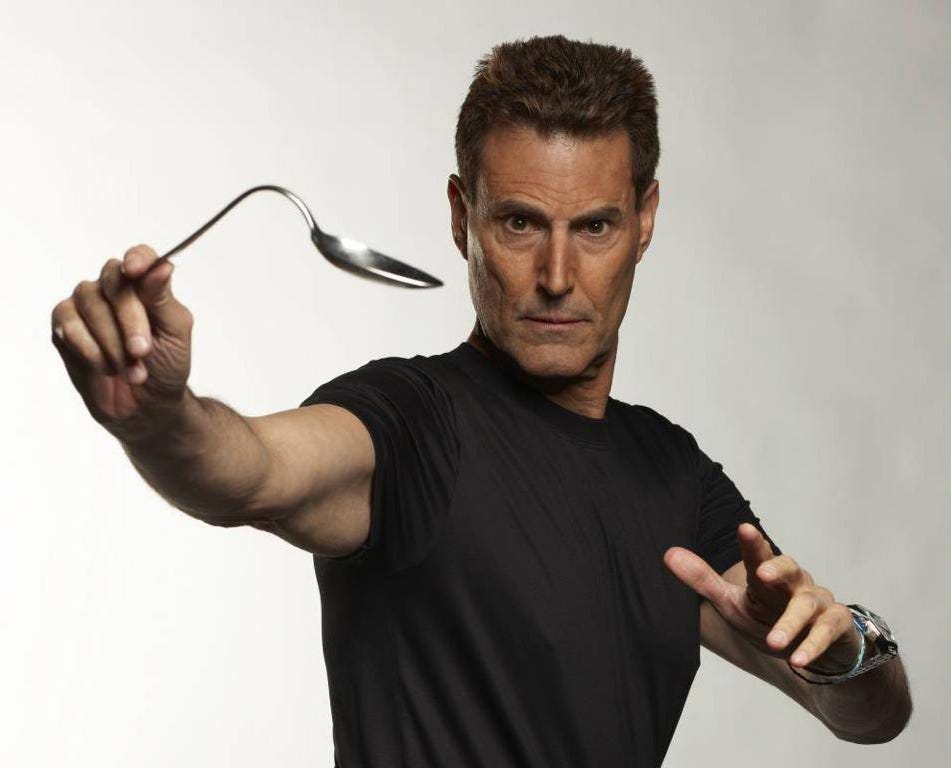
Uri Geller is one of the most famous and polarising figures associated with psychic phenomena. Born in 1946 in Tel Aviv, Geller shot to global fame in the early 1970s with television demonstrations of what he claimed were paranormal abilities. His most iconic feat – the one that became his calling card – was spoon-bending. Geller would hold an ordinary metal spoon lightly between his fingers, stroke it gently and declare that it was “becoming soft”. Moments later, before live audiences and TV cameras, the spoon would appear to bend, sometimes even snapping in two. For millions of viewers, this was the closest thing to witnessing real magic.


Geller explained his abilities as psychokinesis: the power to move or alter physical objects using only the mind. The notion electrified the public imagination during a period fascinated with the paranormal and human potential. Celebrities, politicians and even scientists lined up to see him perform. His fame grew to such an extent that intelligence agencies took notice.
In 1973, the CIA arranged for Geller to be tested at the Stanford Research Institute (SRI). In a CIA report (declassified in 2017) summarising the experiments, the agency concluded:
“As a result of Geller’s success in this experimental period, we consider that he has demonstrated his paranormal perceptual ability in a convincing and unambiguous manner.”
For believers, this was confirmation that something extraordinary was happening.


However, the scientific community was far from unanimous. Magicians and skeptics argued that Geller’s feats were indistinguishable from classic sleight-of-hand tricks. James Randi, a prominent Canadian debunker of paranormal claims, famously reproduced spoon bending and similar effects using illusionist techniques. He accused Geller of exploiting psychological suggestion and audience misdirection rather than supernatural power.
The debate didn’t diminish Geller’s cultural impact. Spoon bending became a global craze, inspiring countless children in the 1970s to try the trick at home – sometimes “succeeding” when no one was looking. IKEA produced a Geller-inspired stool, which had bent, wavy legs. Nintendo made a spoon-wielding Pokémon character, Kadabra, who could cause clocks to run backward. References to Mr. Geller, or mangled silverware, have appeared in songs by R.E.M., Toad the Wet Sprocket and Incubus, and made a memorable cameo in The Matrix.
Over the decades, Geller reinvented himself as an author, motivational speaker and media personality, all the while maintaining his claims of authenticity. These days he gives high-energy tours of his eponymous “Uri Geller Museum” in Tel Aviv.


So, what do we make of it all? “Geller’s bent spoon demonstrations and deep fakes both create this conflict between what we think is possible and what we’re seeing,” says Alice Pailhès, an author of The Psychology of Magic, quoted in a 2023 New York Times piece by David Segal. She adds: “Both elicit strong emotional responses – confusion, delight, distress, maybe even paranoia.” If nothing else, Geller has been a global catalyst for our collective curiosity about the paranormal.
For a lengthy dose of now-78-year-old Geller, watch him being interviewed by longtime friend of REMO Ross Coulthart [Ed: Hi Roscoe!] for his “Reality Check” podcast on NewsNation – HERE or below.
Videos
REMORANDOM 6 is coming in May