


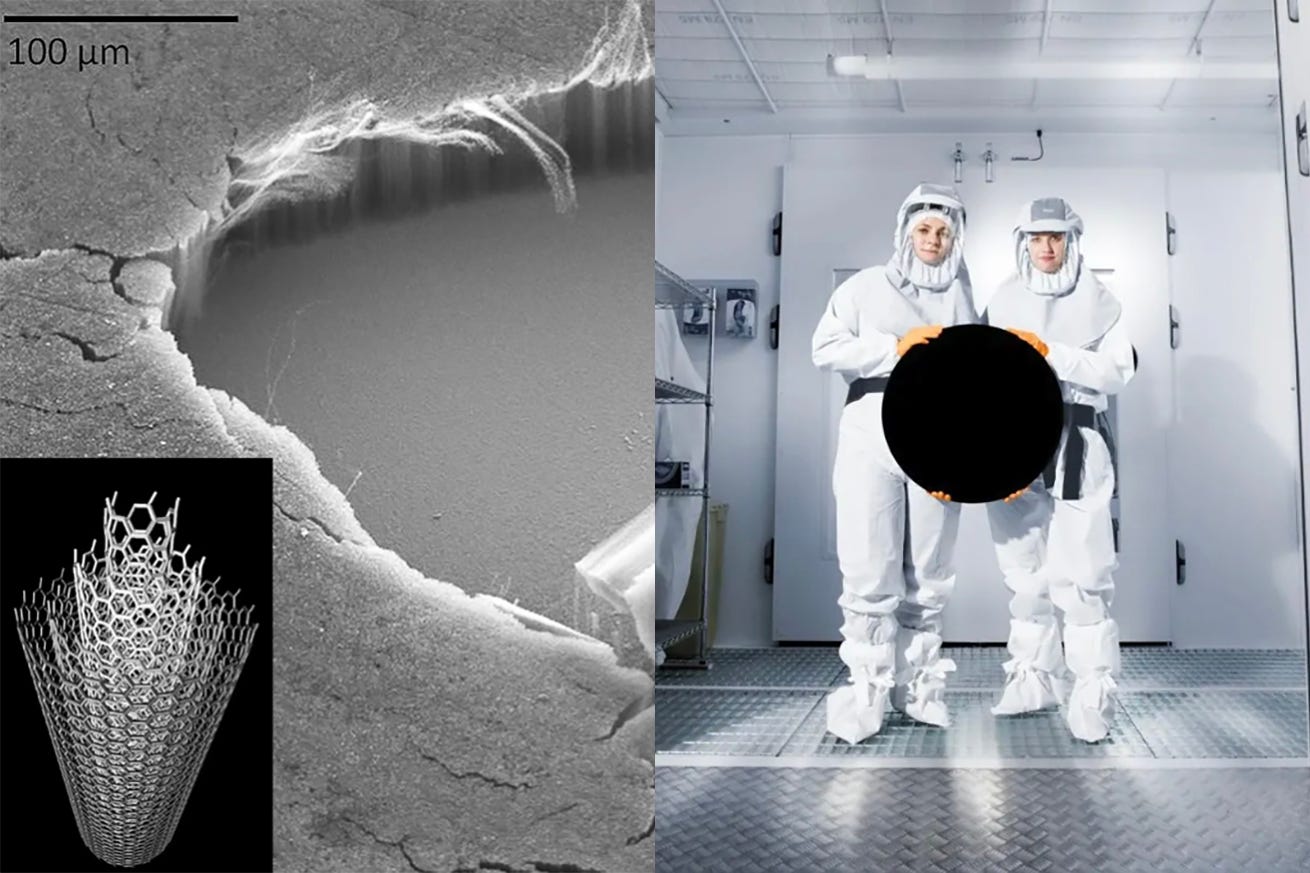
Vantablack is not a colour. It’s a substance that manifests as a black so deep and so dark that it seems to swallow both light and space. Ben Jensen, founder and Chief Technical Officer of Surrey NanoSystems, invented the coatings, grown via chemical vapour deposition (CVD). They were publicly unveiled in July 2014, and eventually commercialised by the scientific team from Surrey NanoSystems.
Vantablack’s name comes from the acronym VANTA: “Vertically Aligned NanoTube Arrays”. These tiny carbon nanotubes, each about 3,500 times smaller than the width of a human hair, form a dense forest of microscopic tubes that trap light rather than reflecting it. When light hits the surface, it bounces around inside this forest until it’s almost completely absorbed. The result is extraordinary: Vantablack absorbs up to 99.965% of visible light, making even three-dimensional objects appear flat, featureless and surreal.


The science behind Vantablack is both simple and profound. Each nanotube acts like a miniature light trap – photons enter but can’t find a way out. Instead of scattering back to the human eye, as with ordinary pigments, the light is converted into heat. Because our visual perception depends on reflected light to interpret shapes and depth, objects coated in Vantablack lose their contours, e.g. a crumpled piece of aluminium foil covered in it, looks like a perfect void – an optical illusion rooted in physics.
Vantablack was originally created for aerospace and defence applications. Its ability to absorb stray light made it ideal for reducing glare inside telescopes, cameras and satellite sensors – improving their accuracy when measuring faint stars or distant planets.
“Vantablack S-VIS” is a sprayable variant of Vantablack designed to extend usability to more complex shapes and surfaces, not just flat substrates baked in a CVD furnace.


Vantablack’s leap from laboratory to public consciousness came through controversy in the art world. In 2016, it was announced that the artist Anish Kapoor [RR4:13] had secured exclusive rights to use Vantablack in artistic works – a move that infuriated many in the creative community. Other artists, most notably Stuart Semple, responded by developing their own “super-black” pigments and releasing them publicly, explicitly banning Kapoor from purchasing them.
Semple also developed his “Pinkest Pink”, again forbidding Kapoor’s use of it, to challenge the idea that one artist (or company) could “own” or block access to a colour. The story took a dramatic turn when Kapoor reportedly posted a photo of his middle finger dipped in Pinkest Pink. [Ed: Don’t you just love an upset artist?] This “black paint feud” became a viral cultural moment, highlighting debates about ownership, access and the intersection of art and technology.


More recently, Semple legally changed his name to “Anish Kapoor” as a piece of performance art that explores what he calls “colour hoarding” and other ideas of ownership and authorship. Where will it end?
Postscript
Since the debut of Vantablack, other ultra-black materials have emerged – including an MIT creation from 2019 that is even darker, absorbing more than 99.995% of visible light (across angles) – but none have captured the public imagination in quite the same way. Vantablack remains both a scientific marvel and a cultural symbol: the colour of nothing.
Video
REMORANDOM Chapter

At the 2019 Rugby World Cup - the All Blacks used a jersey that captured this absence of light - a blacker than black appearance.
I remember the players looking like black smudges on the field - it was amazing once you noticed.