


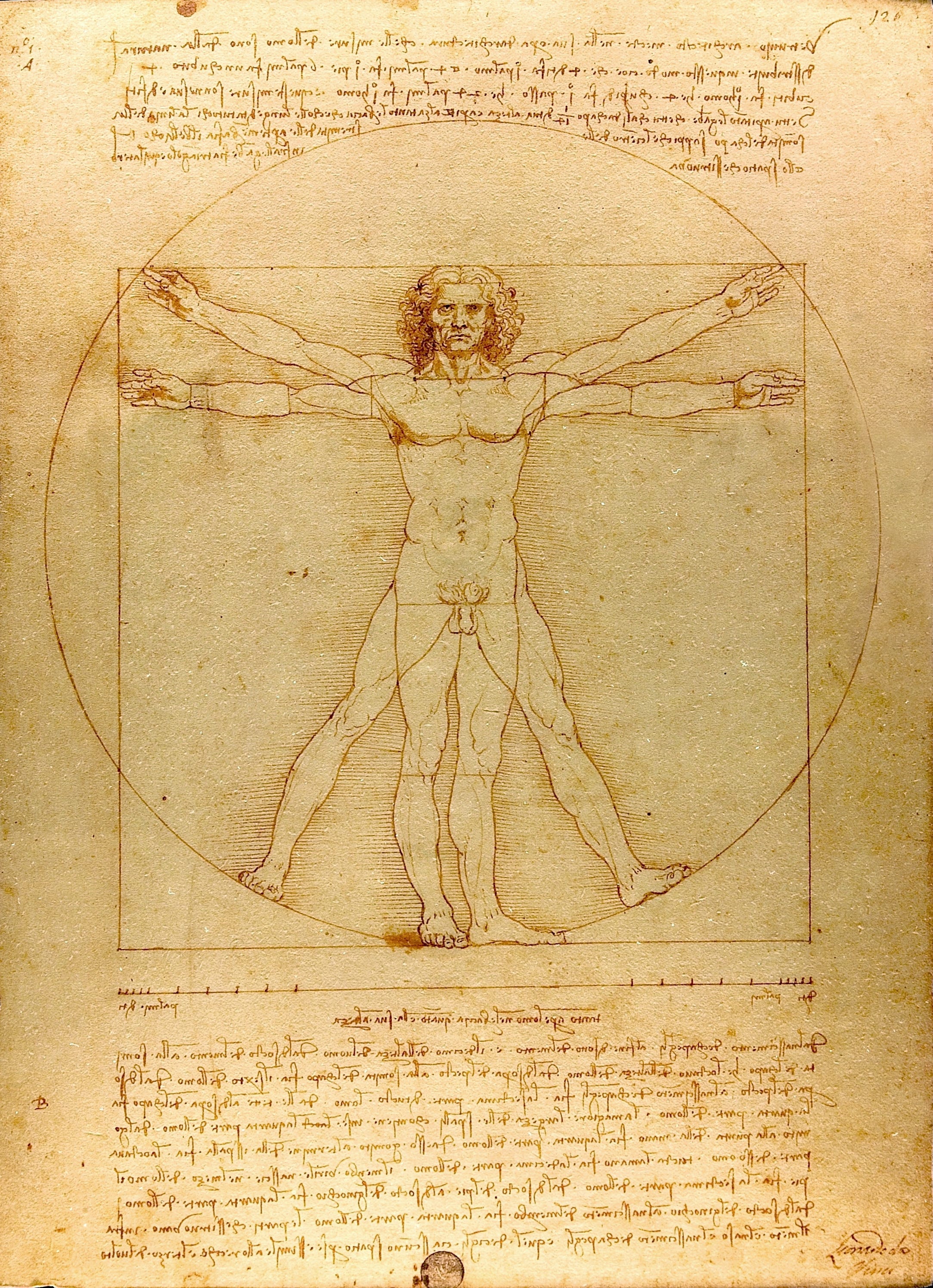
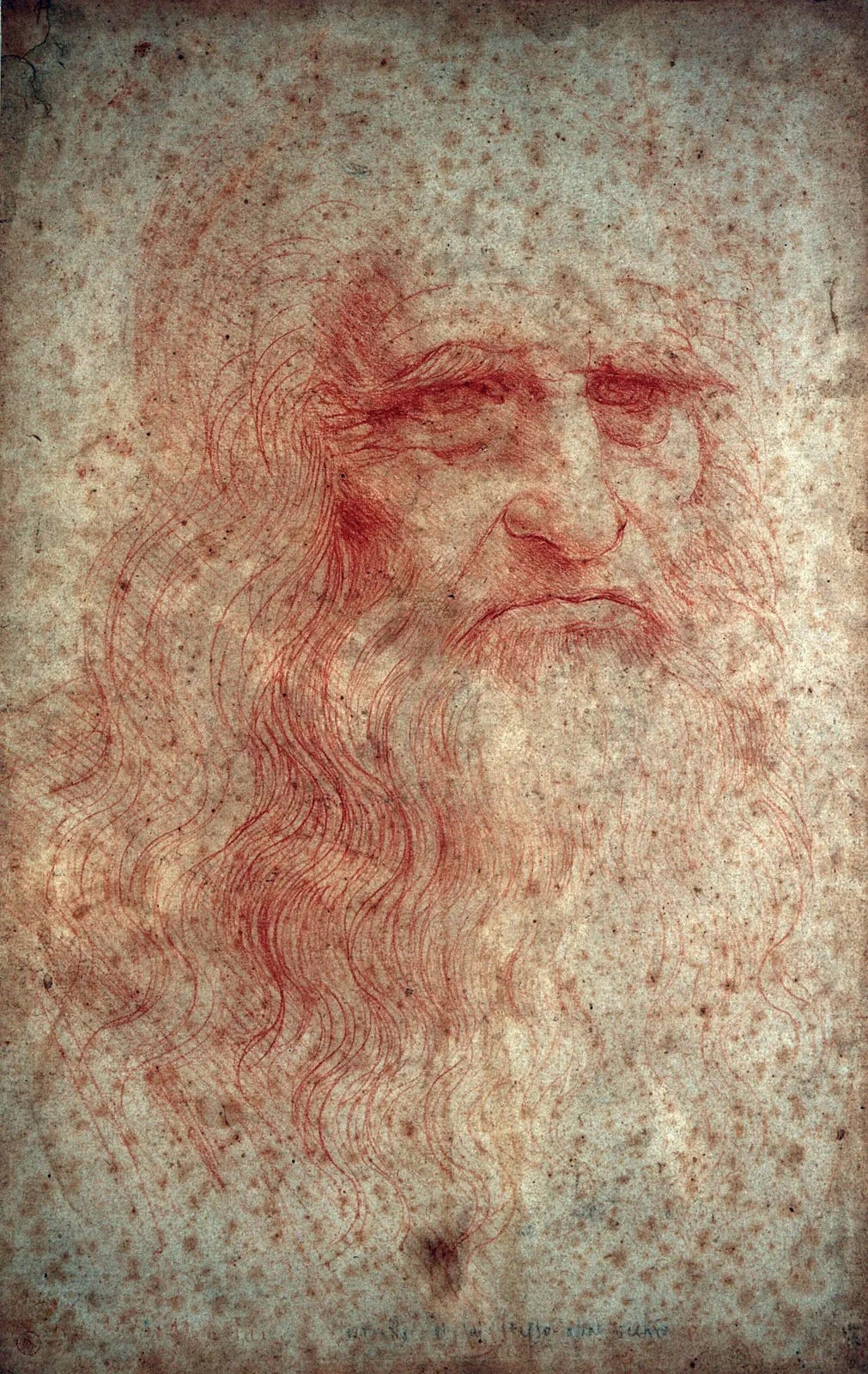
The Vitruvian Man (Italian: L’uomo Vitruviano) is a drawing by the Italian Renaissance artist and scientist Leonardo da Vinci from circa 1490.
Inspired by the writings of the ancient Roman architect Vitruvius, the drawing depicts a nude man in two superimposed positions with his arms and legs apart and contained within both a circle and square. At first glance, one might see only two positions: standing feet together, arms outstretched; and standing feet apart, arms lifted. But part of the genius of da Vinci’s depiction is that the superimposed body allows for views of 16 combinations of outstretched limbs.
The wording above and below the drawing is detailed and descriptive:
“Vitruvius, the architect, says in his architectural work that the measurements of man are in nature distributed in this manner, that is 4 fingers make a palm, 4 palms make a foot, 6 palms make a cubit, 4 cubits make a man, 4 cubits make a footstep, 24 palms make a man and these measures are in his buildings. If you open your legs enough that your head is lowered by 1/14 of your height and raise your arms enough that your extended fingers touch the line of the top of your head, let you know that the center of the ends of the open limbs will be the navel, and the space between the legs will be an equilateral triangle. The length of the outspread arms is equal to the height of the man. From the hairline to the bottom of the chin is one-tenth of the height of the man. From below the chin to the top of the head is one-eighth of the height of the man. From above the chest to the top of the head is one-sixth of the height of the man. From above the chest to the hairline is one-seventh of the height of a man. From the chest to the head is a quarter of the height of the man. The maximum width of the shoulders contains a quarter of the man. From the elbow to the tip of the hand is a quarter of the height of a man; the distance from the elbow to the armpit is one-eighth of the height of the man; the length of the hand is one-tenth of the man. The virile member [Ed: aka penis] is at the half height of the man. The foot is one-seventh of the man. From below the foot to below the knee is a quarter of the man. From below the knee to the root of the member is a quarter of the man. The distances from the chin to the nose and the hairline and the eyebrows are equal to the ears and one-third of the face.”
Vitruvian Man has been described by the art historian Carmen C. Bambach as “justly ranked among the all-time iconic images of Western civilization”.
The drawing represents Leonardo’s conception of (and keen interest in) ideal body proportions, originally derived from Vitruvius but influenced by his own anatomical measurements. The image represents a cornerstone of Leonardo’s attempts to relate man to nature. He believed the workings of the human body to be an analogy for the workings of the universe, and in this one sketch Leonardo was able to combine the mathematics, religion, philosophy, architecture and artistic skill of his age (nicely explained in this TED-Ed video online). It deserves its iconic status.
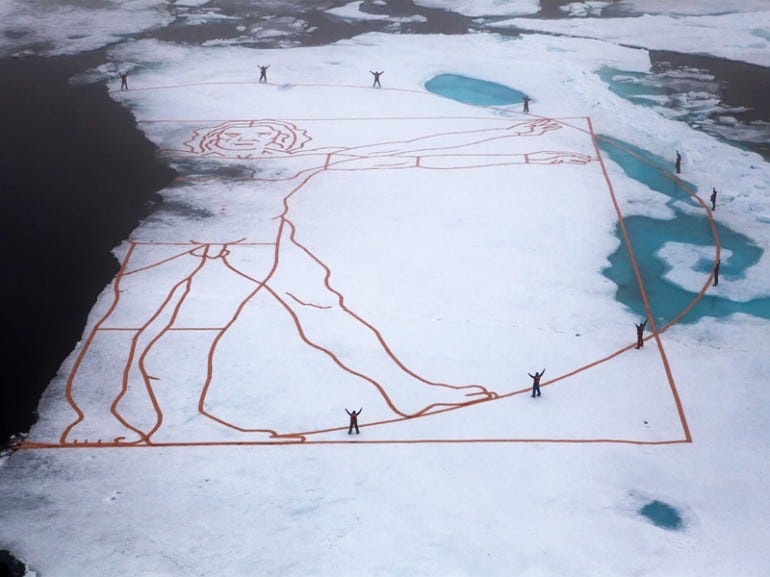
Making reference to Vitruvian Man’s depiction of both man and nature, large-scale American artist John Quigley used the rapid submersion of this familiar image to illustrate the aggressiveness of global warming by using copper strips to construct Melting Vitruvian Man on a massive ice floe 500 miles from the North Pole in 2011. In this way Quigley was able to give the communication of the issue a dramatic new scale. See the short video below or HERE.
Finally, like all good icons, Vitruvian Man has been much celebrated and parodied in the popular culture.


Story Idea: Bonnie Siegler
Videos
References
mentalfloss.com/article/71390/15-things-you-might-not-know-about-leonardo-da-vincis-vitruvian-man
newsfeed.time.com/2011/09/08/artist-renders-giant-melting-vitruvian-man-on-arctic-ice
REMORANDOM Books
Order our books on the REMO store website HERE. Subscribe to receive all future volumes and other printed goodies HERE.
