


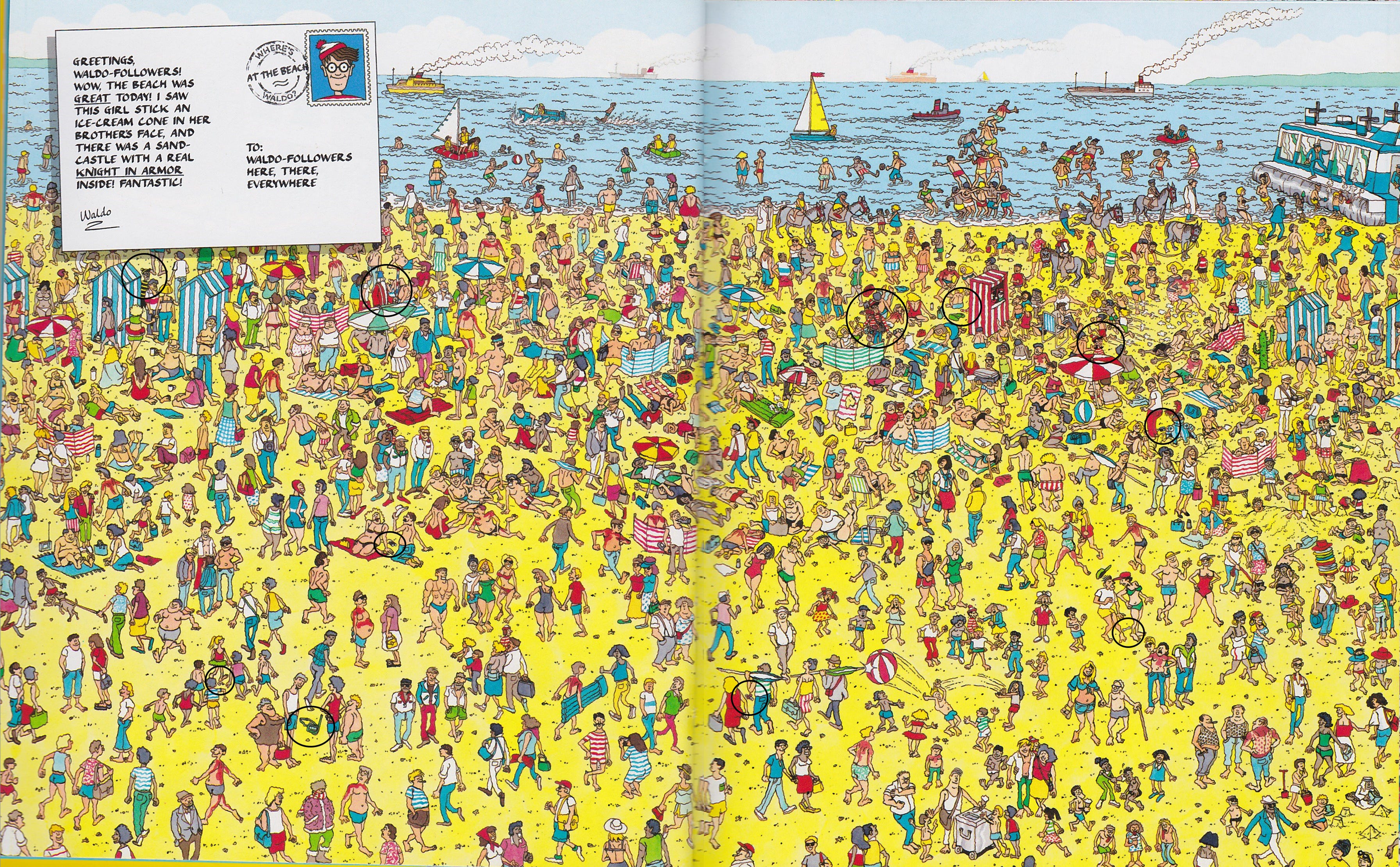
Where’s Wally? (Where’s Waldo? in North America) is a series of children’s puzzle books created by the (reportedly very shy) English illustrator Martin Handford. The books consist of a series of detailed double-page spread illustrations depicting dozens or more people doing a variety of amusing things at a given location. Wally is identified by his red-and-white-striped shirt [RR2:71], blue jeans, bobble hat and glasses. Readers are challenged to find Wally and his friends hidden throughout the pages.


The idea was commissioned. In 1986, Handford was asked by his art director, David Bennett, at Walker Books in London, to develop a book of detailed crowd scenes – inspired by Philippe Dupasquier’s Busy Places series. Bennett also suggested the inclusion of a recurring character to tie them together. To that end, Handford invented “Wally” as the visual thread connecting the chaos.
The first book, Where’s Wally?, was published in the United Kingdom in 1987. It presented 12 large, bustling double-page scenes – from beaches and sports stadiums to medieval feasts – each hiding Wally among hundreds of other figures. The challenge was straightforward but addictive: find Wally in every scene.


Handford works for eight weeks at a stretch to create each two-page Wally spread. As he works, he listens to the Bee Gees, the Clash or old Sergeant Bilko tapes. The pictures are drawn to the same scale as in the books, with each spread containing 300 to 500 figures.
The concept quickly proved exportable. In 1987, the US rights were acquired by Little, Brown & Company, which launched the series under the Where’s Waldo? name in 1988. Other localisations followed, with Wally’s name changing across territories:
Wally (United Kingdom, Australia, South Africa), Waldo (United States, Canada), Charlie (France), Walter (Germany), Wōrī (ウォーリー, Japan), Wēilì (威利, China), Văn Lãng (Vietnam), Valli (Iceland), Ubaldo (Italy), Holger (Denmark), Willy (Norway), Wolli (월리, Korea), Vallu (Finland), Уолли (Uolli, Russia), Hetti (India – Hindi), Effy (Israel – Hebrew), Hugo (Sweden), Ali (Turkey), Valas (Lithuania) and Evert (Netherlands)


By the early 1990s, Where’s Wally? had become a pop-culture phenomenon. The books sold tens of millions of copies worldwide, and Waldo himself became a recognisable global icon.
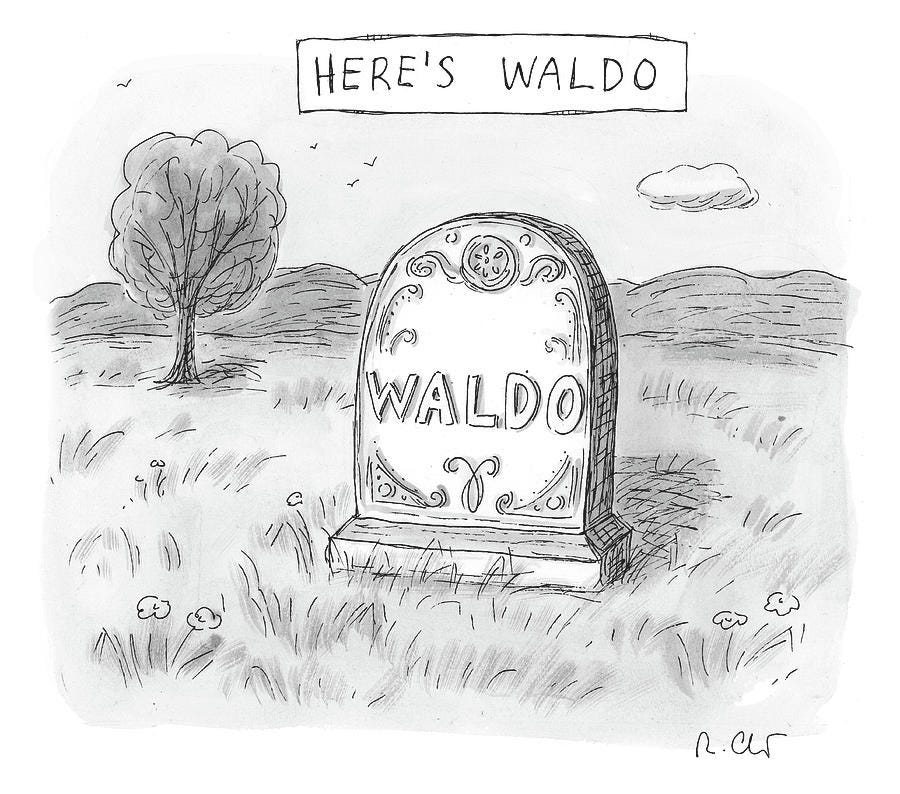
The brand crossed into television, with an animated series in 1991–92 and later adaptations, as well as video games, merchandise and interactive website versions. Schools and libraries adopted Where’s Wally? for activities promoting observation skills, visual literacy and attention to detail. Artists, advertisers and activists have inserted the figure into murals, political cartoons and social media campaigns to comment on everything from surveillance to celebrity culture.


Since the 2000s, Where’s Wally? has also inspired real-world gatherings in which thousands of people dress as the character, attempting to set world records. These events, held in cities from Dublin to Tokyo, underscore the figure’s enduring visual appeal and its function as a unifying, playful challenge.
Videos
REMORANDOM Chapter
