


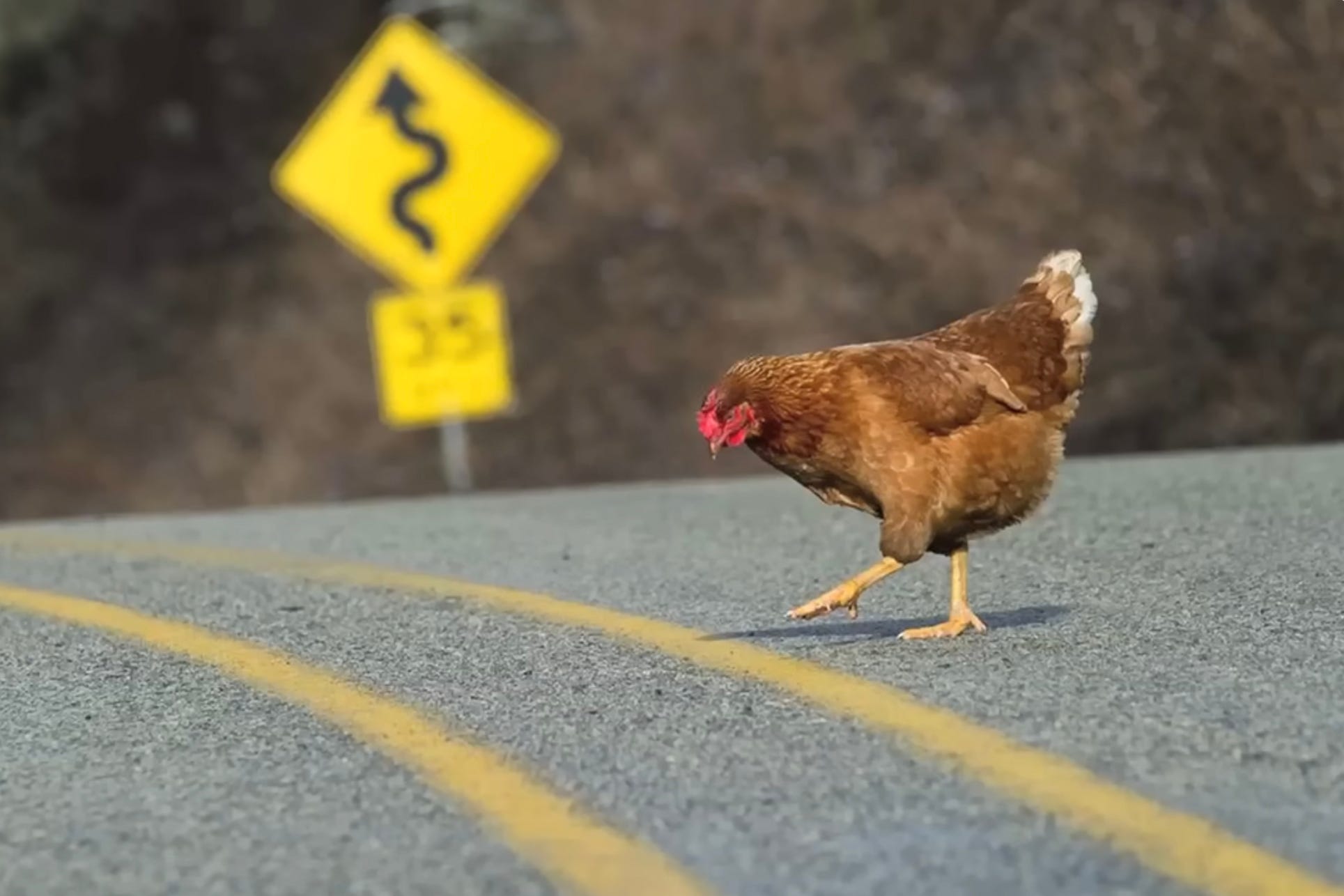
“Why did the chicken cross the road?” is an example of anti-humour, where the curious setup of the joke leads the listener to expect a traditional punchline, but they are instead given a simple statement of fact.
Two more anti-joke examples:
What’s red and smells like blue paint? Red paint.
A penguin walks into a bar. The bartender says, “So what will it be this time?” The penguin doesn’t answer because it’s a penguin.
The chicken riddle first appeared in an 1847 edition of The Knickerbocker, a New York City monthly magazine as an example of a conundrum that really isn’t one:
“There are ‘quips and quillets’ which seem actual conundrums, but yet are none. Of such is this: ‘Why does a chicken cross the street?’ Are you ‘out of town?’ Do you ‘give it up?’ Well, then: ‘Because it wants to get on the other side!’”


The joke was subsequently spread throughout the United States by performers in minstrel shows, a racist and since-discontinued form of theatre where mostly white actors wore blackface makeup for the purpose of comically portraying racial stereotypes of African Americans.
The chicken joke has since become iconic as a generic joke to which most people know the answer, and has been repeated and changed numerous times over the course of history. Variant versions of the joke started appearing as early as the 1890s. This pun from Potter’s American Monthly, 1892: “Why should not a chicken cross the road? It would be a fowl proceeding.”
Subsequent variants have ranged from the corny:
“Why did the chicken cross the playground? To get to the other slide.”
“Why did the duck cross the road?” “To prove he’s no chicken”.
“Why did the chicken cross the Möbius strip [RR1:46]? To get to the same side.”
… to even more cerebral answers, such as those listed by David Moran, Senior Lecturer on Physics at Harvard University in 2008:
Albert Einstein: “The chicken did not cross the road. The road passed beneath the chicken.”
Erwin Schrodinger: “The chicken doesn’t cross the road. Rather, it exists simultaneously on both sides.”
The original chicken joke is so famous, it’s no longer funny. Everybody knows the anti-joke punchline.


Back to that chicken crossing the road, and on a more serious note, researchers have found that an inbuilt magnetic compass guides domestic chickens when they do venture across asphalt and other surfaces. Indeed, many animals have an innate sense of direction, finding their way along migration routes that extend thousands of miles. Often, they detect Earth’s magnetic field and use that for orientation.
Story Idea: Jackie Dent
REMORANDOM Chapter

Rooster Design at REMO
Browse merchandise range HERE


The most recent evolution of the scenario, unsurprisingly, fits with the modern trend for irony, self-awareness, dark humour, and edginess:
The chicken was killed while crossing the road, which is why it has crossed 'to the other side'
Why did the chewing gum cross the road???? Because it was stuck on the chicken’s foot .