


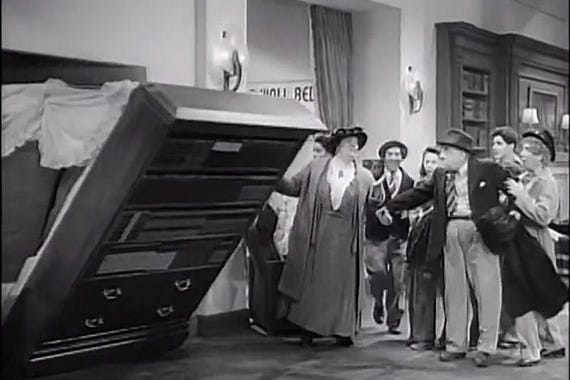
These hideaway beds, long associated with slapstick comedy, have enjoyed somewhat of a revival thanks to smaller homes and the advent of “micro-apartments” – not to mention people just looking to make their living spaces work smarter.
The Murphy bed is named after William Lawrence Murphy (1876–1957). He began tinkering with hideaway beds while living in a one-room apartment in San Francisco in the late 19th century. At the same time, he was falling head-over-heels in love with a young opera singer. Courting customs at that time would not permit a lady to enter a gentleman’s bedroom. But according to family legend, Murphy’s limited finances and a strict moral code didn’t spoil his chance at love. His invention allowed him to stow his bed in his closet, transforming his one-room apartment from a bedroom into a parlour. [Ed: Gotcha!] The couple married in 1900.


Murphy introduced pivot and counter-balanced designs for which he received a series of patents, including one for a “Disappearing Bed” on 18 June 1912.
Throughout the 1920s, newspaper advertisements for apartments used the Murphy bed as a selling point.
Murphy beds were a common setup for comic scenes in early cinema. Charlie Chaplin’s 1916 film One AM features an exaggerated encounter with a Murphy bed.
Watch a compilation of Murphy Bed movie clips below or HERE.


Later films used Murphy beds as comic props – often to cause injury or frustration, or to hide a clandestine guest. Murphy beds were a routine enough feature of comic film to invite commentary from retailers; one store based in Vancouver, British Columbia remarked in an advertisement:
“Gone are the days of Laurel and Hardy where the beds were portrayed as a fold away trap for your worst enemies.”
As it was with Splayds [RR1:77] and Crocs [RR2:03], some ideas are objectively good enough to cut through and survive their own clichés.


The term “Murphy Bed” has entered common usage so thoroughly that it is no longer eligible for trademark protection. So ruled the United States Court of Appeals for the Second Circuit in 1989.
This means you’re free to come up with your own hideaway idea – and, if you’re so inclined, you can even call it a Murphy Bed.
Video
REMORANDOM Book Chapter
