


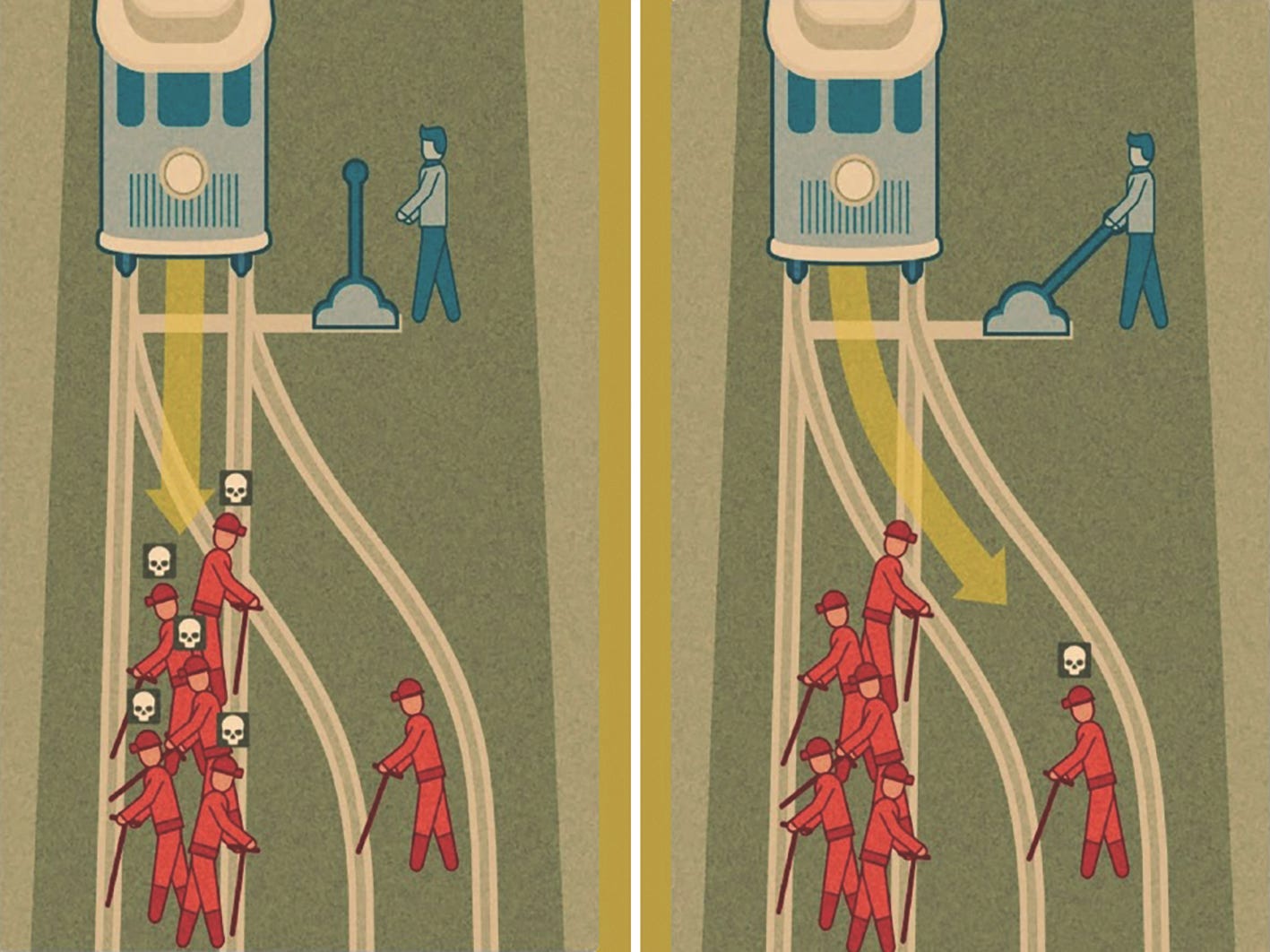
The trolley problem was first introduced in 1967 by the British philosopher Philippa Foot as part of an analysis of debates on abortion and the doctrine of double effect. Her original version asks you to imagine a runaway trolley hurtling down a track towards five workers who will be killed if nothing is done. You are standing by a lever that can divert the trolley onto a side track, where one worker stands. Do you pull the lever, sacrificing one life to save five?


Later, the philosopher Judith Jarvis Thomson, a professor at the Massachusetts Institute of Technology, expanded what she called the “trolley problem” with variations, the most famous being the “fat man” version. Instead of pulling a lever, you must push a large man off a bridge to stop the trolley [Ed: fat requirement explained] and save the five. Many people who would pull the lever hesitate – or refuse – to push the man, even though the numbers are the same. This inconsistency is the whole point of the exercise.
At its core, the trolley problem explores a clash between two major ethical frameworks. Utilitarianism holds that the morally correct action is the one that maximises overall happiness or minimises suffering. From this perspective, pulling the lever – and even pushing the man – is justified, because five lives outweigh one.
On the other hand, deontologists argue that certain actions are inherently wrong, regardless of their consequences. Actively causing harm – like pushing someone to their death – violates a moral duty, even if it leads to a better overall outcome. This helps explain why many people distinguish between redirecting harm and directly causing it.
Philosophers have also explored subtler distinctions: the difference between doing and allowing harm, intention versus foresight, and whether moral responsibility changes when harm is a side effect rather than a means.
Although it began as an abstract puzzle, the trolley problem has found unsettling real-world echoes. In wartime decision-making, leaders sometimes face choices that resemble sacrificing a few to save many – such as strategic bombings. In medicine, doctors may have to allocate scarce resources like organs or ICU beds, effectively deciding who lives and who dies. Aborting the baby to save the mother is another example.


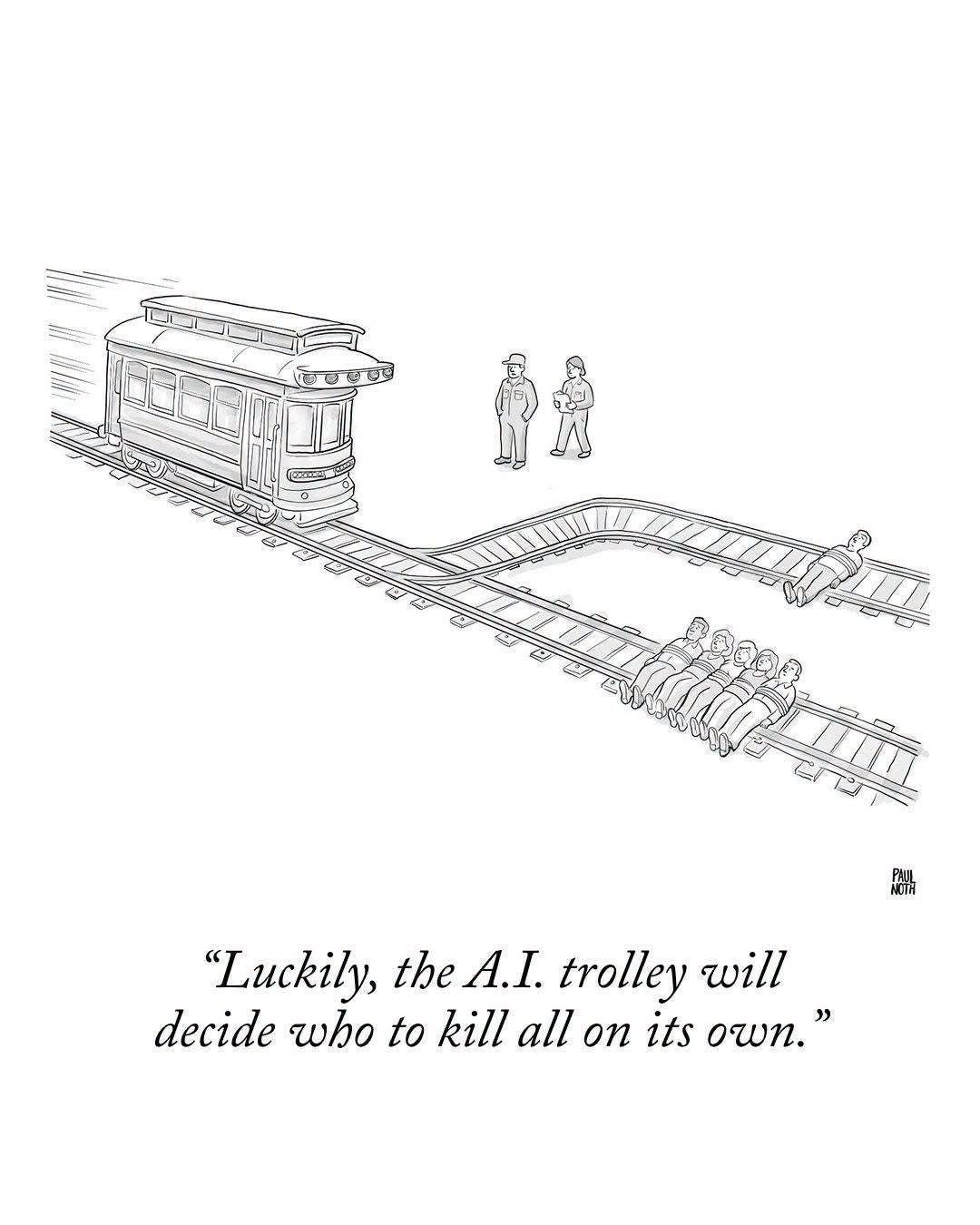
More recently, the problem has resurfaced in debates about AI and self-driving cars: how should an autonomous vehicle be programmed if a crash is unavoidable? How should we teach robots to behave in scenarios that are perceived as inescapable realities?


Psychologists and neuroscientists have even used trolley-style dilemmas in experiments, finding that more “personal” actions (like pushing someone) tend to trigger stronger emotional responses than impersonal ones (like pulling a lever), suggesting that our moral judgments are shaped as much by instinct as by reason.
The trolley problem persists not because it has a clear answer, but because it doesn’t.
Videos
REMORANDOM Chapters


References
OK ... I've only had one coffee so it took to para 2 to realise it was a tram, not a supermarket runaway! But am now in love with the New Yorker AI cartoon!!!